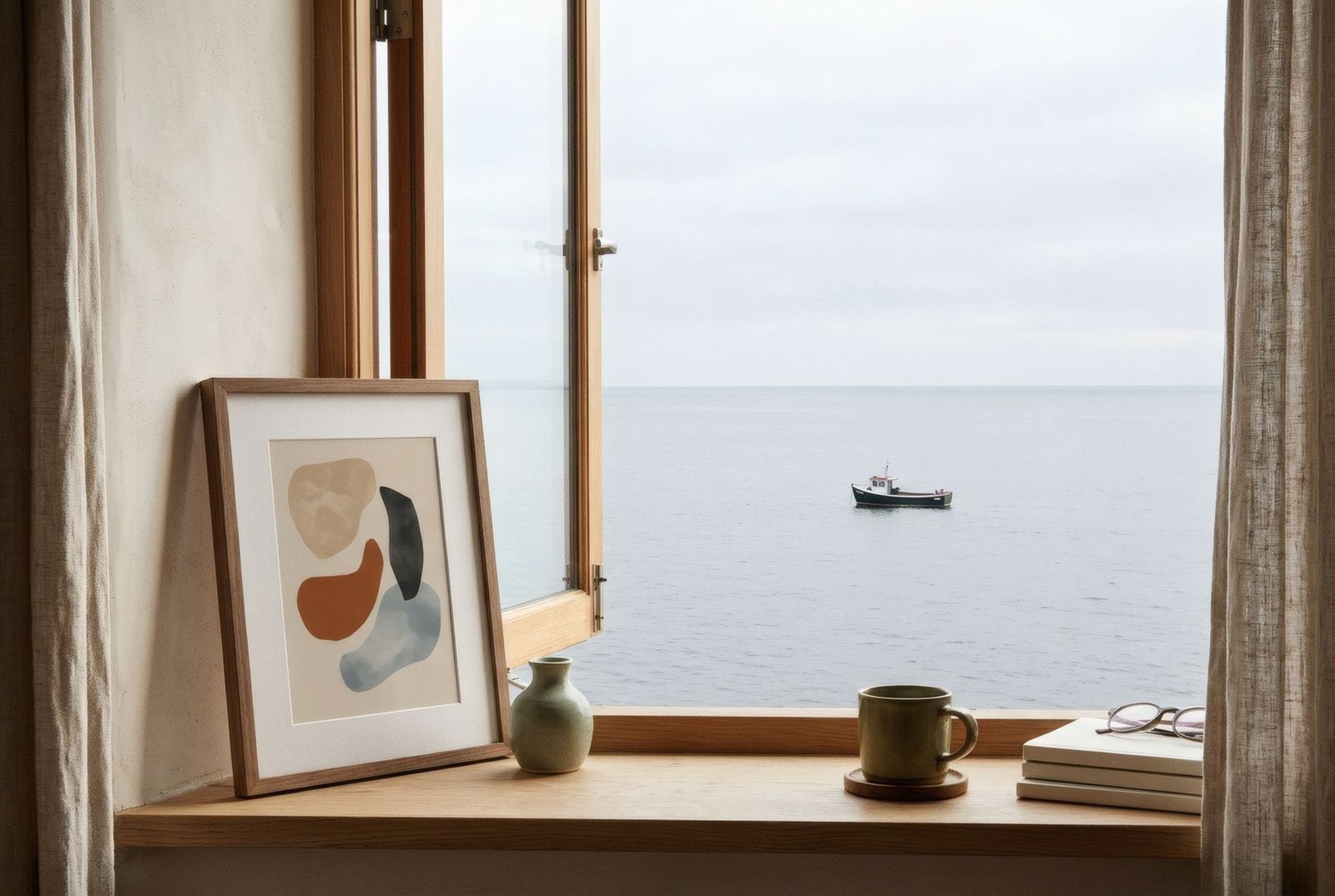
In music, rests matter as much as notes. A pause before the chorus, a moment of silence between two phrases, make what follows sound all the stronger. Without rests, music would be continuous noise. Images work much the same way. Some works fill everything, every centimetre taken by form or colour; others leave large empty areas around a small element. Those areas aren’t wasted space. They’re visual quiet, and it’s one of art’s most delicate and powerful tools.
What isn’t there
In composition, positive space is what the objects, figures and main shapes occupy; negative space is what’s left around and between them. We tend to notice only the positive. But the negative has shape, weight and effect.
A small boat on a great expanse of grey sea conveys solitude and calm. The same boat, cropped to nearly fill the frame, conveys power and detail. The difference isn’t in the boat: it’s in the space around it, as we saw in how cropping and margins change an image.
An old tradition
The value of emptiness has a long tradition, especially in East Asian cultures. In Chinese and Japanese landscape painting, large areas of paper are left unpainted, suggesting mist, water or sky, and what’s painted seems to emerge from that emptiness. Japanese aesthetics even has a word, ma, usually translated as the interval or space between things, which names the value of those pauses.
In twentieth-century Western art, Minimalism and much abstraction also explored visual quiet: near-empty surfaces, a single element, a great deal of space. We discuss this in minimalist art at home.
What quiet does
Without straying into speculative psychology, there are effects negative space quite plainly has when we look at an image.
It isolates. An element surrounded by emptiness draws the eye immediately: it has no competition. It calms. An image with plenty of free space reads without effort, without the eye darting about. It suggests. Emptiness leaves room for imagination: sky, fog, distance, the unsaid. It gives scale. A small object in a large void looks smaller, or the void larger, creating a sense of space.
Quiet in the print
When choosing art, it’s worth noticing how much quiet a piece holds. Prints with lots of negative space suit rooms that call for calm: bedrooms, reading corners, small rooms where more stimulus isn’t welcome. They also work beautifully as a pause in a busy gallery wall, as we saw in how to choose art for maximalist interiors.
Quiet around the print
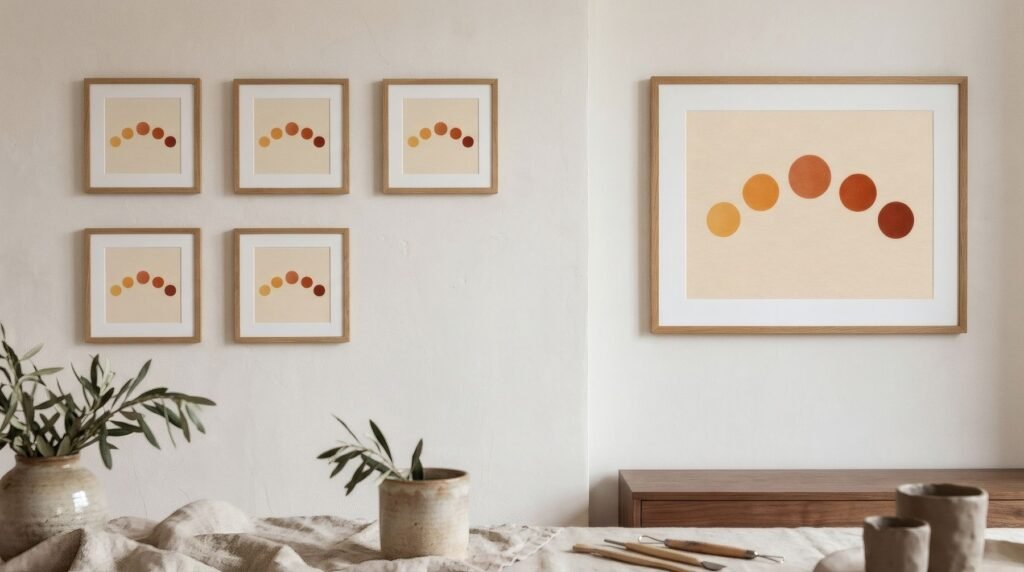
Visual quiet doesn’t stop at the edge of the work. It carries on in the mount, which adds a margin of calm around the image: the wider, the more air. It carries on in the wall: a piece with free space around it is appreciated more than one squeezed among others. And it carries on in the room: leaving a wall bare makes the walls with art look better.
It’s one of the hardest ideas to apply at home, because the temptation is to fill. But often a single print with plenty of space around it says more than five crowded together.
Learning to leave space
Visual quiet asks for a little courage: leaving space unfilled. In an image, a mount, a wall. What you gain is clarity, calm and the chance to really look at what is there.
Bendíra’s Quiet forms prints are built on exactly that principle: few shapes, plenty of air.
Keep reading: The Power of Negative Space in Art, The Beauty of Giving Art Room to Breathe and Wall Art for Monochrome Interiors.