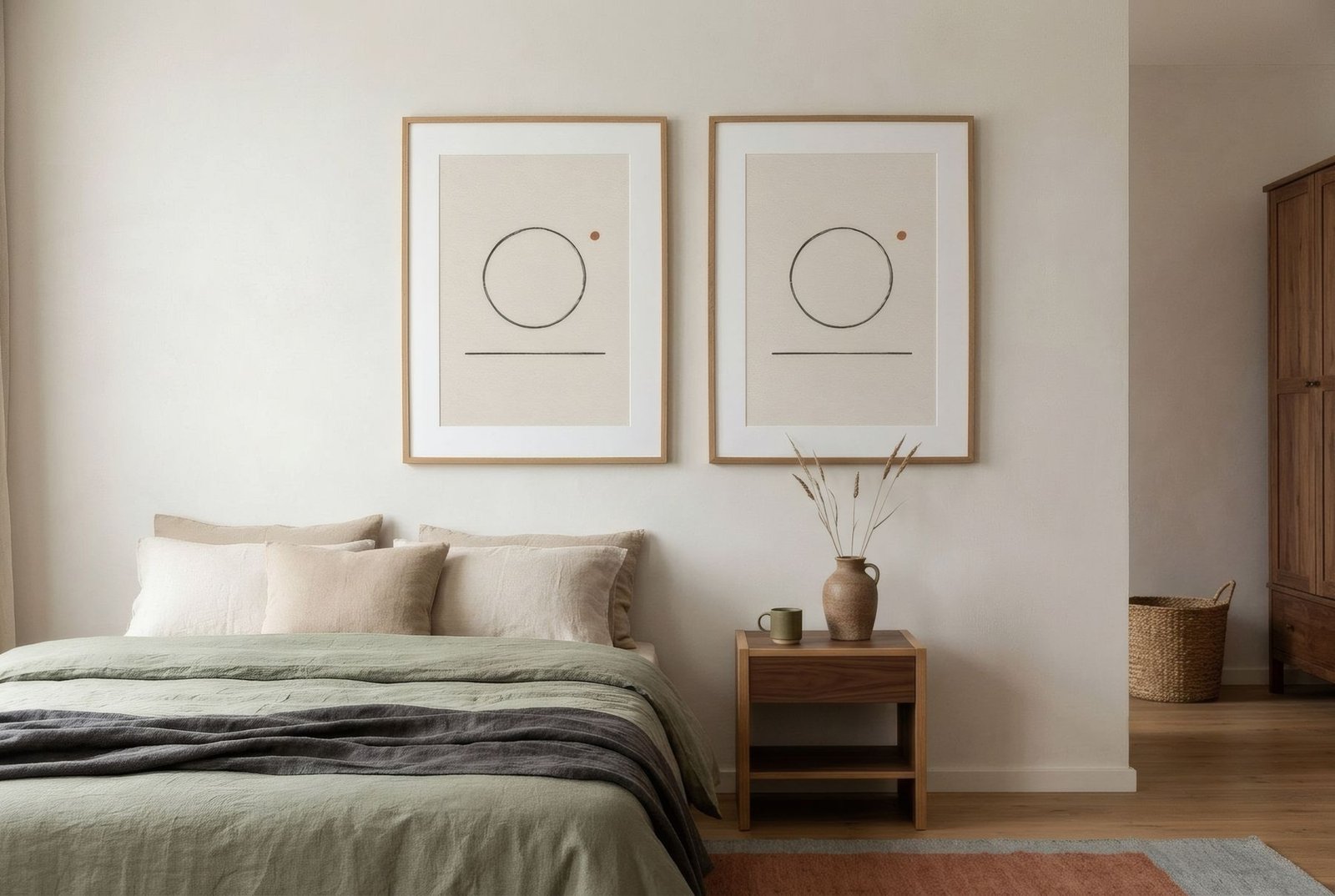
These days «minimalist» describes almost anything: a white-walled flat, a sparse wardrobe, a clean-lined logo, a print with a single circle. But before it became an all-purpose adjective, Minimalism was an art movement with names, works and a very precise idea. It emerged in the United States between the late 1950s and the 1960s. Its artists, among them Donald Judd, Dan Flavin, Carl Andre, Sol LeWitt, Agnes Martin and Robert Morris, wanted work that represented nothing and expressed nothing of the artist’s feelings, but was exactly what you see: form, material, space and light. Understanding that origin helps separate the movement from the decorative style that borrowed its name, and to enjoy both more clearly.
A reaction against the gesture
To understand Minimalism, look at what came just before. In the 1940s and 50s, Abstract Expressionism had dominated American art with painting of large gestures, drips and emotionally charged brushwork. The canvas was understood as a trace of the artist’s inner world.
A new generation wanted to step aside. Tate points to Frank Stella’s Black Paintings, shown at MoMA in 1959, as one turning point: regular black bands separated by thin lines of bare canvas, with no trace of personal expression. From there, several artists began working with simple, repeated geometric forms, often fabricated from industrial materials, and stripping out anything that might read as metaphor or confession.
What they were after
Minimalism’s central idea was that the work should refer to nothing beyond itself. As Tate puts it, no attempt is made to represent an outside reality; the artist wants the viewer to respond only to what is in front of them.

That is why many Minimalist works seem, at first, almost nothing: a row of metal boxes on a wall at equal intervals, a line of bricks on the floor, fluorescent tubes leaning in a corner, a grid of pencil lines on a pale canvas. But that apparent simplicity demands a different kind of looking: at proportion, repetition, how the work changes as you move around it, the light it reflects or casts, the space it occupies.
Many of these pieces also moved away from traditional painting towards sculpture or installation. They sat on the floor, in corners, or in direct relationship with the architecture of the room. The viewer no longer looked at a picture from a distance but shared the space with the work.
Some names
Donald Judd is perhaps the artist most associated with the movement, with his boxes of aluminium, steel or wood arranged in regular series, although he himself rejected the label. Dan Flavin worked with off-the-shelf fluorescent tubes, making coloured light the material of the work. Carl Andre laid identical units, such as bricks, metal plates or timber blocks, directly on the floor. Sol LeWitt developed open cube structures and wall drawings executed from written instructions. Agnes Martin painted delicate grids in barely perceptible colours, with a serenity many have described as contemplative.
Curiously, many of these artists disliked being called Minimalists, because the word implied their work was simplistic or empty of content. To them, it was nothing of the sort.
Minimalism the movement, minimalism the style
This is the distinction that causes most confusion. Minimalism as a movement is a specific chapter in art history, with its artists, works, debates and era. Minimalism as a style is a broader sensibility that has spread into design, architecture, fashion and interiors, and shares some intuitions with the movement: reduction, repetition, the importance of empty space, honesty to materials.
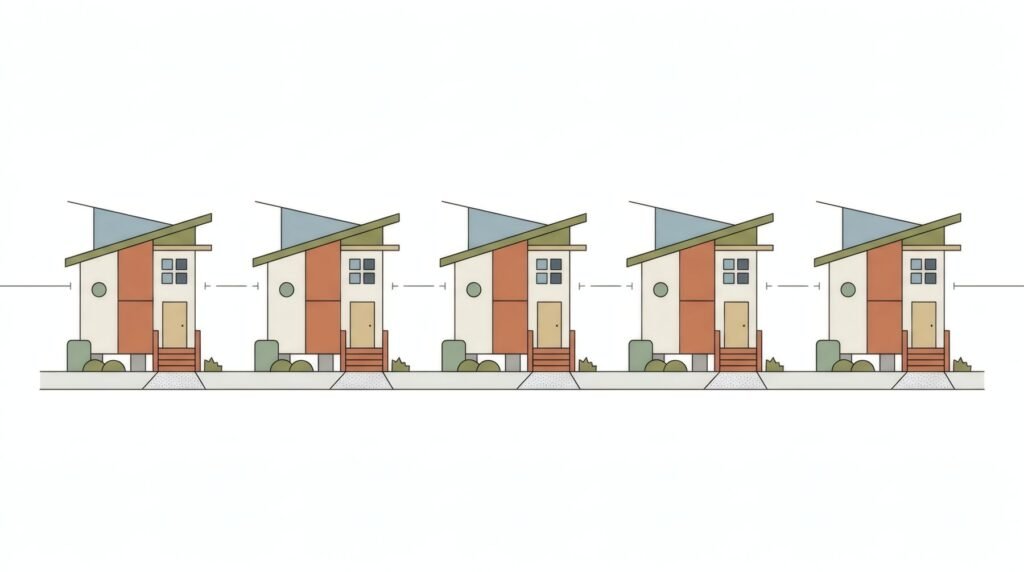
A print with a single form on a pale ground is not a work of the Minimalist movement, even if it is described as «minimalist». It is a contemporary work with a pared-back aesthetic, often closer to geometric or organic abstraction than to Judd’s boxes. There is nothing wrong with that; it is simply worth knowing they are different things.
What Minimalism teaches us to see
Even if you never own a Minimalist work, the movement leaves a useful lesson: when there are very few elements, each one matters enormously. The distance between two forms, the exact tone of a colour, the size of the empty space around them, the way light falls across a surface. All of this, overlooked in a busy image, becomes the subject.
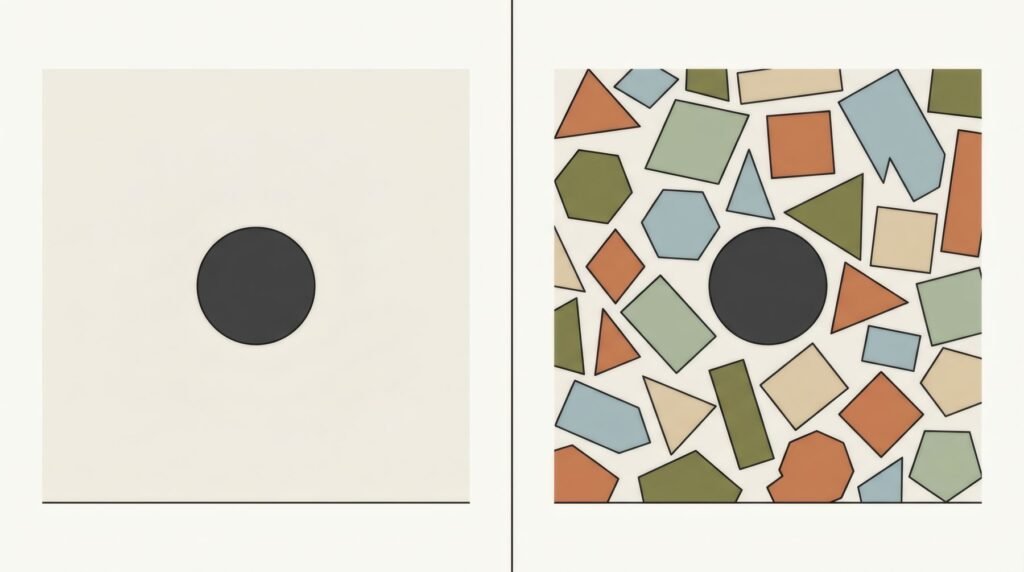
That lesson applies to any wall. A pared-back work needs room to breathe, careful lighting and precise placement. We explore this in the power of negative space in art.
Pared-back art at home
If you are drawn to works of few elements, the key to living with them is to treat them with the attention the Minimalists asked for: give them clear wall, choose frames that do not compete, look at them in different light. A print with a line and a circle can seem slight in a shop and yet bring complete order to a quiet bedroom.
Among Bendíra’s collections, Quiet forms gathers prints of minimal lines and calm shapes which, without belonging to the historic movement, share its confidence that a little can be enough.
Keep reading: Modern vs Contemporary Art: Key Differences, The Appeal of Vintage Posters in Modern Interiors and Warm Minimalism: How to Decorate with Art.