A train seen head-on, reduced to circles and lines that seem to slice the air. The bow of an ocean liner rising, immense, above tiny seagulls. Tall, geometric, almost architectural letters. Art Deco posters of the 1920s and 30s have a power and elegance that make them unmistakable, which is why they still fascinate nearly a century on. Recognising them takes no expertise. You need only know a few visual traits, such as stylised geometry, a sense of speed, lettering and certain subjects, and understand the climate of optimism and modernity in which they were made.
A style named after the fact
Curiously, the people who made these posters did not talk about Art Deco. The term was coined much later, in the 1960s, as a shortening of the great International Exhibition of Modern Decorative and Industrial Arts held in Paris in 1925, regarded as the style’s grand showcase. At the time people spoke rather of the «modern style» or, in some countries, of streamlined design.
Art Deco flourished mainly between the 1920s and 30s, spanning architecture, furniture, jewellery, fashion, objects and, of course, graphics. It was a style of modernity: of cars, fast trains, ocean liners, aeroplanes, skyscrapers and electricity.
Feature one: stylised geometry
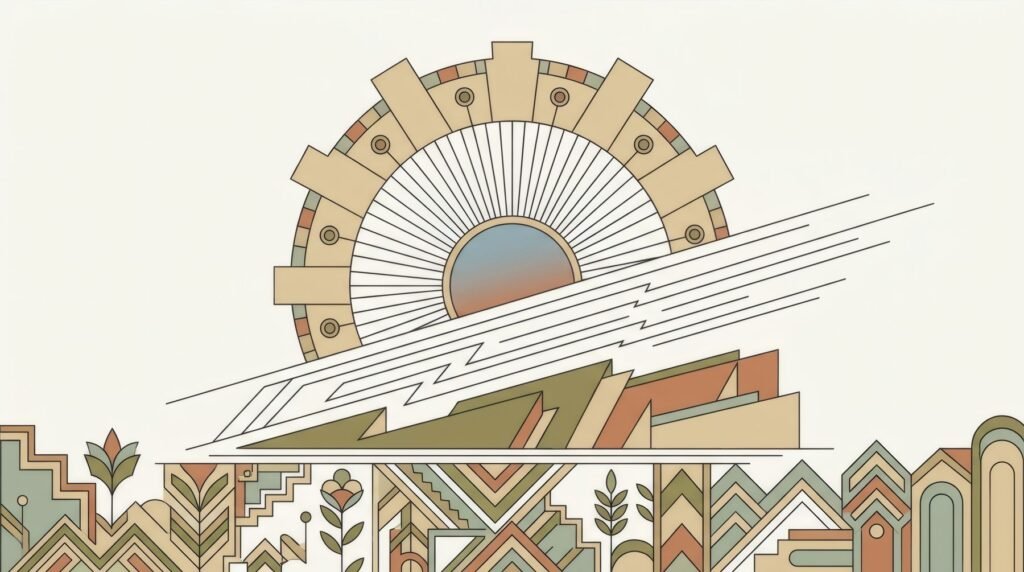
The most recognisable trait of the Art Deco poster is how it stylises form. Figures, objects and landscapes are simplified into geometric shapes: circles, arcs, straight lines, triangles, fans. Unlike pure abstraction, Art Deco does not remove the subject, but turns it into an almost architectural construction.
A train becomes a sequence of circles and rails; a ship, a monumental mass of vertical lines; a human figure, a tall, elegant silhouette.
Feature two: speed and movement
Many Art Deco posters celebrate speed. Parallel lines suggest motion, perspectives rush towards a vanishing point, forms seem to surge towards the viewer. Transport, trains, ships, aeroplanes and cars, appears constantly, and the poster tries to convey the thrill of a world moving faster than ever before.
Feature three: lettering
In an Art Deco poster, lettering is as much part of the composition as the image. Typefaces tend to be geometric, often sans-serif, with elongated or highly contrasted letters, sometimes stencil-built. The text integrates with the image, aligns with its lines and becomes another architectural element. We discuss lettering in posters in typography in European cultural posters.
Feature four: colour and gradient
The Art Deco palette often pairs strong colours with black, gold or silver, and frequently uses soft gradients, in many cases airbrushed, to give forms volume and sheen. That contrast between crisp planes of colour and smooth transitions is highly characteristic.
Feature five: subjects
Beyond transport, Art Deco posters advertised resorts, spas, spirits, perfumes, shows, fashion and the products of modern life. Luxury, travel and leisure recur, reflecting an era that, in its images at least, celebrated progress. In Britain, railway companies commissioned many travel posters in this spirit.
One name: Cassandre
If one poster artist is associated with Art Deco, it is A. M. Cassandre, the pseudonym of the French artist Adolphe Mouron. His posters for railway and shipping companies are among the most celebrated of the era. His Étoile du Nord of 1927 reduces a train to rails converging on a star on the horizon; his 1935 poster for the liner Normandie shows the ship’s bow from below at an almost overwhelming scale. Both display every trait of the style: geometry, speed, integrated lettering and masterly use of gradient.
Other poster artists, in France and elsewhere, developed variations on the same language, each with their own accent.
Originals and reproductions
Original Art Deco posters are now collectors’ items and often valuable. Many of their images are reproduced, but much work by poster artists of the period is still under copyright, as their creators died less than seventy years ago. Cassandre, who died in 1968, is one example. A responsible reproduction must be properly licensed. More in the appeal of vintage posters in modern interiors.
Art Deco at home
A poster or print inspired by Art Deco brings elegance, geometry and a sense of travel to any wall. It works especially well in entrance halls, which become a kind of welcome station; in clean-lined living rooms; and in spaces with brass, velvet or dark wood details that echo the style’s sophistication.
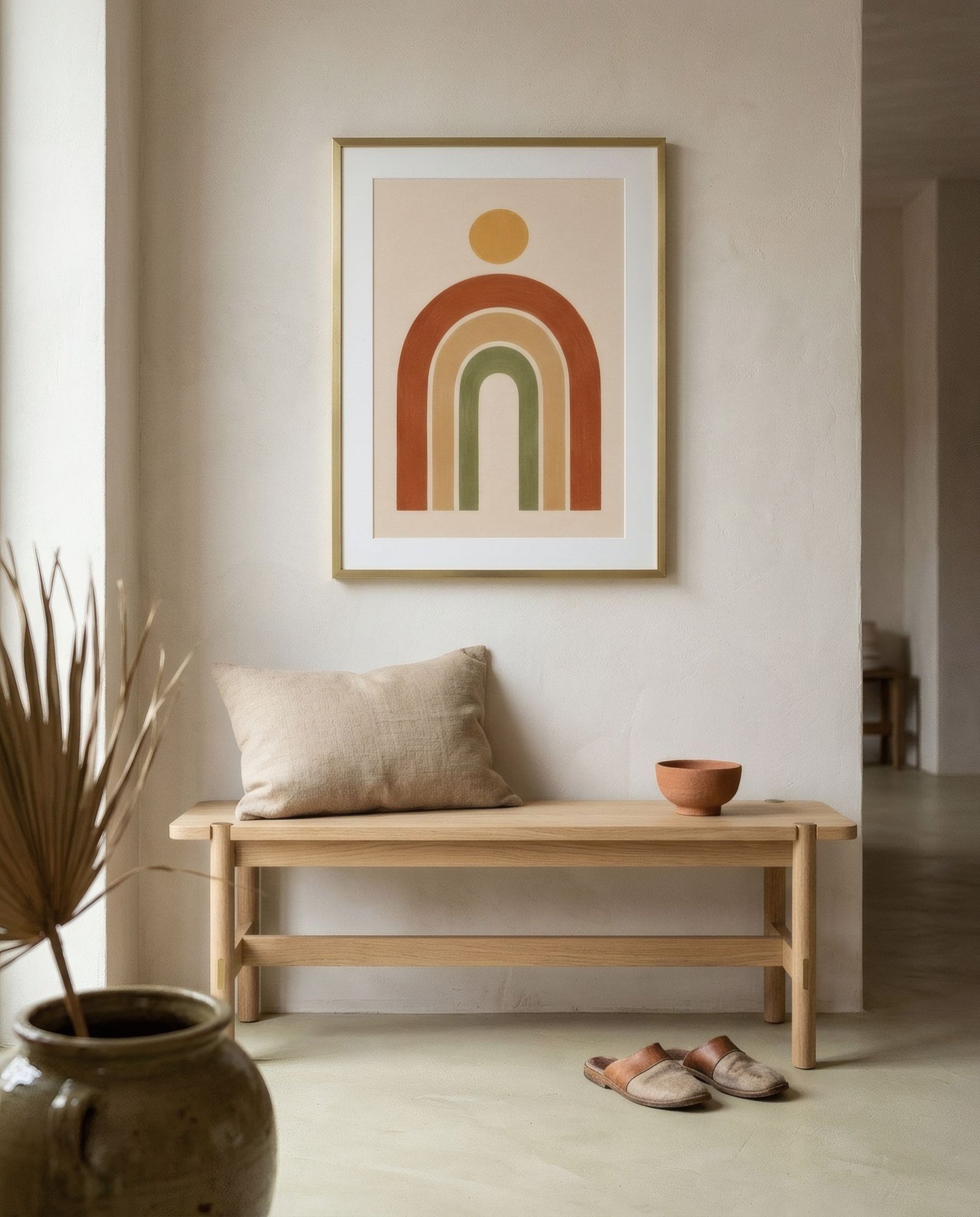
Bendíra’s prints are not Art Deco, but some works in Southern light, with their layered arches and low suns, share its love of stylised geometry and the light of travel.
Keep reading: Organic Abstract Art: Forms and Influences, Swiss Graphic Design: Grids, Typography and Posters and A Brief History of the European Art Poster.