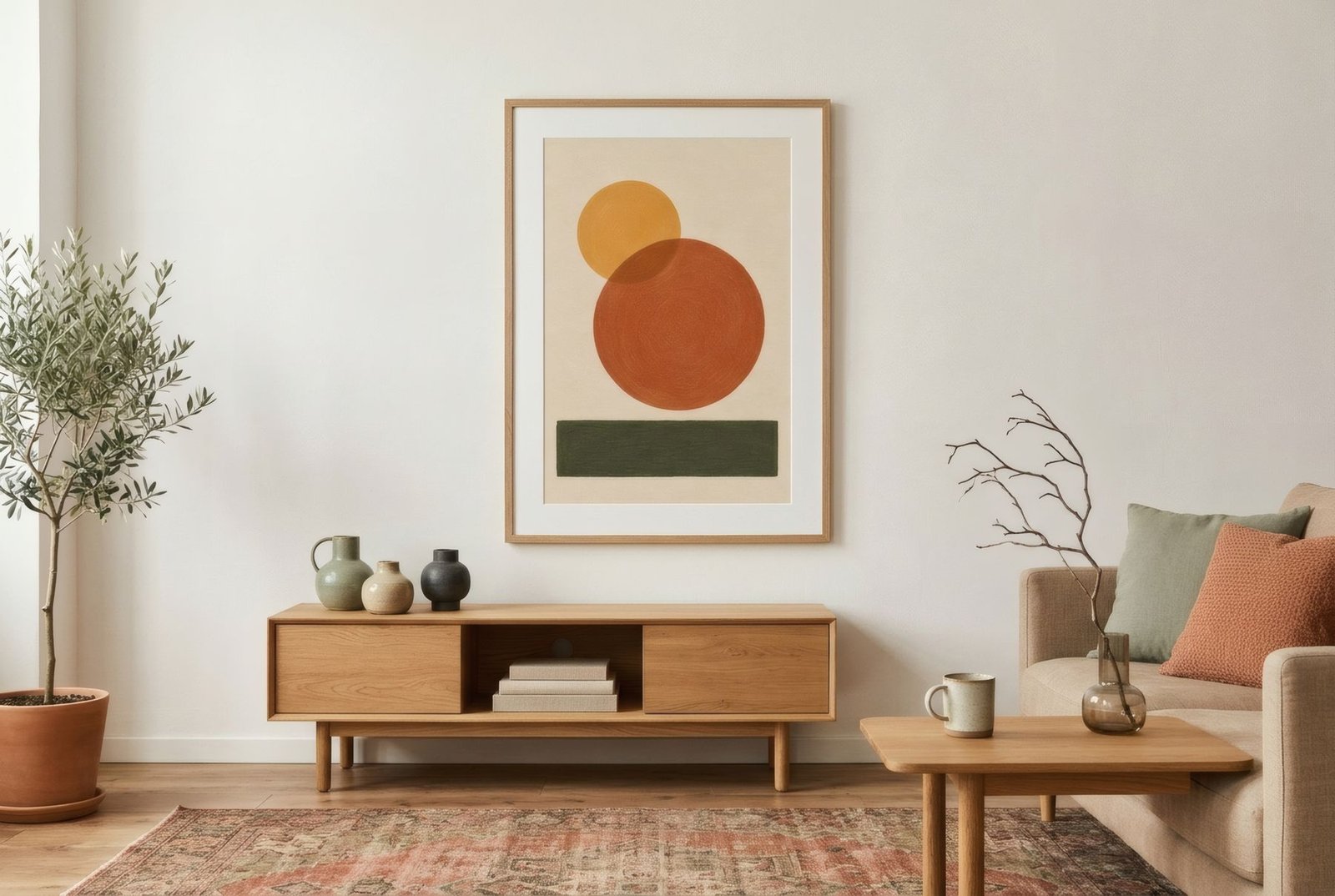
For years minimalism had a reputation for coldness: white walls, glossy surfaces and the feeling of a show home where you hardly dared put a mug down. Warm minimalism arrived almost as a reply to that image. It keeps the essential idea, owning less and choosing it better, but translates it into materials you want to touch: wood, linen, limewash, ceramics, stone. In that setting, art is not one more ornament; it is one of the few voices in the room. So it deserves to be chosen the way everything else is in this style. That means few pieces, with real presence, in natural palettes and with space around them.
What sets warm minimalism apart
The difference lies not in the number of objects, which stays small, but in temperature. Where stricter minimalism sought smooth surfaces and cool neutrals, the warm version prefers texture: the grain of oak, the uneven bloom of a limewashed wall, the fall of a linen curtain, a pot that still carries the mark of the hand that made it. The palette moves towards broken whites, sand, toasted browns, muted greens and the occasional terracotta. Natural light becomes almost another material.
It is worth not confusing this interior style with Minimalism as an art movement, the one that emerged in the 1960s and which we explore in minimalist art: less is more. They share intuitions but are not the same thing. The aim here is not to hang works from that movement, but to choose images that suit a calmer way of living.
The role of art when there is little else
In a home full of things, one print more or less barely registers. In a warm minimalist home, every piece is seen, and seen clearly. That is a great advantage and a small responsibility. One well-chosen work can give meaning to a whole room; a poorly chosen one shows as plainly as a stain on a linen tablecloth.
That is why this style usually favours one lead piece per room, or a carefully related pair, over anything abundant. Gallery walls are not forbidden, but they need rigorous order, such as a strict grid of identical prints, so as not to break the calm.
Which images belong
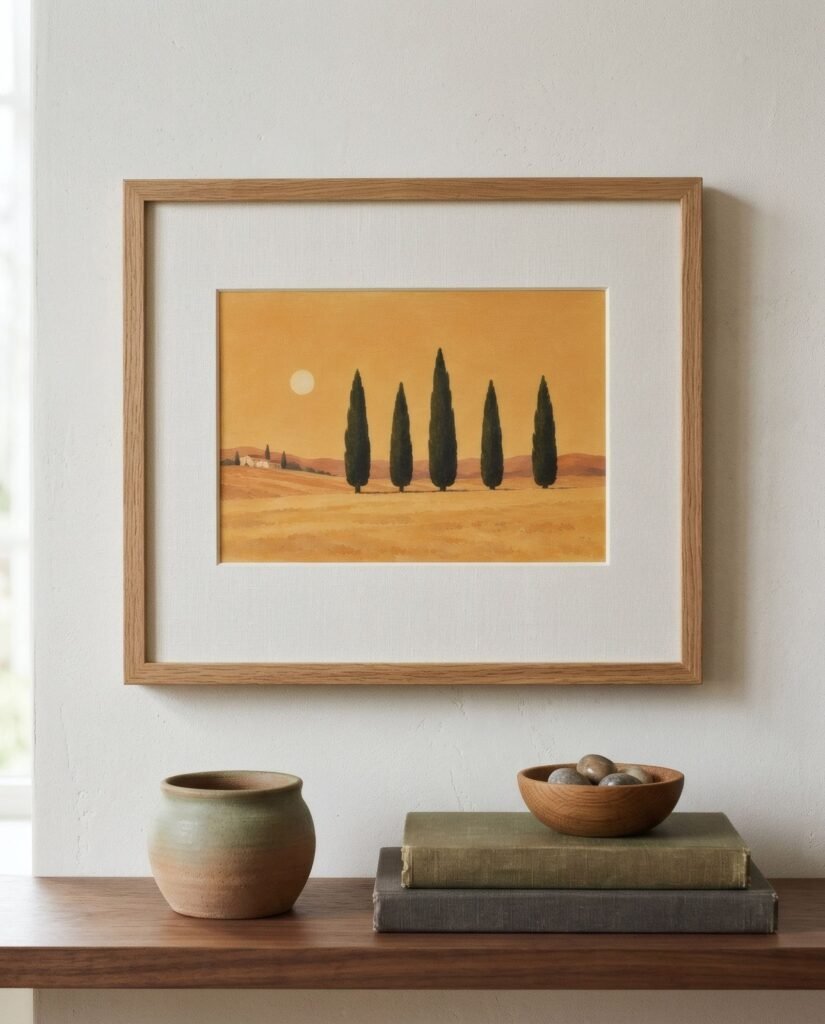
The works that sit best with warm minimalism have one thing in common: they let the eye breathe. They include abstractions of a few forms, with plenty of ground and a gentle gradient; line drawings in which a single stroke holds the whole composition; landscapes reduced to essentials, a horizon, a hill, a low sun; and photographs of texture, architecture or nature with little information and a lot of light.
Negative space is the key, the emptiness around the forms that matters as much as what is painted. A terracotta circle on a bone-white ground can say more in a minimalist living room than a landscape crowded with detail. If the idea interests you, we develop it in the power of negative space in art.
Palette: art as an extension of the materials
In this style, the palette of the art works best when it extends the palette of the home rather than contrasting with it. If you have pale oak floors and an undyed linen sofa, a print in sand, bone and a touch of olive will look as though it was born in that room. If the walls are limewashed and the joinery is dark, a work in charcoal and warm white picks up that conversation.
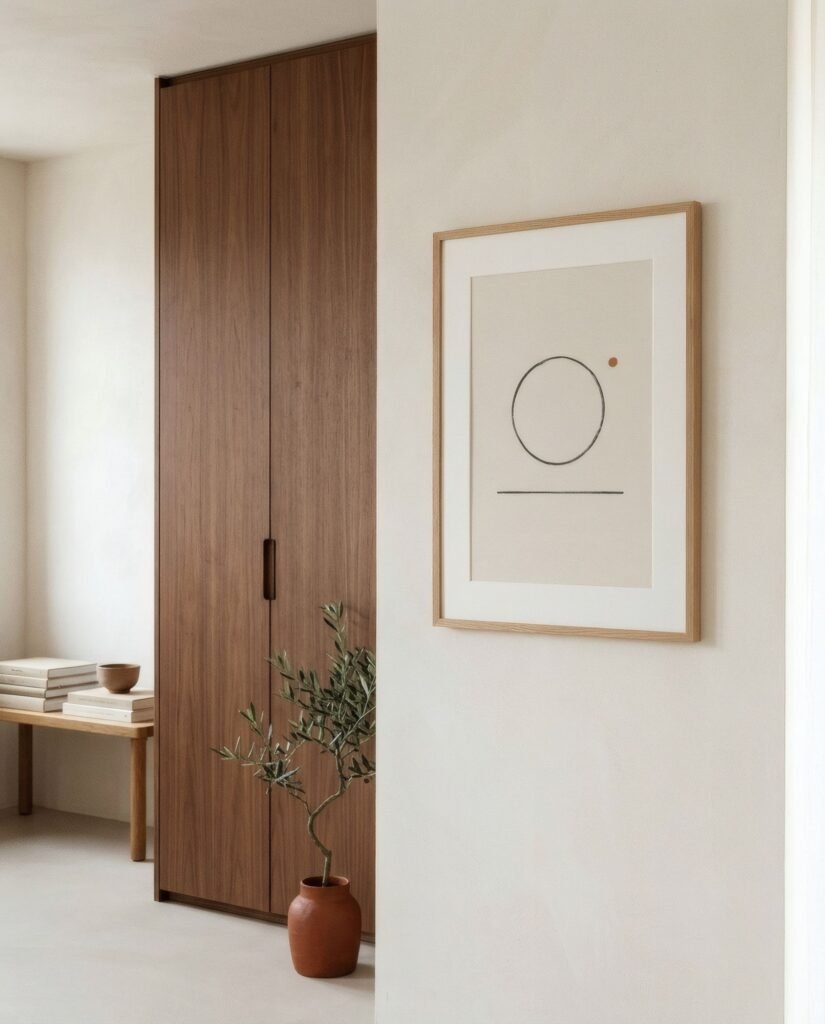
There is room for an accent, and it is often what saves the whole from monotony. But in warm minimalism an accent works better muted than shrill: a toasted terracotta rather than pure red, a misty blue rather than cobalt.
The frame, and the space around it
The frame is part of the style’s vocabulary. Slim profiles in natural wood, especially oak, ash or walnut, are the most coherent, because they repeat a material already in the room. A generous mount, 6–10 cm (2.5–4 in), multiplies the sense of air around the image and fits the spirit perfectly. Thin metal or matt black can work in interiors with darker joinery, always in discreet profiles.
Then leave more air around the frame. In this style, a work usually needs more bare wall around it than in an eclectic home. Do not worry that something seems to be missing. That space is exactly what lets the work be seen.
Three ways to bring it home
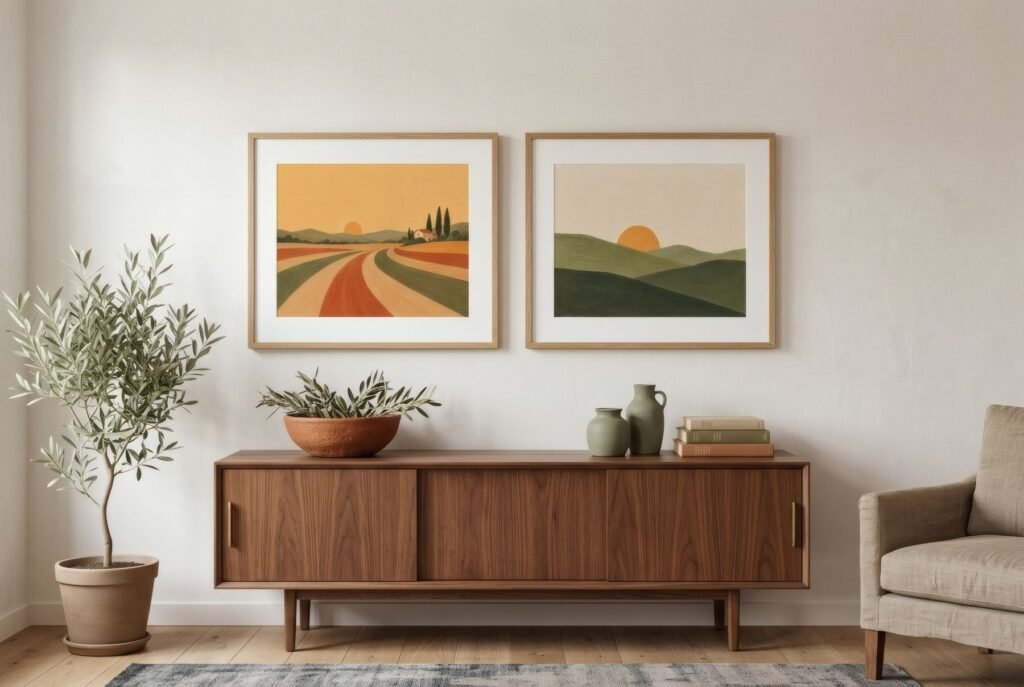
In a living room with oak floors, a linen sofa and off-white walls, a single 50 × 70 cm print of an organic form in sand and terracotta, framed in oak with a wide mount and hung above the sofa, may be all the room needs. In a bedroom with undyed bedding and a single ceramic on the bedside table, a portrait-format line drawing beside the wardrobe, almost hidden, is discovered in passing. In a dining room with a solid wood table, two matching pared-back landscapes in olive and stone, aligned above the sideboard, bring order without stiffness.
What jars
In warm minimalism, very busy images, pure saturated colours over large areas, ornate or glossy frames, and abundant arrangements without clear order all stand out awkwardly. So does too much neutrality: a home where everything is beige, art included, risks feeling flat. We look at that in how to add personality to neutral interiors.
Less, but with soul
Warm minimalism is not about emptying a home. It is about keeping only what matters to you, in materials that invite touch. Art, in that setting, is a way of saying who lives there in very few words.
If this way of living appeals, Bendíra’s Quiet forms collection brings together prints of minimal lines and calm shapes in bone, charcoal and sage, made for walls that need room to breathe.
Keep reading: Framed vs Unframed Art Prints: Which to Choose? and Japandi Wall Art: What Works Best?.