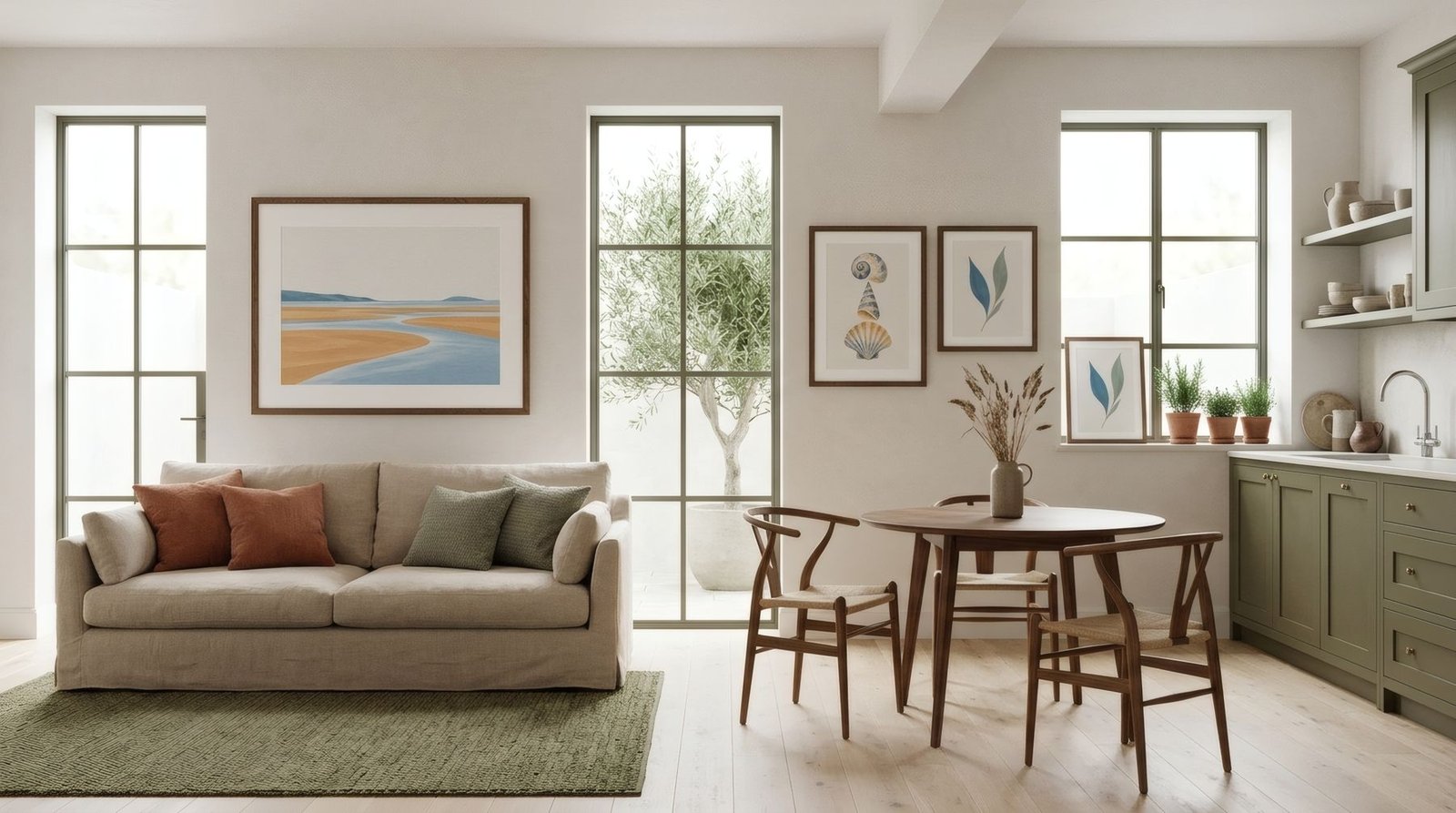
Open-plan living has something liberating about it. Without walls, light moves freely, conversation flows between kitchen and sofa, and the home feels larger. But it brings a challenge too: when living, dining and kitchen areas share one space, everything is seen at once. What would be separate decisions in a home of distinct rooms becomes a single composition. Art can be one of the best tools to resolve it, because it can do two things at once: define each zone with its own focus, and connect them through a common thread. The key is balancing coherence and variety, so the space feels like one without becoming uniform.
Seeing everything at once
Start by looking at the space as the people who live in it do. Stand at different points, the entrance, the sofa, the dining table, the kitchen, and notice which walls you see from each. In an open-plan room, a work hung by the dining table is also seen from the sofa; a print in the kitchen may sit in the living area’s line of sight.
Those sightlines decide how works relate to one another. Two pieces that seem independent up close can clash when seen together from across the room.
A common thread
What unifies an open-plan space is a thread running through every zone. In art, that thread can take several forms.
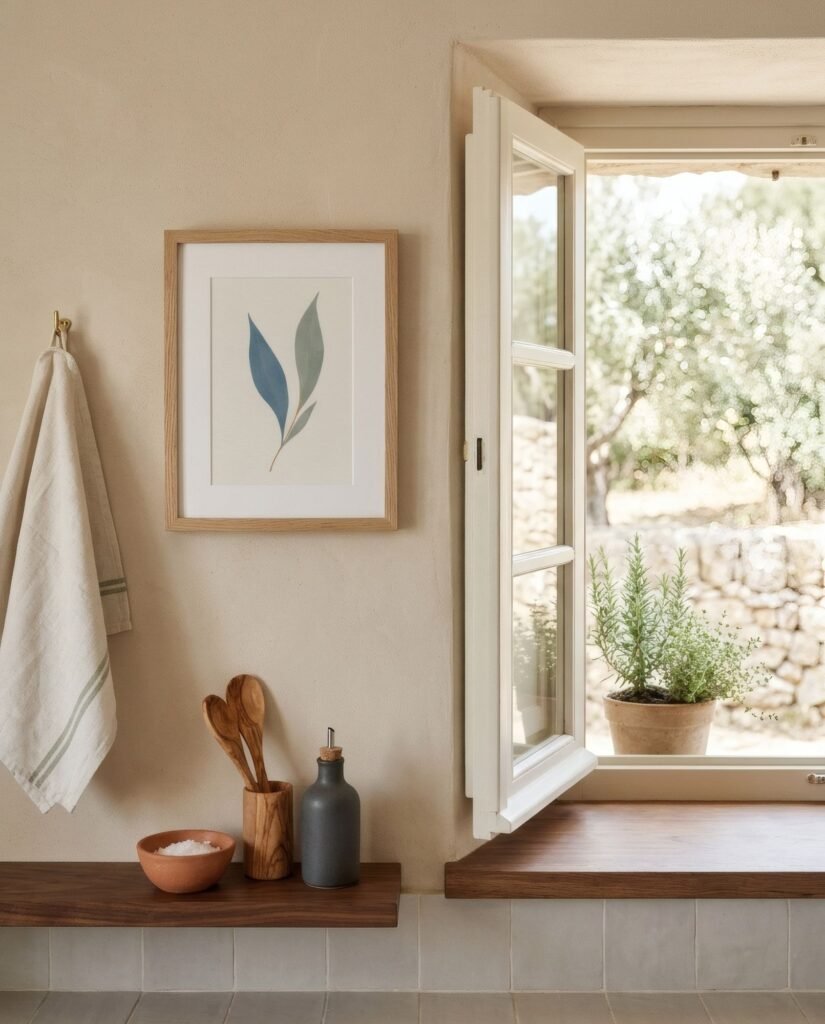
Palette is the most effective. If the works in different zones share two or three tones, such as earths, greens or blues, the space reads as coherent even when the images are very different. They need not be identical; they only need to belong to the same family.
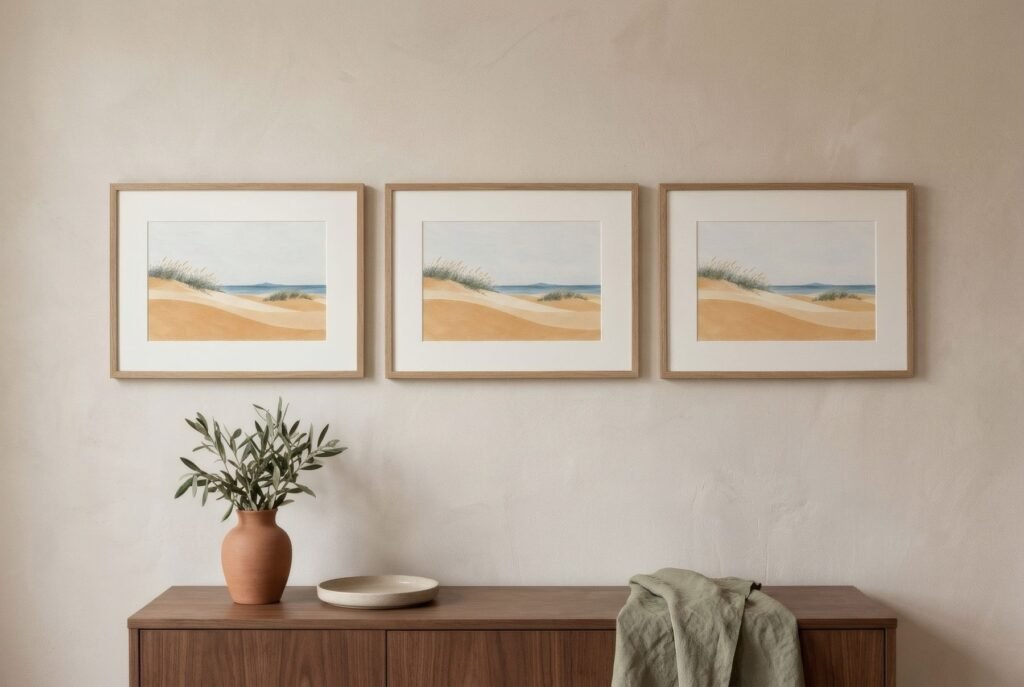
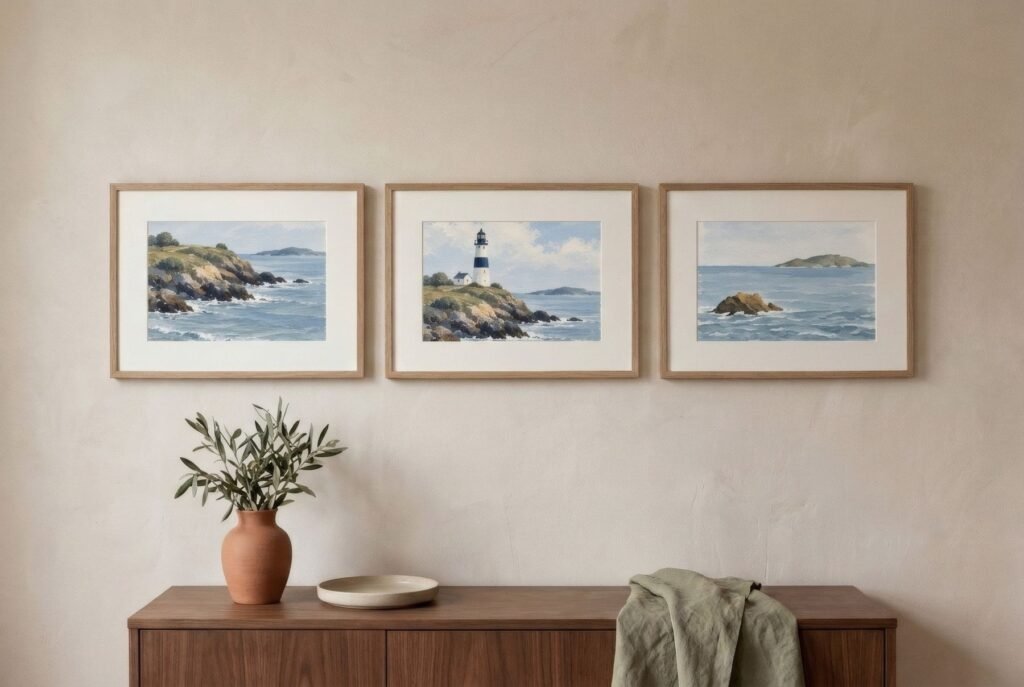
Frames are another simple device. One frame style, such as natural oak or slim black, across every zone creates continuity almost automatically.
Height unites too. Keeping one reference line for hanging, whether a centre height or a bottom edge, makes the space read as an ordered whole.
Variety within coherence
The opposite risk to disunity is too much uniformity: the same type of print, size and palette repeated in every zone. The result can feel monotonous and slightly impersonal, like a hotel.
To avoid it, give each zone its own character within the shared palette. The living area might hold the largest, leading work; the dining area a pair or a piece that invites conversation; the kitchen something smaller and lighter. Varying size, technique or subject, without abandoning the common thread, gives the whole richness.
Defining zones with art
In an open-plan room, art can also help mark where each zone begins and ends, without dividing furniture. A large work above the sofa marks the heart of the living area. A piece centred above the dining table, or on its pendant’s axis, defines the eating area. A small print by the worktop defines the kitchen.
Each zone gets its own visual anchor, and the whole feels organised.
Beware of competition
In open-plan living, two strong works in different zones can compete, because they are seen together. If the living area has a large, intense work, the dining area’s should be calmer, and vice versa. There should be a clear hierarchy: one principal piece in the whole space, with others supporting it.
Filling every wall does not help either. In an open plan, empty space matters as much as occupied space; let some walls breathe.
The kitchen zone
If the open plan includes a kitchen, remember that art near the cooking area is exposed to steam, grease and heat. Frame it behind glass, keep it away from the hob and sink, and prefer small or medium formats.
An example
Picture an open-plan space with pale oak floors and off-white walls. Above the sofa, a large print in terracotta, sand and olive, framed in oak. On the dining wall, on the pendant’s axis, a pair of portrait prints in the same palette but different forms, also in oak. In the kitchen, by the window, a small olive-green botanical print in the same frame. Three zones, three characters, one thread.
One space, many stories
Art in an open-plan space works like the thread of a necklace: each piece has its own shape, but all are joined. With a shared palette, consistent frames, a clear hierarchy and some breathing room, the space feels like one while every corner keeps its personality.
Bendíra’s collections are arranged by colour family, which makes it easier to choose different prints for each zone that still share a single thread.
Keep reading: Choosing Wall Art for Coloured Walls, Constructivism in Graphic Design: Key Visual Ideas and How to Choose Wall Art for Your Living Room.