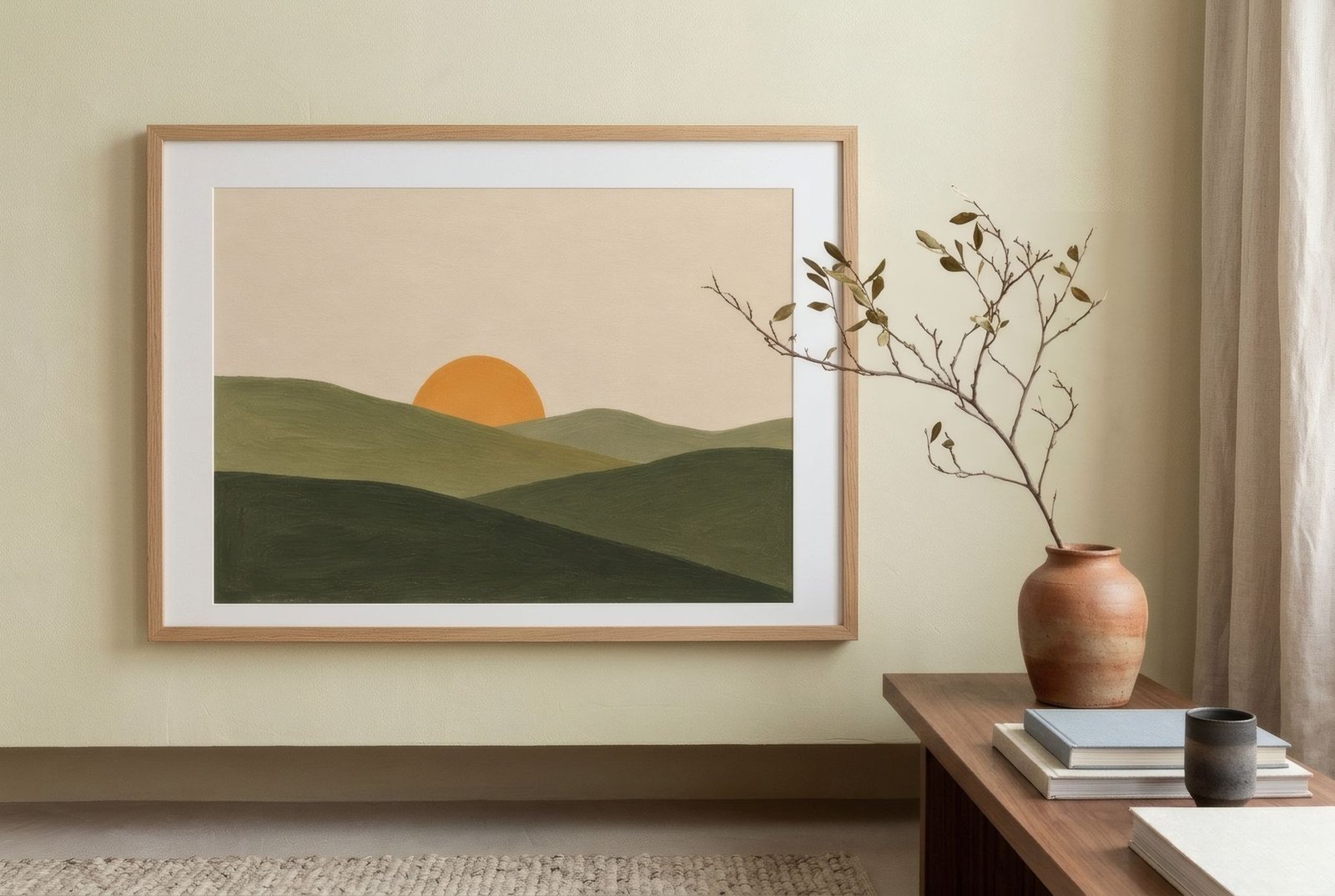
The spiral of a shell, the branching of a tree in winter, the ripples wind leaves in sand, the network of veins in a leaf held up to the light. Nature is full of forms that, though nobody designed them, look like works of art. It is no surprise that artists of every era have returned to them again and again, sometimes to depict them faithfully, sometimes to draw out a rhythm, a structure or a palette. Understanding how natural forms appear in art helps us recognise them in the works around us and, if they appeal, choose images that bring something of the outside world into our homes.
Forms that recur
Look closely at nature and certain forms recur in very different contexts.
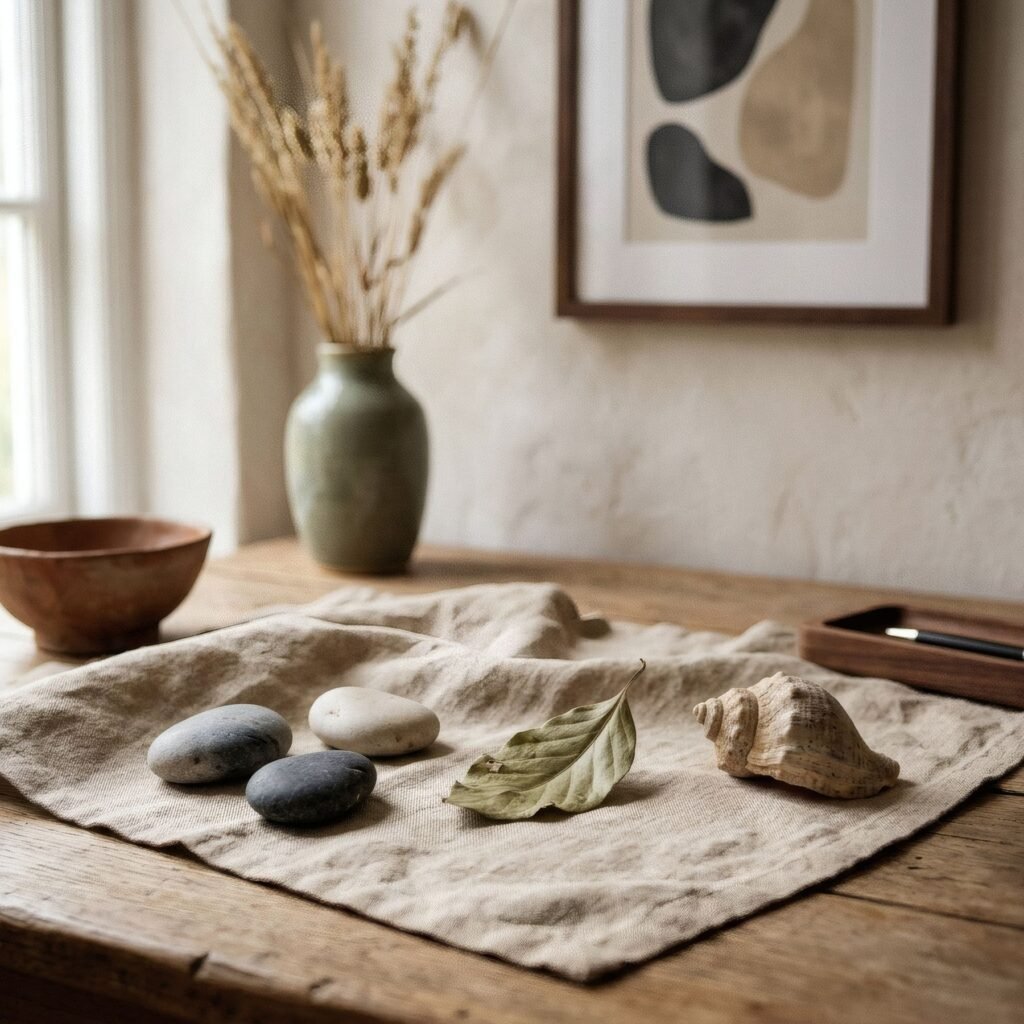
The spiral appears in many shells, in the arrangement of sunflower seeds, in unfurling ferns, in whirlpools. It is a form of growth, expanding without losing its structure. It is worth treating some popular claims with caution, though, particularly those that find exact mathematical proportions in every natural spiral. There are real examples, but many exaggerations.
Branching appears in trees, in rivers seen from the air, in lightning, in blood vessels: a line dividing again and again into smaller lines.
The wave is in water, dune sand, wood grain and the lines of rolling hills. It is the shape of movement.
The cell or network appears in honeycomb, the skin of some fruits, foam and cracked dry mud: spaces clustering into a fabric.
And the horizon, perhaps the simplest natural form and the most present in art: a line separating land or sea from sky.
Nature as model
For centuries, the usual way to bring nature into art was to depict it: landscapes, flowers, animals, still lifes. But at the end of the nineteenth century and the start of the twentieth, some artists and scientists began to look at it differently, attending to its structures.
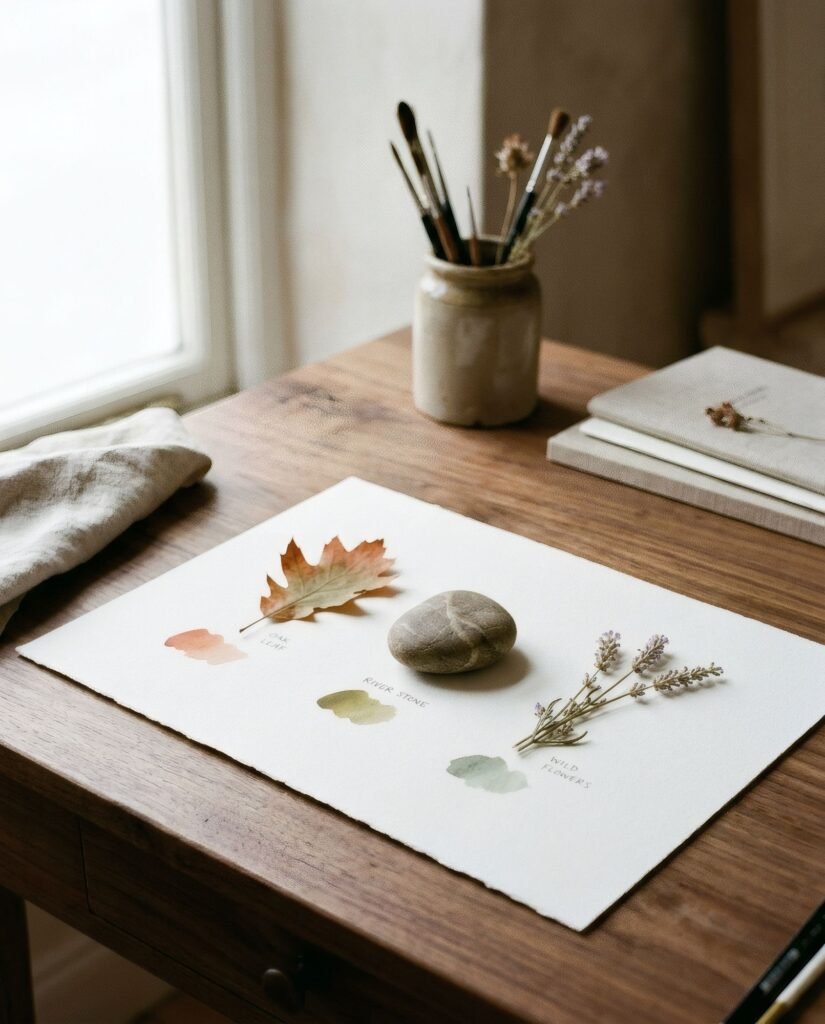
The German biologist Ernst Haeckel published, at the turn of the twentieth century, a work called Art Forms in Nature, with plates of marine organisms, radiolarians, jellyfish and other creatures drawn with a symmetry and detail that influenced the decorative arts of the time, especially Art Nouveau. Soon after, the German photographer Karl Blossfeldt photographed plants in extreme close-up, presenting stems, buds and seeds as if they were architecture or sculpture. His work showed that nature, looked at attentively, holds an almost endless repertoire of forms.
Nature abstracted
In twentieth-century and contemporary art, nature often appears abstracted: not a particular tree, but the rhythm of its branches; not a wave, but undulating movement; not a hill, but the curve of its profile. Many abstract artists began from natural forms and refined them to their essentials, as we saw in organic abstract art: forms and influences.
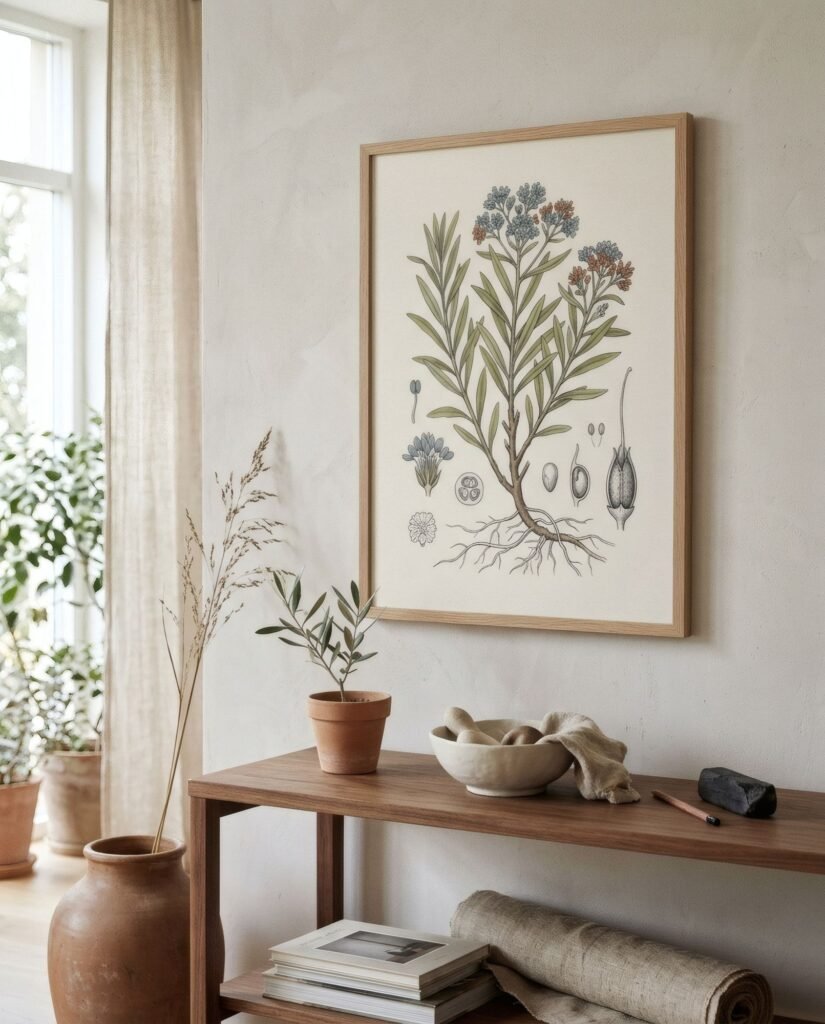
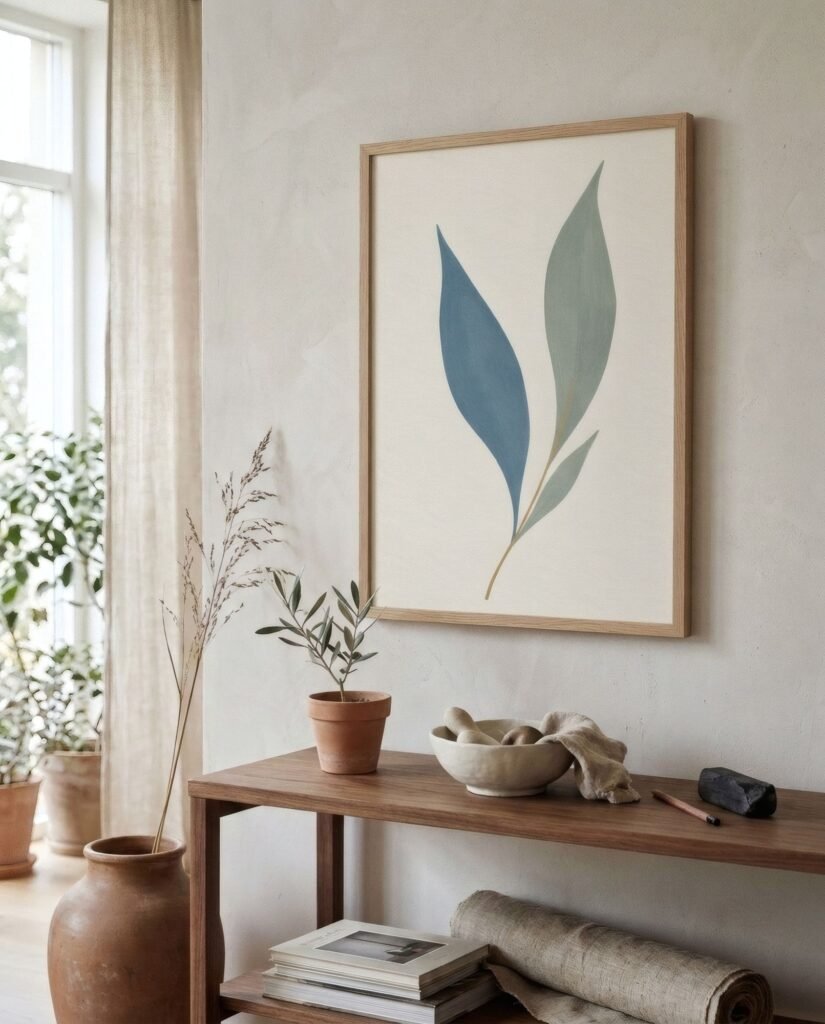
That journey from nature to abstraction is also the path of many contemporary prints: hills reduced to two curves, a sea turned into bands of colour, a leaf simplified to its silhouette.
What nature brings to a home
Nature-inspired images have a special presence at home. They bring something of the outside in: the sense of a horizon, the rhythm of water, the texture of a leaf. They sit naturally with natural materials, such as wood, linen, stone and ceramics, and with real plants.
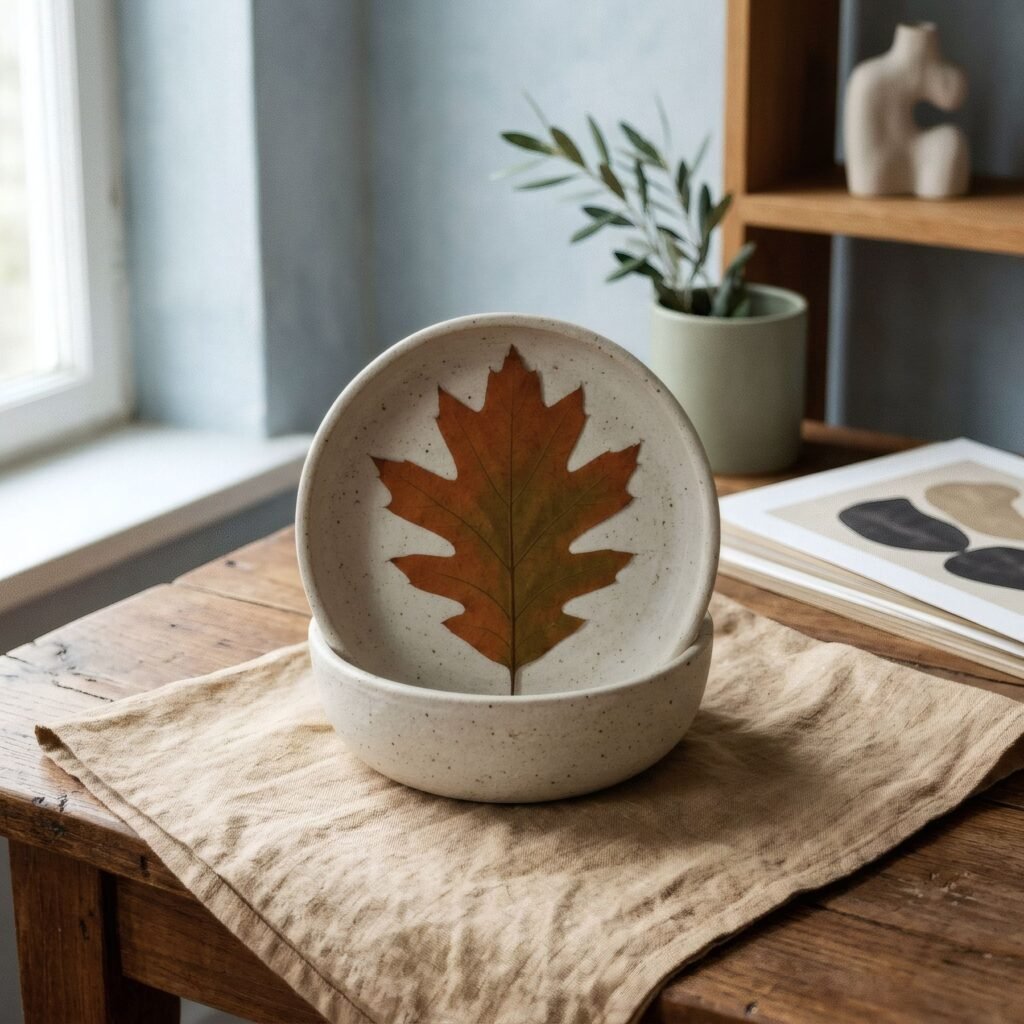
It is wise not to claim more for them than they can give, however. Nature imagery is sometimes presented as having proven effects on wellbeing, or as if hanging a landscape were an ecological gesture. Such claims deserve caution. What can be said is that many people find in these images a calm and beauty they like to have close.
Choosing
If natural forms draw you, think about which aspect of nature interests you most. Landscapes and horizons bring space and calm, suiting living rooms and bedrooms. Botanical forms, leaves, branches and flowers, bring delicacy and suit intimate spaces. Structures such as spirals, waves and networks have a more graphic, contemporary character. And abstractions of nature, which suggest without depicting, are the most versatile.
Looking out to look in
Nature has always been one of art’s great teachers. Its forms, repeated in shells, trees, waves and hills, keep inspiring artists of every kind and keep finding their place on the walls of our homes.
In Bendíra’s collections, nature appears abstracted: olive hills, tides, sea grass and low suns reduced to simple forms, in palettes drawn from the landscape.
Keep reading: Symmetry in Art: Balance and Visual Interest, Vintage Maps as Visual Art: History and Appeal and Botanical Art: From Scientific Illustration to Interior Design.