Two prints together on a wall have something special about them. They are neither a single work nor a gallery: they are a conversation. They look at each other, answer each other, complete each other. A well-composed pair conveys order and balance while saying more than a single image can. But it is also a demanding arrangement, precisely because it is so simple. With only two elements, any slip in spacing, alignment or the relationship between the works shows at once. Choosing the right layout, measuring the gap with care, and picking two images that truly converse are the three keys.
Three ways to hang a pair
There are three main layouts, each with its own character.

Side by side. The two prints next to each other at the same height, aligned top and bottom. This is the most common layout, perfect above a sofa, bed, sideboard or dining table. It works with portrait formats, which together form a near-square or landscape block, and with landscape ones, which form a long band.
Stacked. One print above the other, aligned on a vertical axis. Ideal for narrow walls, the strip between two doors or beside a window, because it follows the height of the space. More in how to decorate a narrow wall with prints.
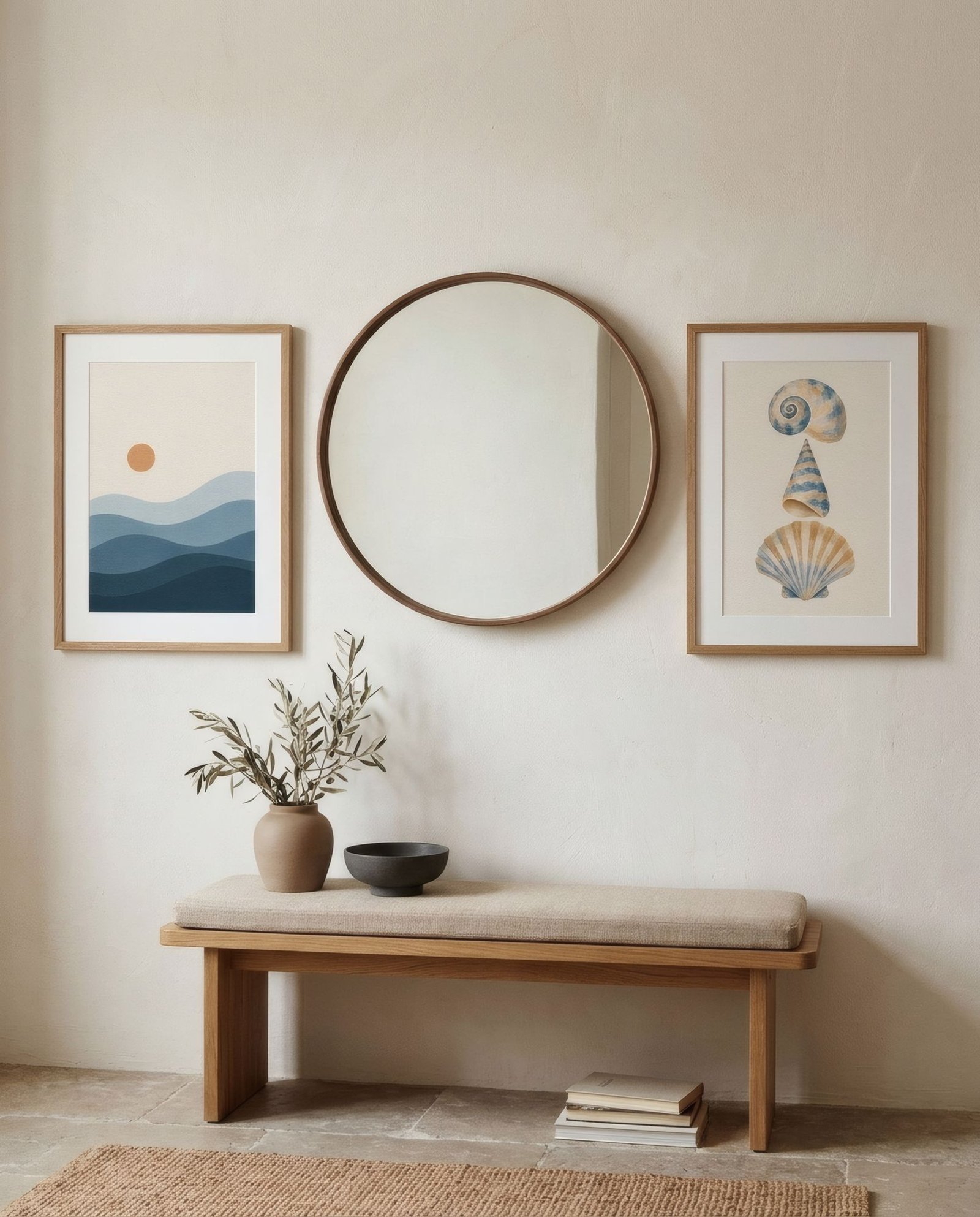
Either side of something. The two prints flank a central element, such as a window, mirror, bed, door or fireplace. Here the pair does not read as a block but as a frame for that element. It is an elegant, symmetrical layout that brings order to the whole.
The gap between them
When the prints hang together, side by side or stacked, the space between them is what people notice most. As a guide, 5–10 cm (2–4 in) works in most cases: enough for each work to breathe, close enough for them to read as a pair. For small formats, lean towards 5 cm; for large ones, 8–10 cm.
Too far apart, beyond about 15 cm (6 in), and they begin to read as two separate works that happen to share a wall. Too close, and they can look cramped.
When the pair flanks an element, the reference changes. What matters is that each print sits the same distance from that element, say 15–20 cm (6–8 in) either side of a window, and that both hang at the same height, usually aligned with the top edge or centre of the element.
Alignment and height
In a pair, alignment allows no carelessness. Side by side, the two prints must be at exactly the same height; stacked, perfectly centred on the same axis. A spirit level and tape measure are essential.
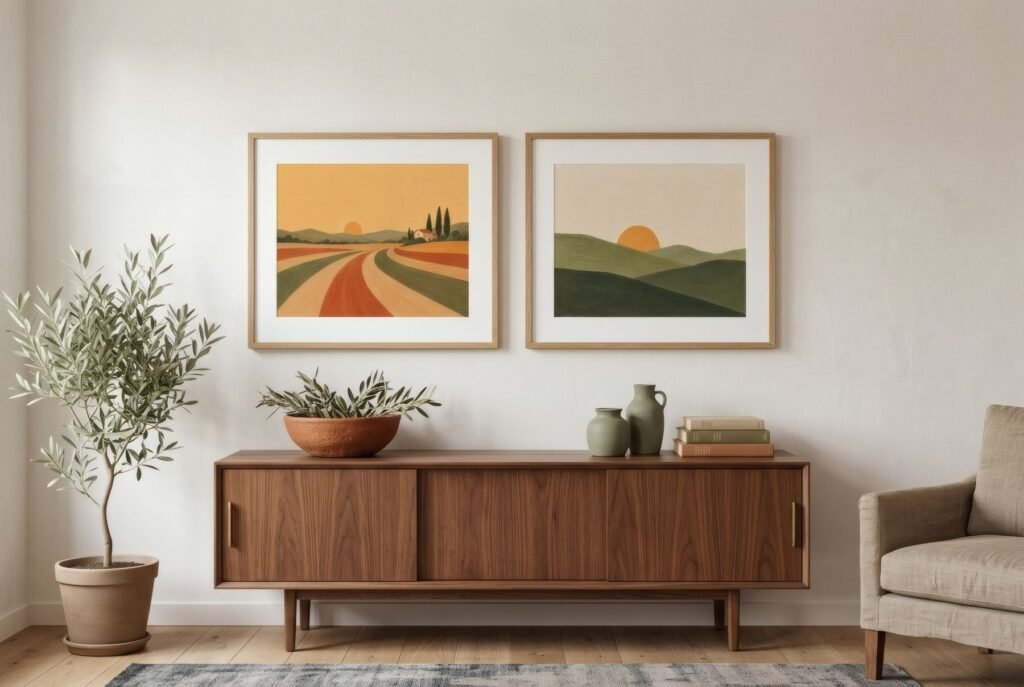
For the height of the whole, treat the pair as a single work: the centre of the arrangement at around 145–155 cm (57–61 in) from the floor on an open wall, or its bottom edge 15–25 cm (6–10 in) above the furniture below. More in how high should you hang pictures?.
Coherence: same size, same frame
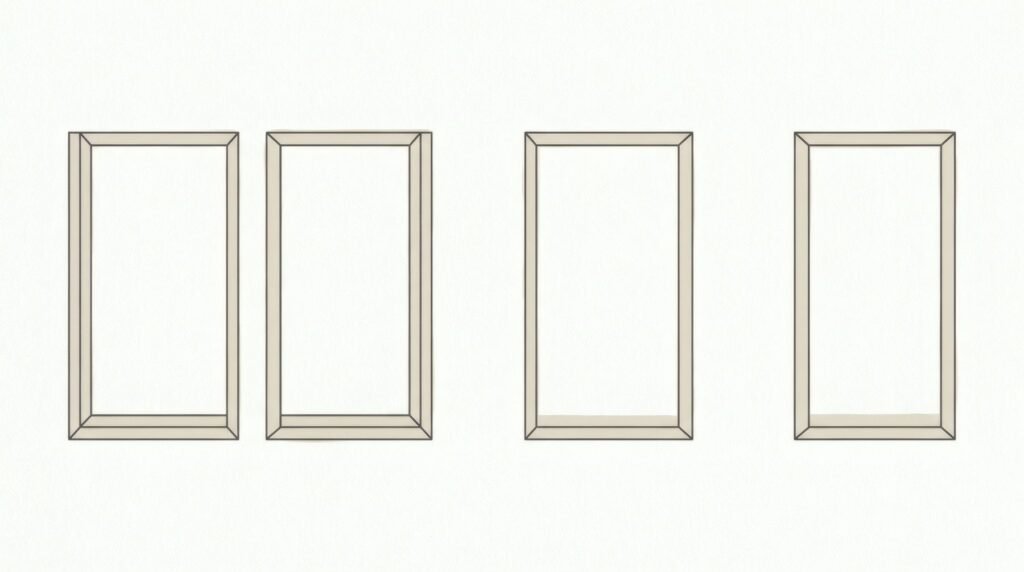
The most harmonious pairs usually share size and frame. Two prints of the same format, frame profile and mount read instantly as a set, even when their images differ.
Mixing sizes in a pair is possible but risky. With only two pieces, a size difference creates a hierarchy that can look like a mistake. If you do it, make the difference clear and the alignment, by the base or the centre, impeccable.
Two images that converse
Beyond form, a good pair needs two images with something to say to each other. There are several ways.
They can be two works from one series: two landscapes, two forms, two variations on a theme. The simplest and safest option.
They can complement each other: one light and one dark, one warm and one cool, one with a full form and one with an empty one. That contrast within a shared family creates a lovely tension.
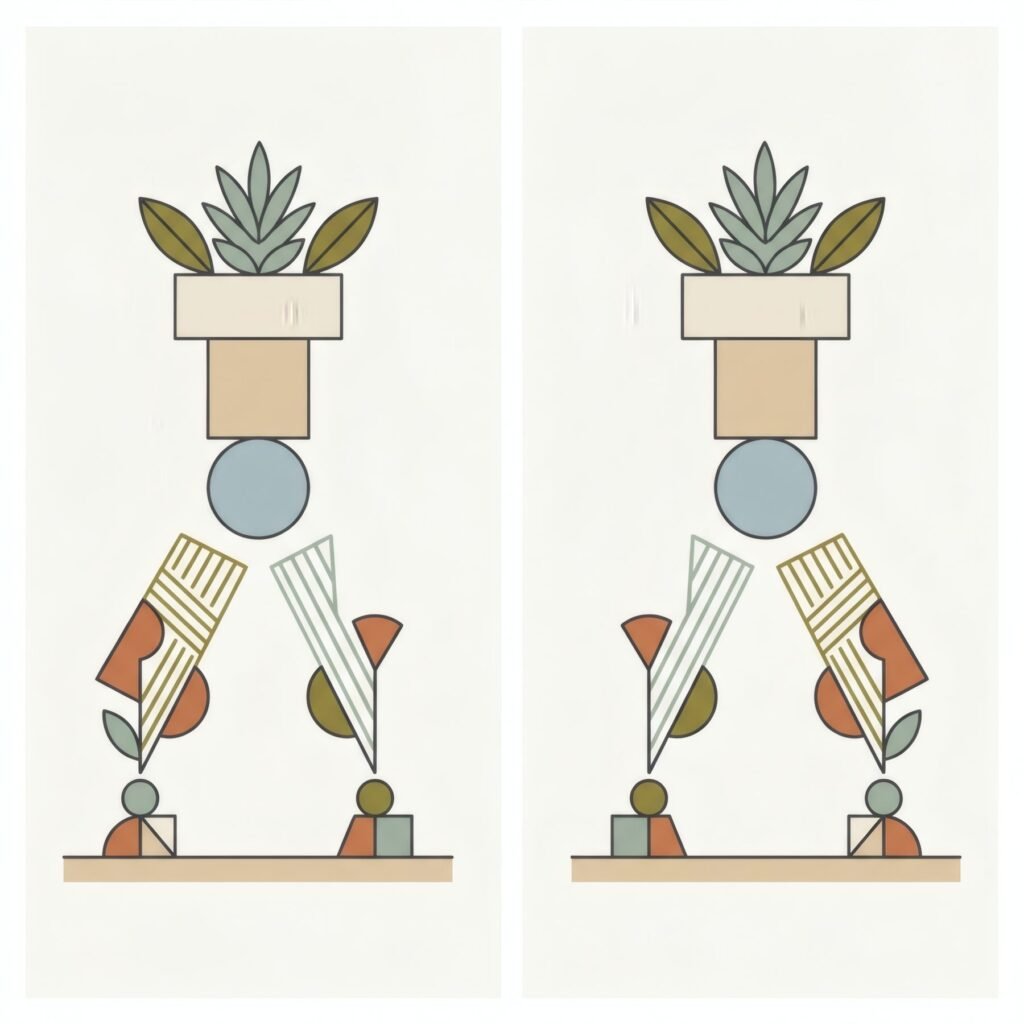
They can mirror each other: compositions that face each other, with their main elements towards the centre of the pair, so the eye stays within the arrangement.
Or they can simply share something: a palette, a subject, a technique. Even by different artists or from different eras, that common thread unites them.
Pair or diptych
It is worth distinguishing a pair, two independent works in dialogue, from a diptych, a single image divided into two parts that together form a continuous composition. Diptychs demand even more precision in alignment and spacing, because any slip breaks the continuity of the image. If arrangements of several pieces appeal, see also triptych wall art: when and how to use it.
Two that understand each other
A well-composed pair of prints has the serenity of symmetry and the richness of dialogue. At the same height, with a careful gap and two images that answer each other, it can be one of the most elegant solutions for almost any wall.
Many Bendíra prints are made to live in pairs, since they share a palette and atmosphere within each collection, from the blues of Coastline to the warm tones of Southern light.
Keep reading: Home Office Wall Art That Helps a Space Feel Considered, Bedroom Wall Art Ideas for a Cosy Space and How to Arrange Art Above a Sofa.