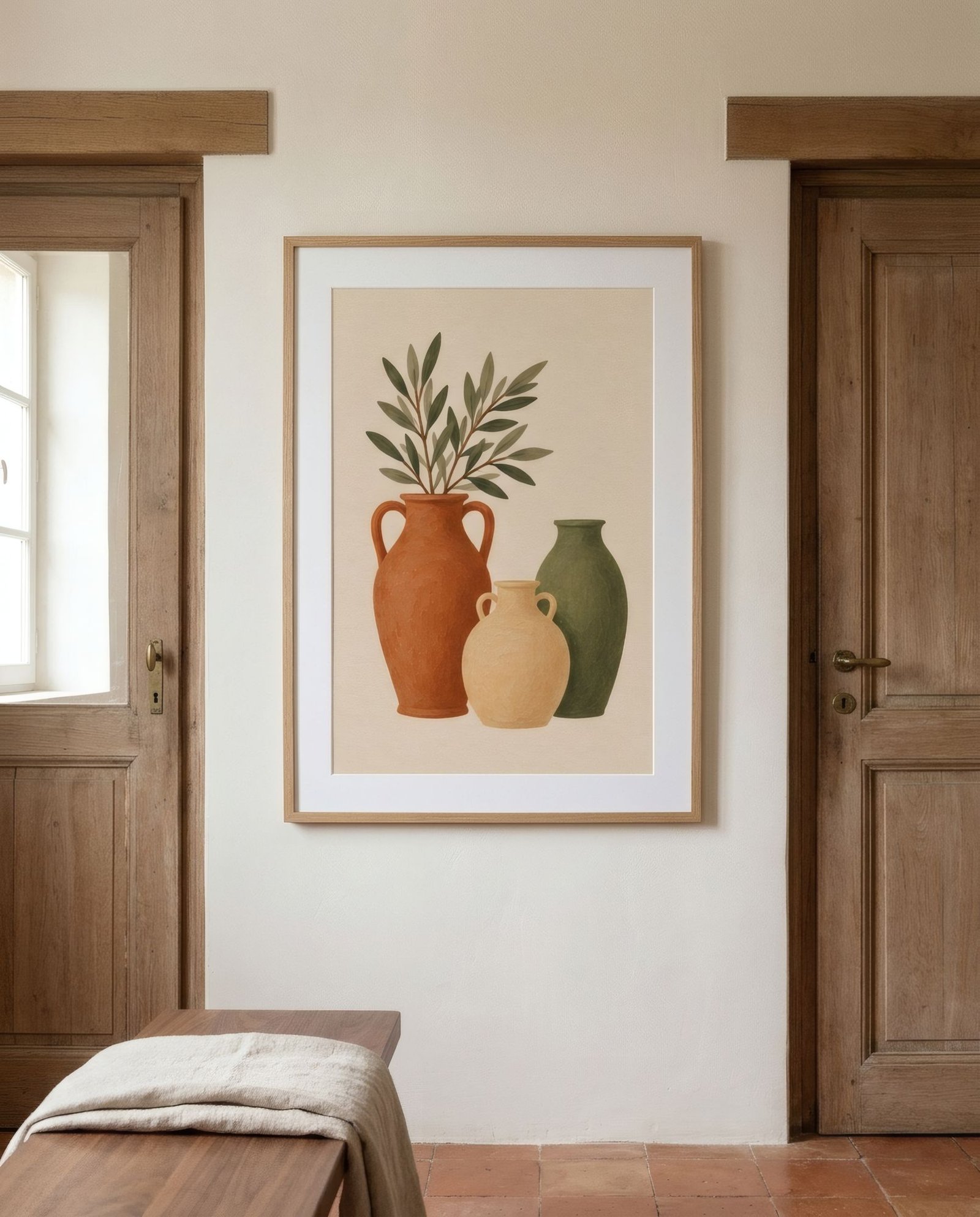
Every home has one: the strip of wall between two doors, the gap beside a window, the side of a column, that narrow stretch between the fridge and the corner of the kitchen. These walls usually stay bare because it seems nothing will fit. Yet, well handled, they can become some of the loveliest corners in the house. The key is to accept their shape rather than fight it. Choose portrait formats, respect their proportions, make use of the stacked column, and pay attention to light, which is often scarce in these spaces.
Embrace the vertical
A narrow wall is, by definition, taller than it is wide. Trying to fill it with a landscape piece almost never works: it either looks too small or spills over. A portrait print, by contrast, repeats the wall’s own proportion and settles in naturally, as if made for it.
As a rough guide, a work covering half to three-quarters of the wall’s width looks balanced, leaving a margin either side. On a 60 cm (24 in) strip, that means a print 30–45 cm (12–18 in) wide, such as a 30 × 40 cm or an A3 in portrait. On a one-metre stretch, a 50 × 70 cm portrait print fits with real elegance.
One piece or a column
There are two main solutions for narrow walls.
The first is a single portrait print, centred on the strip at eye level, with its centre around 145–155 cm (57–61 in) from the floor. It is the cleanest option and works best on walls that are not especially tall.
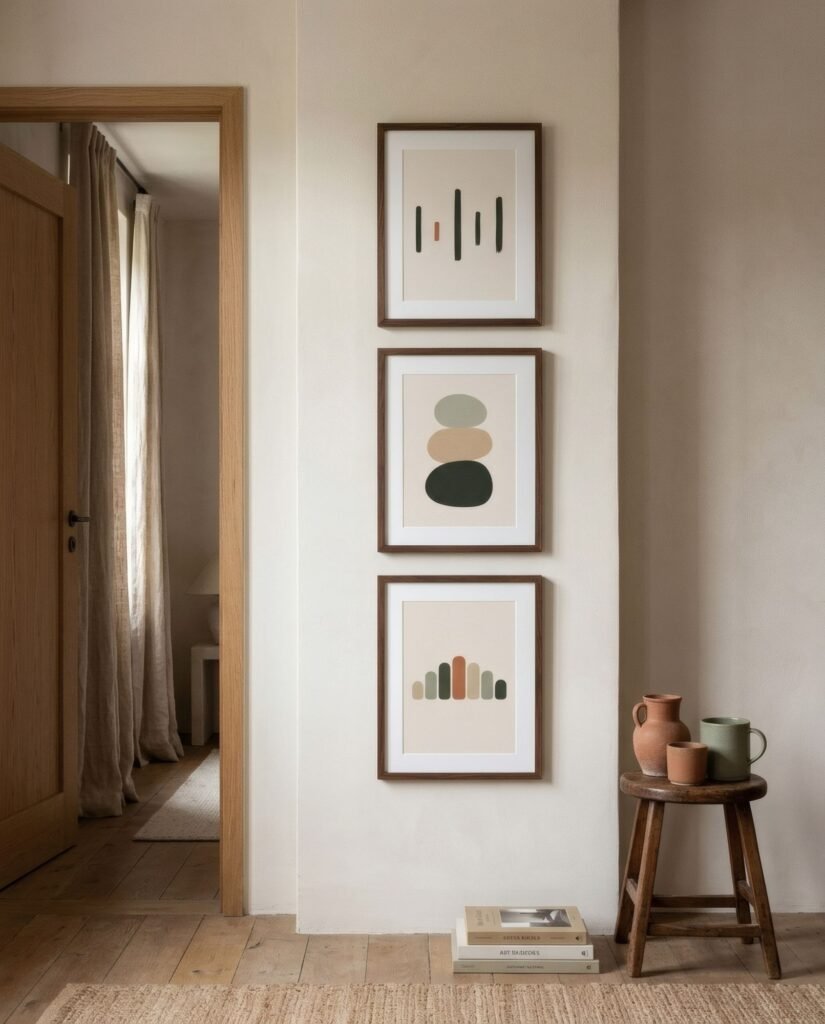
The second is a column of two or three matching prints stacked on a central axis, 5–8 cm (2–3 in) apart. It is a very elegant answer for tall, narrow walls, following and emphasising their verticality. It works especially well with a series: three botanicals, three photographs of one coastline, three variations on a form. To stop the arrangement climbing too high, keep its centre near eye level.
Relate it to its surroundings
Narrow walls are usually surrounded by things: door frames, windows, switches, corners. These are part of the composition, and taking them into account makes the print look as if it belongs.
One very effective device is alignment. If the wall sits between two doors, aligning the top of the print with the door lintels creates a continuous line that tidies the whole stretch. Beside a window, aligning with the window’s top edge or centre does the same. Nobody notices these details consciously, but they make a wall feel considered.
Watch for doors that open towards the wall, too. Check that the print will not be hidden or knocked by the handle.
Light in corners
Many narrow walls sit in dim places: hallways, corners, beside doors. In low light, very dark prints, or those in closely related tones, disappear. Works with pale grounds, good light-dark contrast or an accent of colour that catches the light work better.
If the wall gets spot lighting, watch for reflections on the glass. Anti-reflective glazing or an unglazed matte print can make the difference, as we explain in how to reduce glare on framed art.
Which images
Narrow walls are often seen close up, in passing, which favours works with detail: line drawings, botanical illustration, nuanced photography. Naturally vertical compositions work well too, such as a standing figure, a tree, a waterfall, an elongated form or a column of colour.
What tends to work less well are prints with lots of small text in places where there is no room to stop, or strongly horizontal compositions squeezed into a portrait format.
Some specific spots
Between two doors in a hallway. A portrait print aligned with the lintels, or a column of two if the wall is tall.
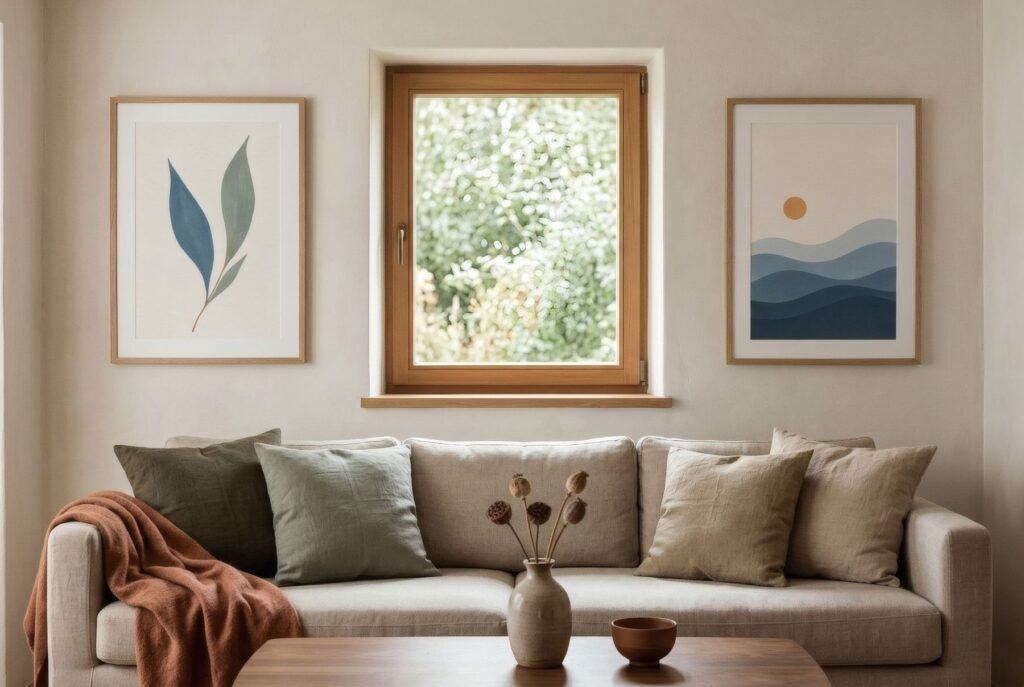
Beside a window. A narrow print that keeps the window company without competing, aligned with its top edge.
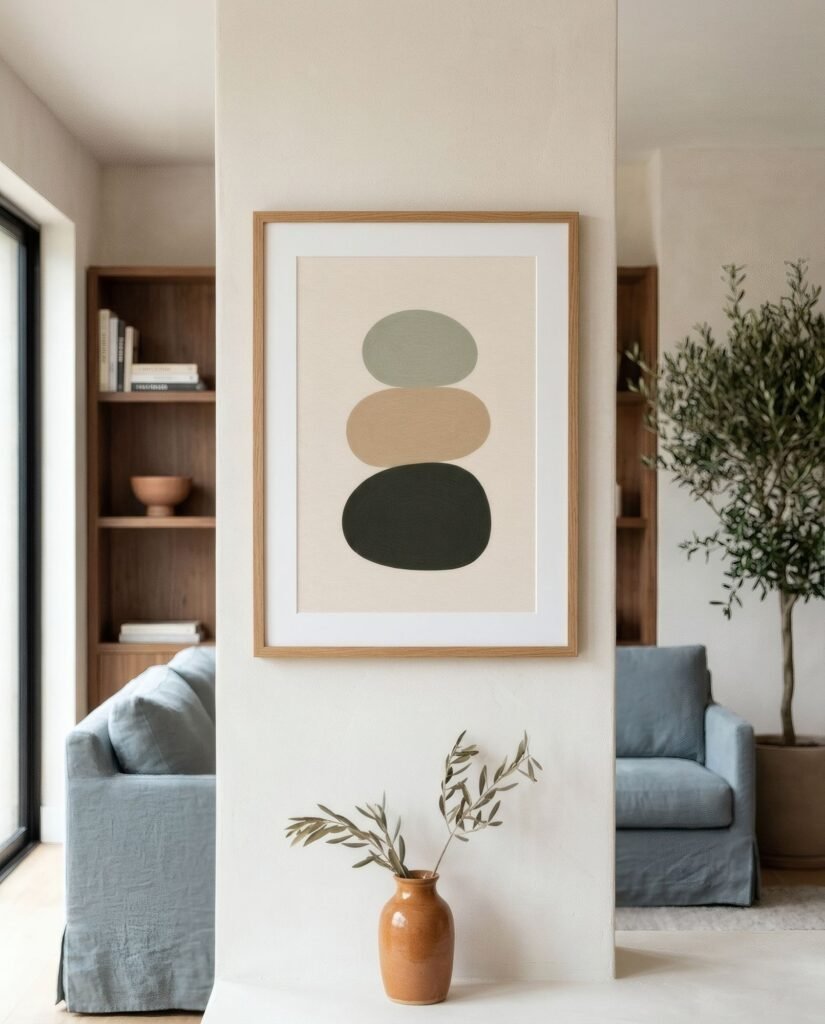
A column in the living room. A single portrait piece, centred on the most visible face, can turn an awkward structural element into a point of interest.
Next to the fridge or in a kitchen corner. Small formats, behind glass and away from heat.
A stair landing. A portrait print you see as you climb, like a small discovery halfway up.
Corners worth discovering
A well-dressed narrow wall has an element of surprise: a small discovery where you expected nothing. With a portrait format, good alignment and a little light, those forgotten corners can become some of the most loved in the house.
If you are looking for prints for narrow walls, Bendíra’s A3 and 30 × 40 cm sizes in portrait suit these spaces especially well, on their own or in a column.
Keep reading: One Large Print or Several Small Prints?, How to Choose Wall Art for a Dining Room and How to Choose the Right Art Print Size.