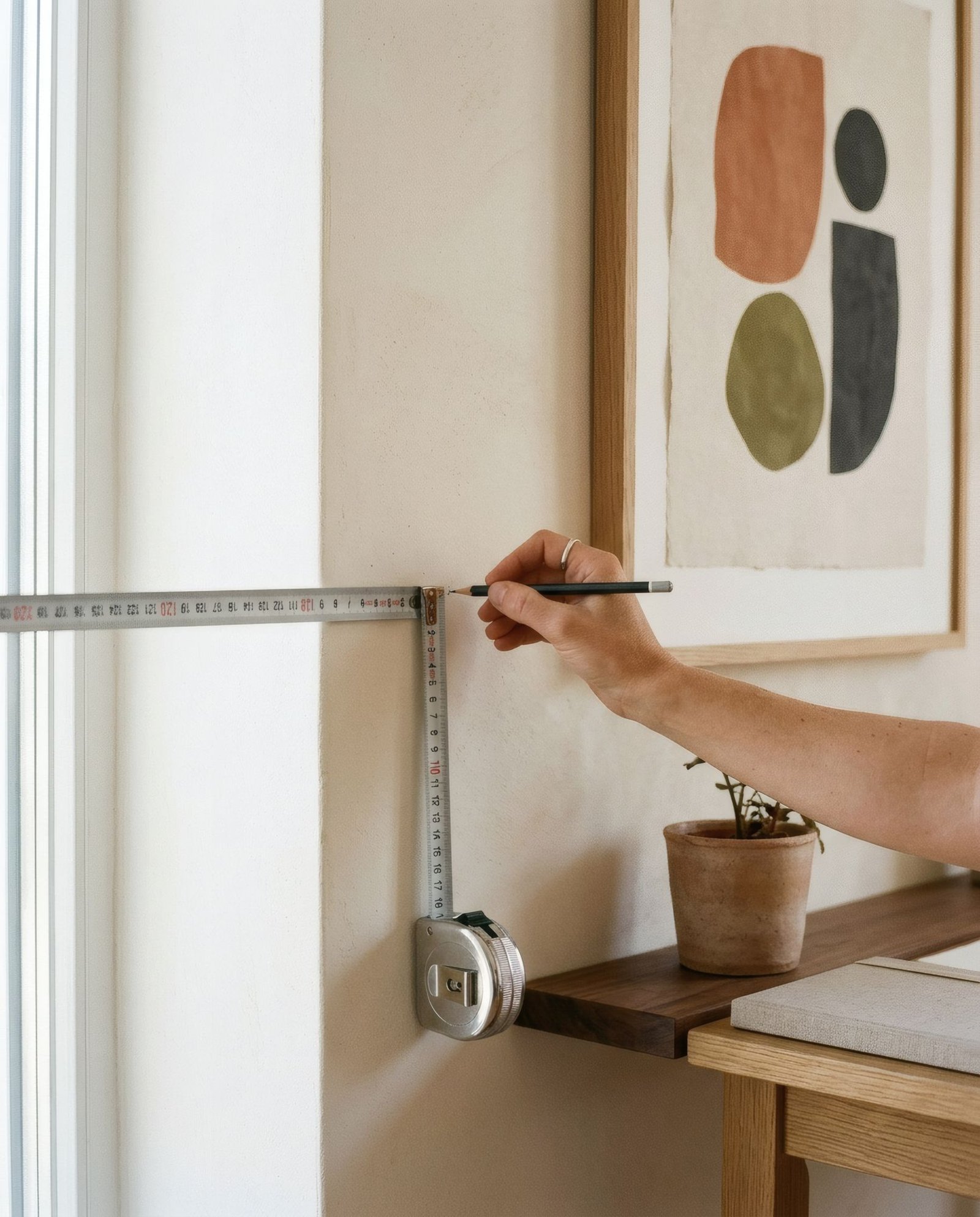
On an open wall, a widely used guide is to hang a picture so its centre sits around 145–155 cm (57–61 in) from the floor, roughly the eye level of a standing adult. Above a sofa, sideboard or bed, leave about 15–25 cm (6–10 in) between the furniture and the bottom of the frame. Treat these as starting points rather than rules. Ceiling height, who uses the room, and whether people are standing or sitting all shift the numbers.
Below are heights for specific situations, and the sum that tells you exactly where the nail goes.
Why measure from the centre
Measure from the top or bottom edge and every picture ends up at a different height, depending on its size. Measuring from the centre lets works of different formats share a single eye line through the house. That is why many museums and galleries work with a fixed centre height, often in the region of 57–60 in, although each institution sets its own.
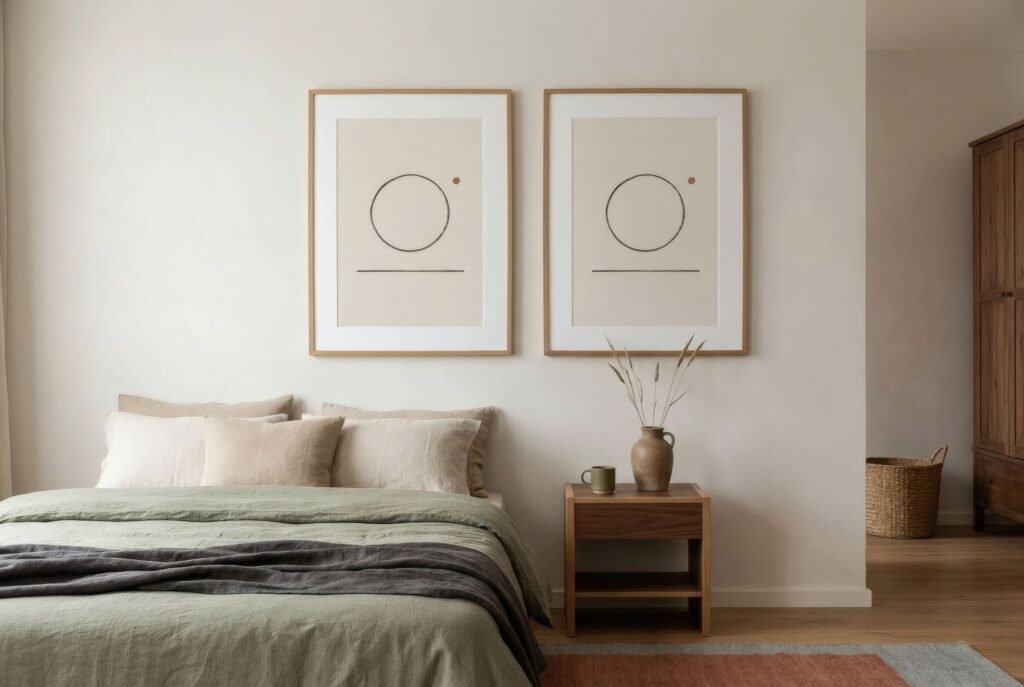
You do not need to be so strict at home, but keeping a consistent centre height across a room creates an order that people sense more than see.
Heights by situation
Open wall, standing: centre at 145–155 cm (57–61 in). Hallways, landings and living room walls without furniture.
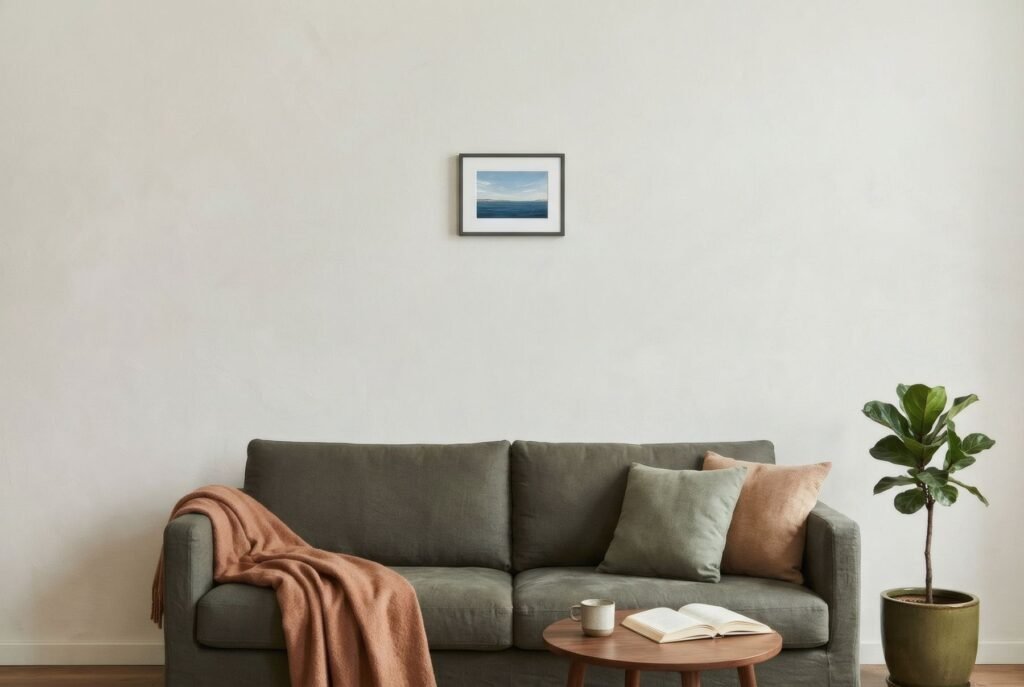
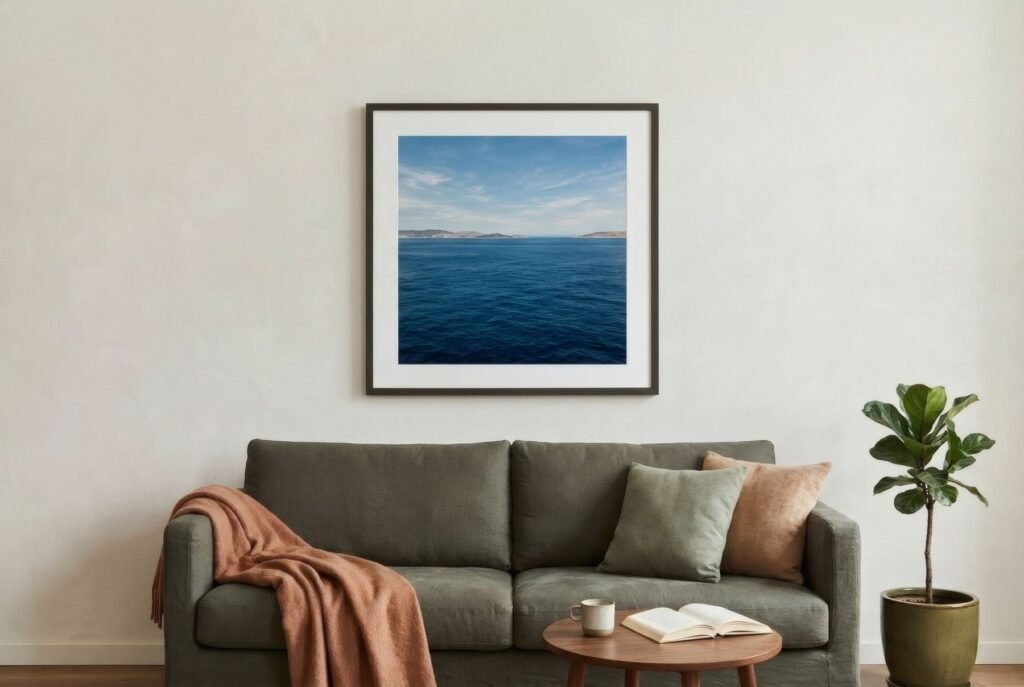
Above a sofa: 15–25 cm (6–10 in) from the top of the backrest to the bottom of the frame. With deep cushions or a low-backed sofa, stay at the upper end so the art does not look sunk.
Above a sideboard or chest of drawers: 15–25 cm (6–10 in) above the surface. If you will stand lamps or tall objects on it, plan for them. The art should either clear them or work with them deliberately.
Above a bed: 20–30 cm (8–12 in) above the headboard, or above the mattress if there is no headboard. Allow a little extra here, because people lean back and sit up.
Dining room: people are seated, so the centre can drop to 130–145 cm (51–57 in). If a table sits against the wall, leave 20–30 cm (8–12 in) above the chair backs.
Stairs: keep the same distance between the centre of each frame and the step beneath it, following the pitch, at around 145–155 cm (57–61 in) measured from the nosing of the step.
Children’s rooms: hang for the people who live there. A centre of around 100–120 cm (39–47 in) brings images to a child’s eye level. Use acrylic glazing and secure fixings.
Home office: if you sit facing the wall, lower the centre to around 120–135 cm (47–53 in) so the art stays in view without craning.
Working out where the nail goes
Once you know the centre height you want:
- Start with your centre height, say 150 cm (59 in).
- Add half the frame’s height. For a 50 cm (20 in) frame, that is 25 cm, so the top edge will sit at 175 cm.
- Subtract the drop to the hanging point. If the hook is 6 cm below the top of the frame, or the wire pulls up to 6 cm below it, you get 169 cm.
The nail goes in at 169 cm (about 66.5 in).
With picture wire, pull it taut upwards with a finger, as the nail would, and measure from there to the top of the frame. With two hooks, do the same calculation and place two nails at the same height, spaced to match the hooks.
High ceilings, low ceilings
- High ceilings (over 2.8 m / 9 ft): the instinct is to hang higher to fill the wall. It rarely works: the art drifts away from the eye and the room feels colder. Keep the centre height and choose a larger format or a taller group instead.
- Low ceilings (under 2.4 m / 8 ft): bring everything down slightly, by about 5 cm (2 in). Landscape formats help keep the wall from feeling compressed.
Groups and gallery walls
Treat the whole group as one artwork. Its overall centre, not the centre of each frame, goes at the reference height. Above furniture, it matters more that the bottom row relates to the piece below, at 15–25 cm, even if that lifts the group’s centre. The full method is in how to create a gallery wall at home.
Signs a picture is too high
- You have to lift your chin to look at it.
- The gap between furniture and frame reads as a separate wall.
- The art relates more to the ceiling or cornice than to anything beneath it.
The opposite problem is rare. When in doubt, go lower.
Before you drill
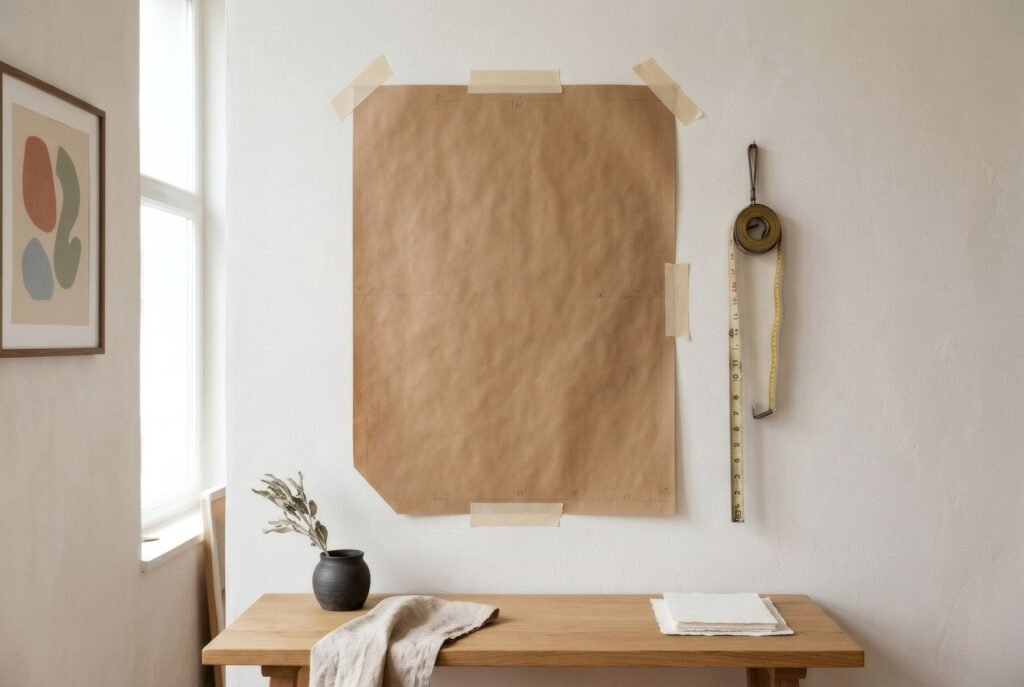
Tape a paper template the size of the frame to the wall, with the nail position marked on it, and leave it for a day. Look at it from where you will actually see the picture: the sofa, the dining chair, the doorway. It is the most reliable way to check that the numbers work in your home.
Once the height is settled, the next decisions are size, palette and frame. If you have reached that point, Bendíra’s prints can be browsed by collection and size, so you can find one that suits the measurement you already have.
Keep reading: How to Choose Wall Art for Your Living Room, Bedroom Wall Art Ideas for a Cosy Space and How to Arrange Art Above a Sofa.