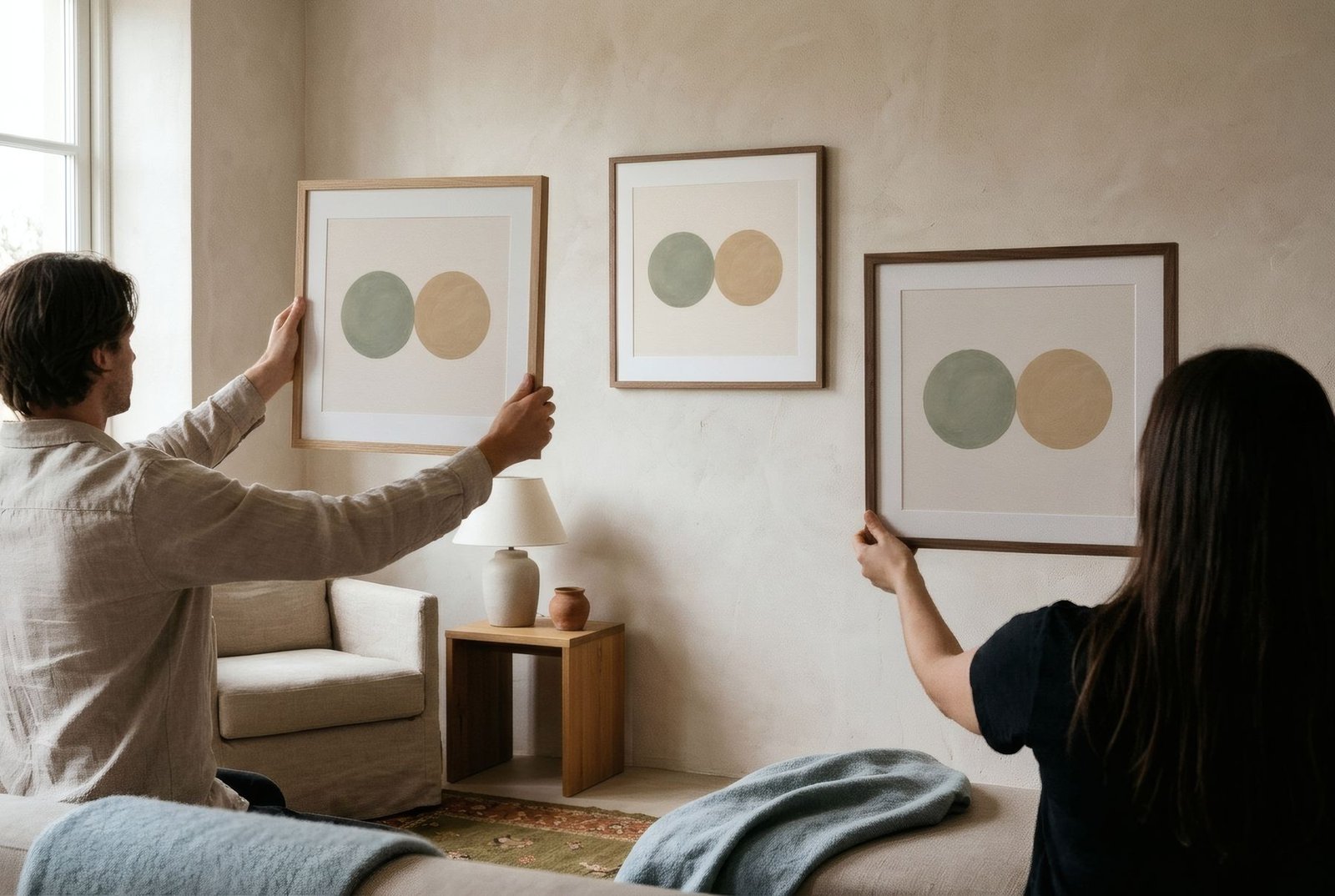
She loves bold, colourful posters; he prefers black-and-white photography. One flatmate arrives with an enormous band print; another can’t bear anything on the walls. The parents want family photos in the sitting room; the teenagers want something else entirely. Sharing a home means sharing walls, and art, being so personal, can become a small source of friction. But it can also be the opposite: a way of building something together, a space where everyone recognises a little of themselves.
Your spaces and shared spaces
The first useful distinction is between each person’s own space and everyone’s space. In your own bedroom, you decide. That’s where the band poster, the postcard collection or the completely bare wall belong. It’s the place for personal expression, and it’s best respected without too much comment.
Shared areas, living room, kitchen, hallway, are different. They’re where everyone spends time, where guests are welcomed, where the feeling of a shared home is built. There, art works best when it comes from agreement.
Start with what everyone likes
Rather than arguing over a particular piece, it often works better to start with what you all share. Some helpful questions: which colours do you all like? What mood do you want the living room to have, calm, cheerful, cosy? Is there a subject you all enjoy, a place, nature, architecture, music?
Tastes that look opposite often have more in common than you’d think. Someone who loves colour and someone who prefers black and white may meet in graphic prints with few colours; someone who likes abstraction and someone who likes figurative work may agree on very pared-back landscapes. We explore this in how to find your art style.
Choose together
A simple idea: look for art together. An evening browsing online shops, a wander round a design market, a gallery visit. Looking at work in company reveals reactions you wouldn’t guess: what makes the other person smile, what bores them. And a piece chosen together feels like everyone’s.
If you can’t agree on a particular piece, try each making a shortlist and looking for overlaps, or take turns: one person picks one wall, someone else the next, with a shared rule such as palette or frame.
A shared rule
When different tastes live together, a common visual rule does a lot to make the whole look coherent. It could be the frame: every piece in the shared spaces in the same type of frame, however different the images. It could be the palette: varied works sharing two or three colours. Or it could be the mount: all with a generous white mount, which unifies. We discuss this in mixing metal and wooden frames.
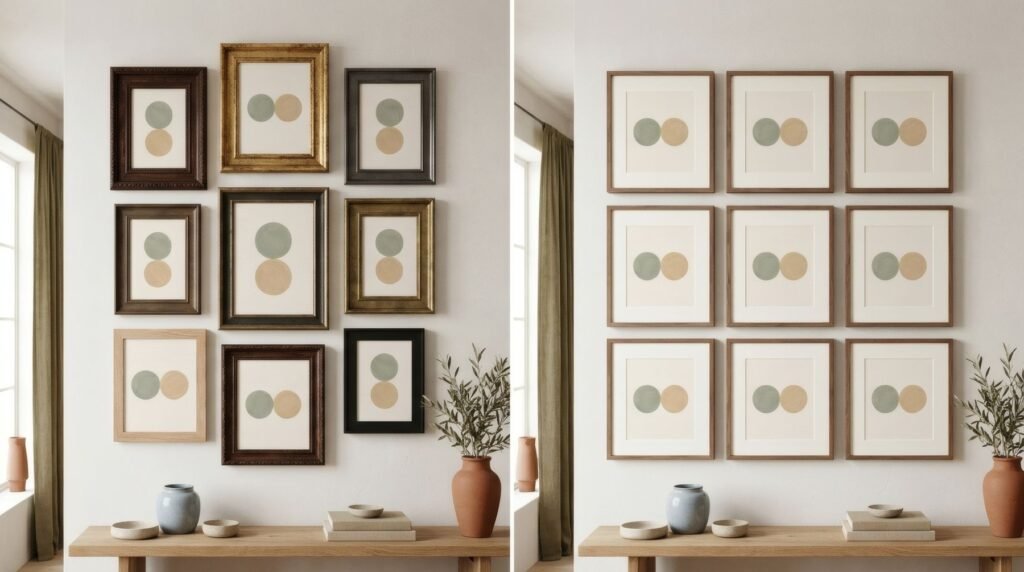
With a shared rule, an abstract print and a black-and-white photograph can sit on the same wall without it looking like a battle.
Gallery walls as neutral ground
A gallery wall is a very useful answer for shared homes, because it takes pieces from different people without any one dominating. Everyone can contribute one or two, and the whole becomes a collective portrait of the household. It’s also easy to change: if someone moves out, they take their pieces and someone else adds theirs. We develop this in building a gallery wall that evolves over time.
When someone moves out
In flatshares, people come and go. It’s worth being clear from the start whose each piece is, especially if you buy jointly. A simple conversation, «this one’s yours, this one’s mine, this one we bought together and we’ll toss for it if we part ways», avoids misunderstandings later. Couples have this conversation less often, but it can still be a nice way to value what each person brings.
A home with several voices
A shared home with well-chosen art isn’t anybody’s home in particular, but everyone’s. Different tastes needn’t be a problem: they can be a richness, if there’s room for the personal, agreement on the shared, and a rule that helps it all get along.
If you’re looking for common ground, prints from a single Bendíra collection, with their shared palette, can make a good foundation for the shared spaces.
Keep reading: Symmetrical vs Asymmetrical Gallery Walls and How to Create a Gallery Wall at Home.