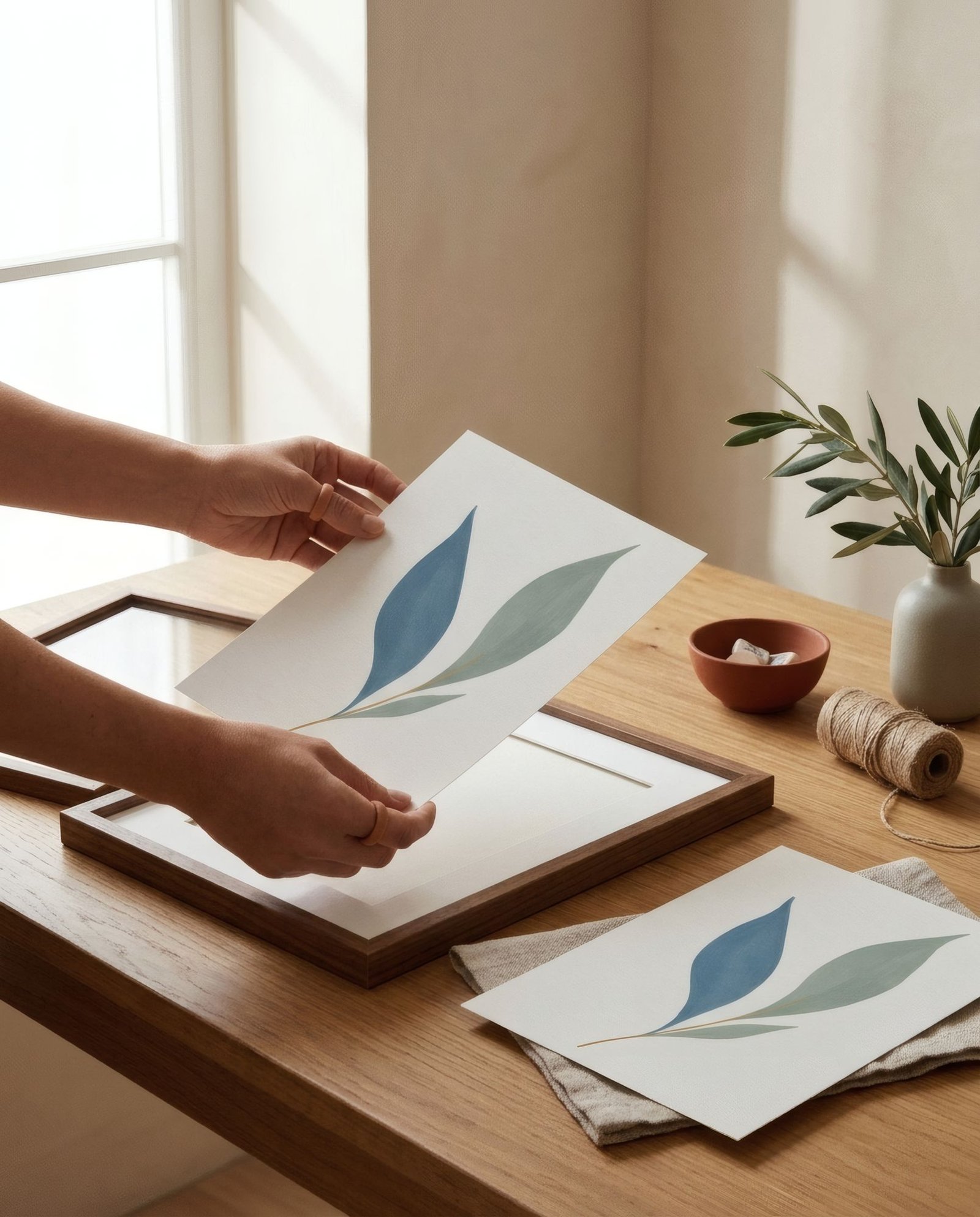
The gallery walls we love most were almost never made in a day. They’re the ones that grew: a print bought on holiday, a friend’s drawing, a photo from an important moment, a poster found at a flea market. Each piece arrived in its own time, and together they tell a story. But for a wall to grow like that without turning to chaos, or without taking everything down whenever something new arrives, it helps to think of it from the start as something living. Not a finished composition, but a structure that welcomes change.
Think structure, not final layout
The difference between a fixed gallery wall and an evolving one lies in how it’s planned. With a fixed wall, you decide in advance which pieces go where, at what size, in exactly which position. With an evolving one, you decide first on a structure, a set of rules, and pieces slot into it over time.
That structure can take a few forms, depending on the look you like.
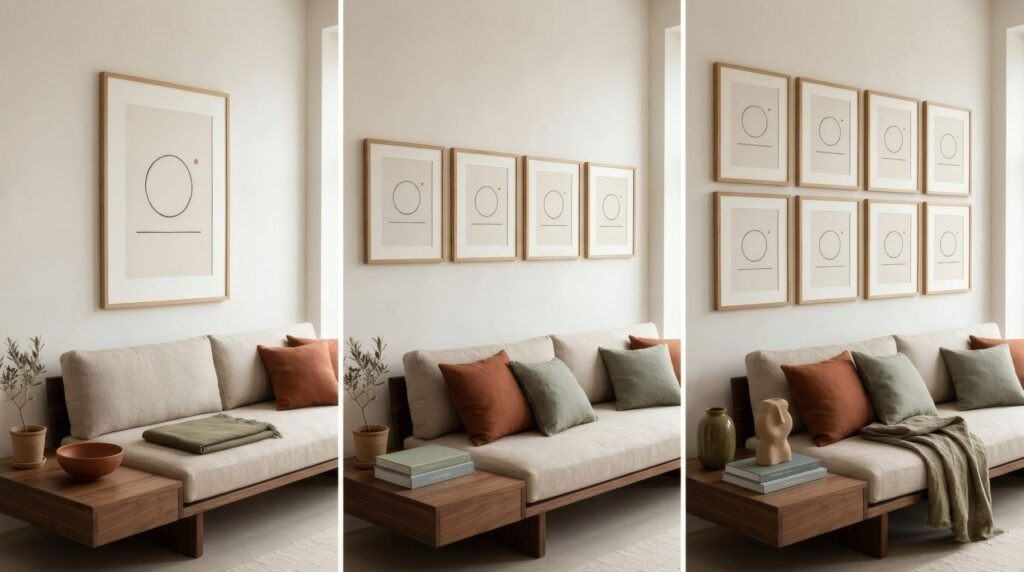
A baseline. Every piece aligned along its bottom edge at the same height, say 20 cm (8 in) above the sofa back. Each new piece joins at one end, keeping the line. It’s the simplest structure and the easiest to extend.
A central axis. Pieces arranged around an imaginary horizontal line at eye level, some above it, some below. The wall grows sideways, upwards and downwards in balance.
A grid. A matrix of equal-sized slots, filled one by one. Ideal if you like ordered, symmetrical arrangements, as we discuss in symmetrical vs asymmetrical gallery walls.
Start with the anchor
On an evolving wall, it’s best to begin with an anchor: the largest or most important piece, which gives the group its centre of gravity. It goes up first, in a position that leaves room to grow around it, usually a little off-centre in a freeform arrangement or dead centre in a symmetrical one.
From there, new pieces join following the chosen rule and a consistent gap, 5–8 cm (2–3 in) usually works well. The gap does more than anything else to keep the wall coherent, even when the pieces arrive years apart.
A thread for what’s to come
Since you don’t know which pieces will arrive, it helps to have a common thread that guarantees coherence. It might be the frame: choose one type, slim black or natural oak, say, and use it for every future piece. It might be the mount: all with white mounts. Or it might be a broad palette: pieces sharing, at least in part, certain tones. There’s more in mixing metal and wooden frames.
Make it easy to change
An evolving wall will see holes, repositioning and change. A few tricks make that easier.
Standard frame sizes. If all your pieces fit common frame sizes, you can swap works within the same frames without touching the wall. A 30 × 40 frame can hold one print today and another tomorrow.
Ledges. One or two picture ledges let you add, remove and layer pieces without new holes. They’re the most flexible way to keep a gallery alive. We cover this in how to lean art on ledges and furniture.
Paper templates. Before hanging a new piece, cut its outline from paper and try it on the wall. You’ll see whether it fits without drilling.
Filler to hand. Holes left by repositioning disappear easily with a little filler and a dab of paint.
When life changes
An evolving wall can shrink too. There are times when you want less: a move, a new chapter, a need for calm. Taking pieces down, leaving more air, putting some away for later, is also part of the evolution. And when you move, the structure can be recreated on a new wall, adapted to fit.
A story in progress
A wall that evolves with you is, in a way, a visual diary. It’s never finished, and that’s the beauty of it. With a clear structure, a common thread and a few practical tricks, it can grow for years without losing its harmony.
Bendíra prints fit standard frame sizes, which makes it easy to swap them within a gallery wall as it grows.
Keep reading: How to Create a Gallery Wall at Home and Moving Art Around: A Simple Way to See Differently.