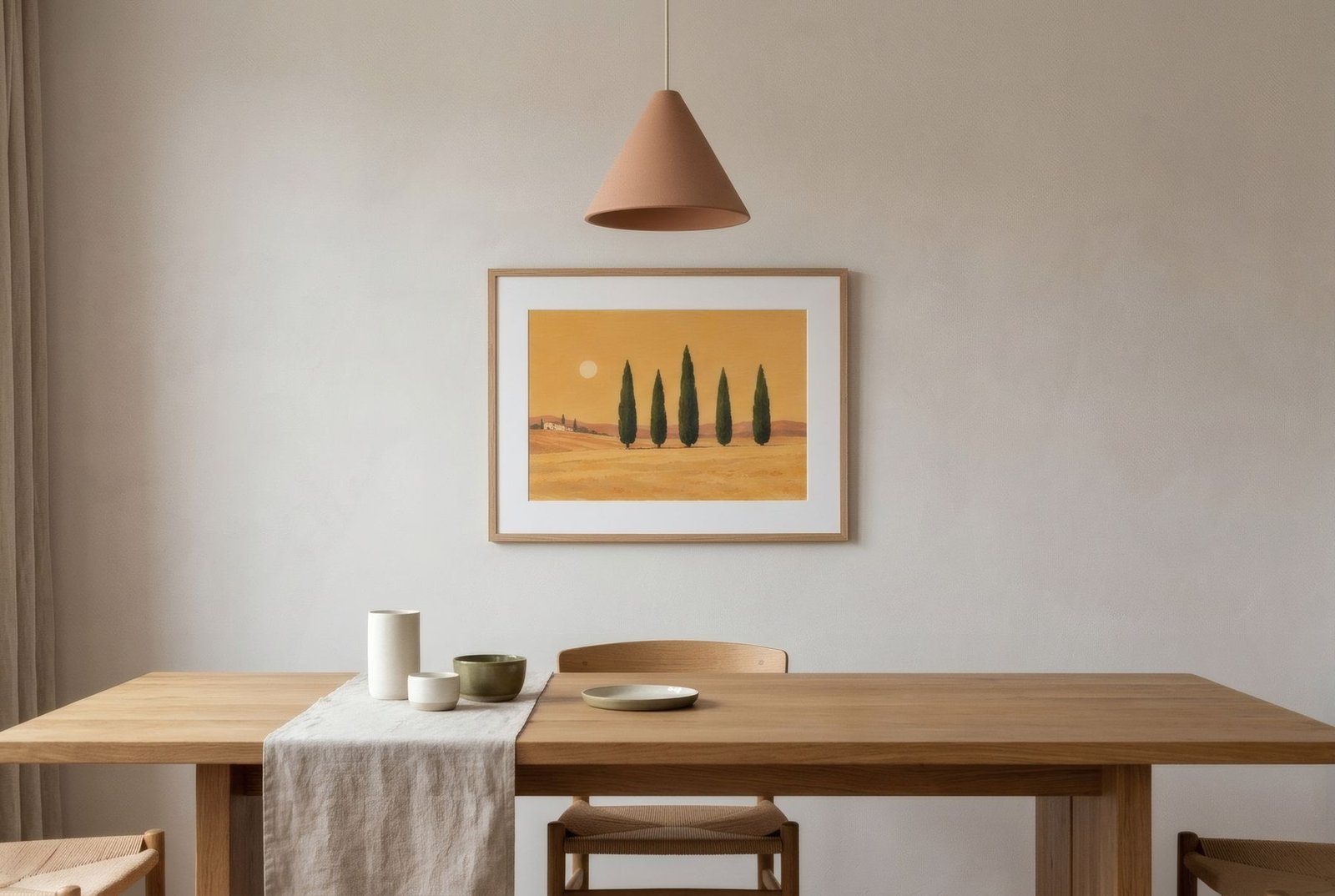
The dining room has a rhythm all its own. It is used at particular moments, such as meals, long dinners with friends and Sunday breakfasts, and almost always seated, close to the walls. That changes how art is seen. What in a living room is viewed standing or from the sofa is, here, looked at from the eye level of someone sitting, a metre or two away, during a conversation that may stretch for hours. Choosing dining room wall art means taking that gaze into account, relating the art to the table, pendant light and sideboard, and choosing images that keep the meal company without getting in its way.
The table as reference
In the dining room, the table leads, even when it is not against a wall. If it is, the art should relate to it: as a guide, a work or group spanning half to two-thirds of its width looks balanced. Above a 180 cm (71 in) table, that means a piece 90–120 cm (35–47 in) wide. Art wider than the table tends to look as if it spills over it.
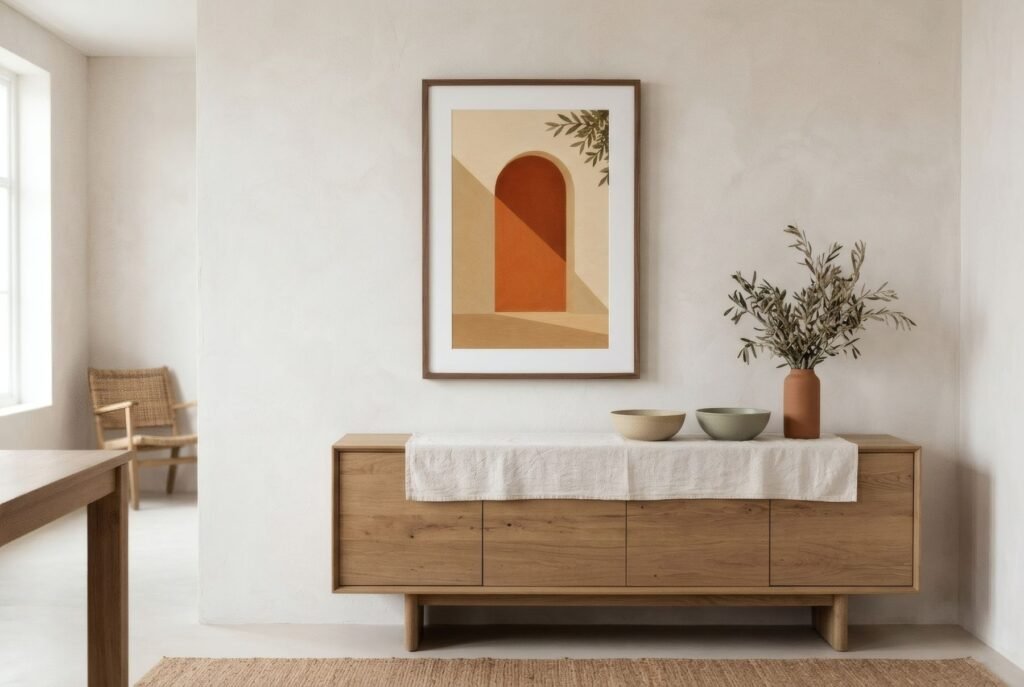
If the table sits in the middle of the room, the reference becomes the wall and whatever furniture stands against it, usually a sideboard. Then the art relates to the sideboard as it would to a sofa: centred, about 15–25 cm (6–10 in) above its surface.
Height, for people who are seated
This is the biggest difference from the rest of the home. In a dining room people look while seated, so the usual centre height of 145–155 cm (57–61 in) can feel high. Lower it to around 130–145 cm (51–57 in), so the image sits at the eye level of those at the table.
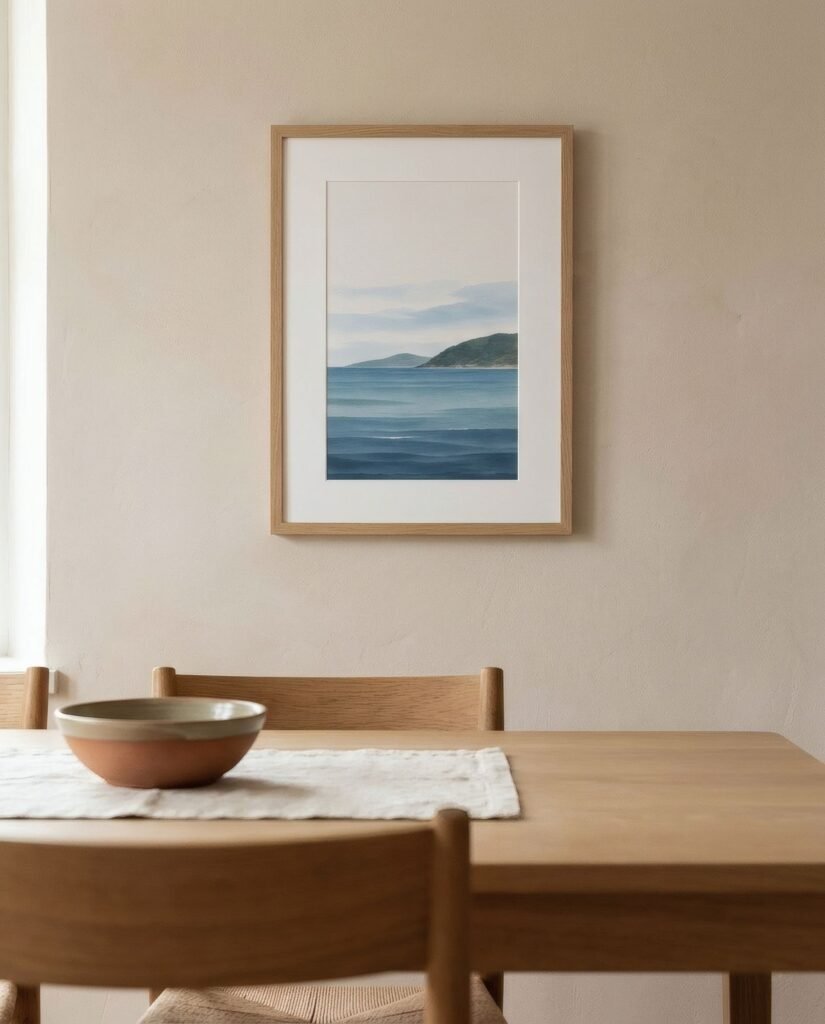
If the table is against the wall, the practical reference is the chair backs: leave 20–30 cm (8–12 in) between the top of the chairs and the bottom of the frame, so nobody knocks the picture leaning back. More in how high should you hang pictures?.
The pendant and symmetry
In many dining rooms, the pendant light above the table sets a strong axis. If the art is on the end wall or behind one of the long sides, aligning it with that axis reinforces the sense of order. A piece centred on the pendant, or a symmetrical pair either side, fits naturally.
For a more relaxed feel, you can break that symmetry on purpose with an off-centre piece or an asymmetric group, provided the result looks intended.
What can be seen from the table
Before deciding where to hang the art, sit in the different chairs and look. Which wall does each person see? Often the best position is the one facing most diners, or the wall seen from the seat you use most. Check, too, that the work is not directly behind someone, so that everyone else sees it as a backdrop to their head all evening.
Which images
People talk, eat and sit for hours in a dining room, so choose works that keep them company without tiring. Images that invite calm or conversation work very well: wide landscapes, warm abstracts, still lifes, botanicals, architectural photography. So do works with detail, since they are seen close up and for a long time.
A note: food prints of fruit, bottles or cutlery are a dining room classic, and can be lovely if they are good works. But dining room art need not be about food. Often a work with nothing to do with the table is more interesting.
Colour and light
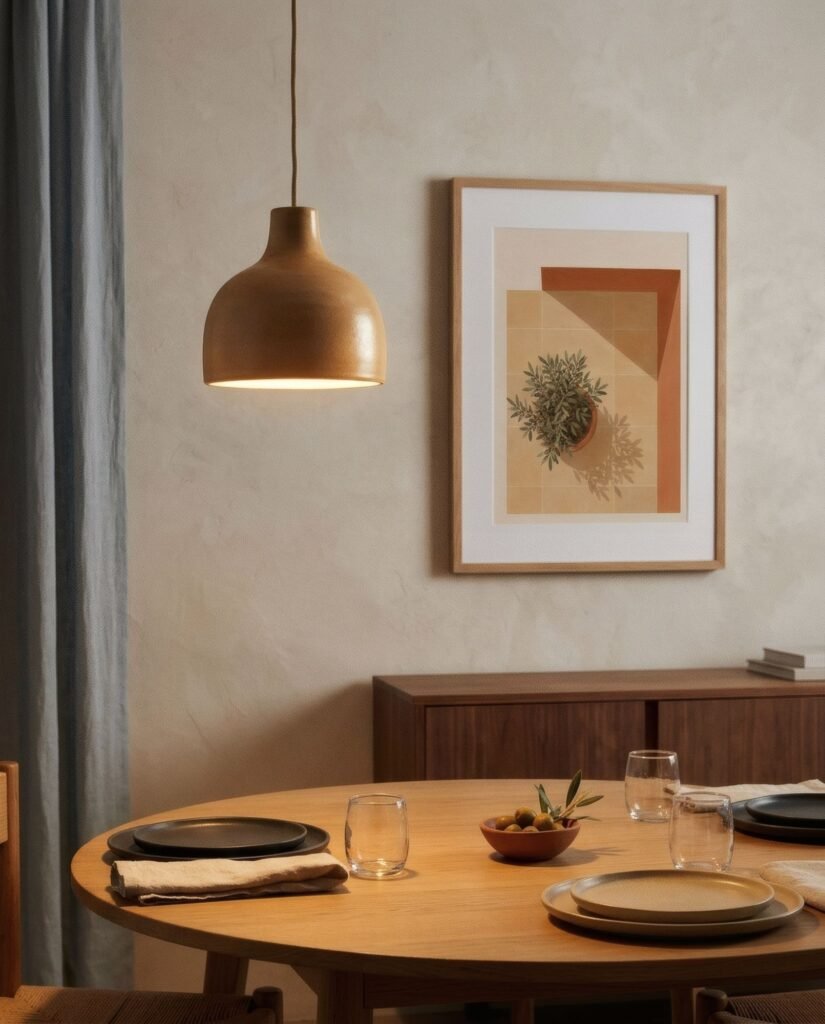
Dining rooms are often used under artificial light, in the evening. Look at the work with the dining light on before deciding: warm colours such as ochres, terracottas and mustards tend to glow under it, while some blues and greys can turn flat.
If the pendant hangs low over the table, watch for reflections in the glass. Anti-reflective glazing or matt acrylic can help.
Caring for art in the dining room
Dining rooms are close to kitchens and sometimes share space with them. Steam and grease can affect a print over time, so frame it behind glass and keep it away from the cooking area. And if there are children, acrylic is wiser than glass for pieces near the table.
Open-plan dining
In many homes, the dining area is part of an open-plan space with the living room or kitchen. Here, art can help define the dining zone: a work or pair on the wall nearest the table, with a palette that converses with the living area but has its own character. We explore this in using wall art to connect open-plan rooms.
A dining room to linger in
A good dining room artwork does not compete with the table or the conversation; it keeps them company. Hung at the eye level of people seated, related to the table and pendant, and chosen to be looked at calmly, it may make long lunches linger a little longer.
If you are looking for a dining room piece, Bendíra’s earth-toned collections, such as Southern light, gain warmth in evening light and sit beautifully above wooden tables.
Keep reading: How to Decorate a Narrow Wall with Prints, Home Office Wall Art That Helps a Space Feel Considered and How to Pair Wall Art with Wooden Furniture.