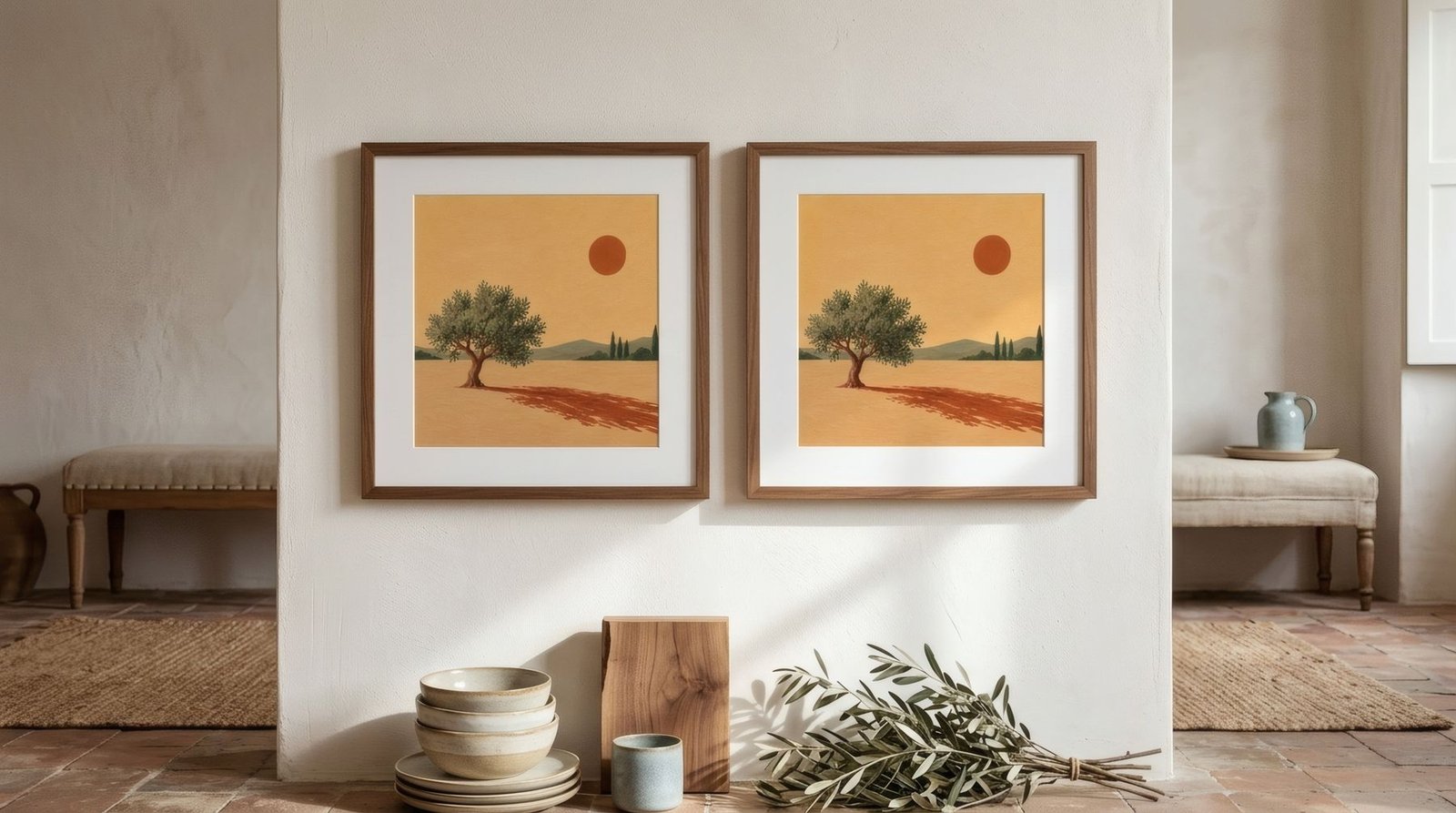
Every era has its forms. Ours are hard to sum up, because so many coexist: minimalism and craft, the digital and the handmade, nostalgia for the past and the rush towards the new. Amid that crowd, every studio, every designer, everyone who makes something has to find their own place. At Bendíra we have looked for ours in a fairly simple idea: contemporary design that keeps its warmth, grows from light and materials, and leaves room to breathe. This piece tries to explain that way of seeing, and to acknowledge the traditions we learn from.
Simplicity, with warmth
We admire the clarity of good modern design, its ability to say a great deal with very little. But we also know simplicity pushed too far can turn cold or remote. So we look for a warm simplicity: forms reduced to essentials, yes, but with soft edges, colours that come from the earth and a slight imperfection that reminds you a hand was involved.
An arch, a circle, a horizon line, a leaf. These are forms anyone recognises and that, at the same time, allow endless variation. We are drawn to them because they are universal and because, well composed, they convey calm without boredom.
Light as a starting point
Many of our works begin with a light. A long afternoon on a limewashed wall, a low sun over an olive grove, mist on the sea first thing. We do not try to depict those moments literally, but to capture their atmosphere: their temperature, colours and rhythm.
That is why our palettes move between fired clay, sand, ochre, olive and sage on one side, the blues of water and sky on the other, with bone and charcoal as counterpoint. These are colours found in many parts of Europe, from the Mediterranean to the Atlantic, and they converse easily with the natural materials of a home.
Space as part of the work
If we had to name one trait that defines how we design, it might be space. We like our compositions to breathe, with emptiness around the forms and a place for the eye to rest. That space is not a gap; it is part of the work, as we explain in the power of negative space in art.
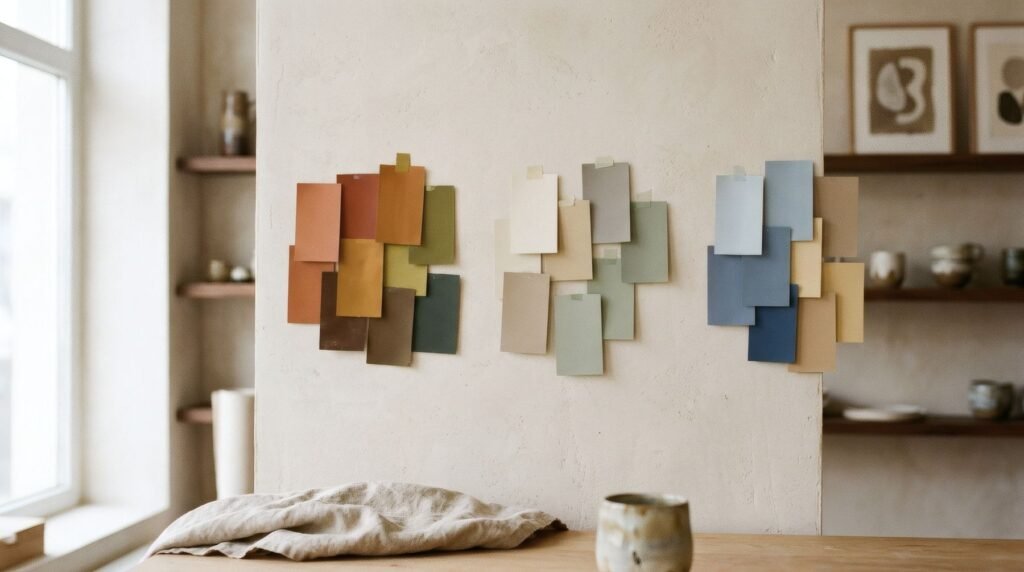
At a time of visual overload, we believe a calm image has special value. It does not compete for attention; it receives it when it comes.
The traditions we learn from
No design comes from nowhere, and it seems honest to acknowledge the traditions that inspire us, without claiming to belong to them.
We learn from modern geometry, from the Bauhaus and twentieth-century abstraction, with their faith in basic forms and balanced composition. We learn from mid-century design, its optimism and its way of combining the organic with the geometric. We learn from Mediterranean architecture, its arches, its lime and its relationship with light. And we learn from Nordic and Japanese calm, their respect for emptiness and for materials.
These are broad references, European and beyond, belonging to no single country or era. We take them as sources of learning, not styles to copy.
Contemporary, not fleeting
We want our works to be of today, but not only of today: at home in a contemporary house without depending on a trend that will pass in a season. So we avoid flashy effects, seasonal palettes and compositions chasing instant impact. We prefer images that reveal themselves over time and can keep a home company for years.
Design for daily life
In the end, our perspective on contemporary design is above all a perspective on domestic life. We design with real walls in mind: living rooms where people talk, bedrooms where they rest, hallways walked every day. We care less about a moment’s applause than about many years of companionship.
If this way of thinking about design feels close to your own, we invite you to see it in our collections, where each work tries, in its own way, to put these ideas into practice.
Keep reading: The Value of Objects Made to Last, Accessible Art Without Compromising on Quality and Bauhaus: Its History and Influence on Modern Design.