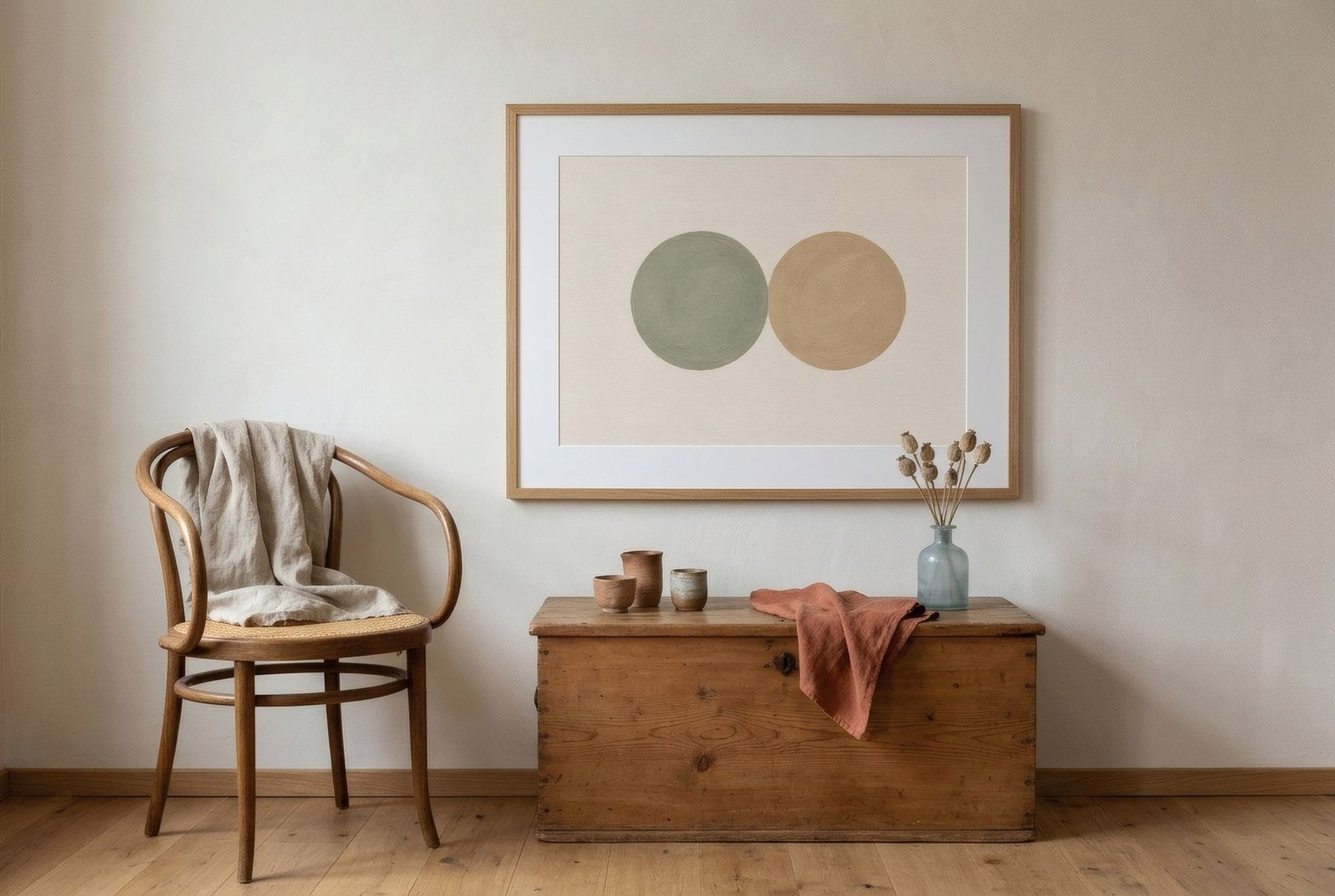
Some furniture arrives with a story attached. The chest of drawers you found at a car boot sale one Sunday morning, the chairs from a grandparent’s house that nobody else wanted, the 1970s table a neighbour left out on the pavement, the sideboard bought online from someone moving abroad. Second-hand furniture gives a home something that’s hard to get any other way: layers of time. And when it comes to choosing art for those walls, an interesting question comes up: should the art belong to the same era as the furniture?
The era doesn’t have to match
The short answer is no. A home full of mid-century furniture doesn’t need 1950s posters; one with a Victorian chest doesn’t need nineteenth-century engravings. When everything comes from the same period, the home starts to look like a set, a reconstruction, a period room in a museum. It can be beautiful, but it rarely feels lived in.
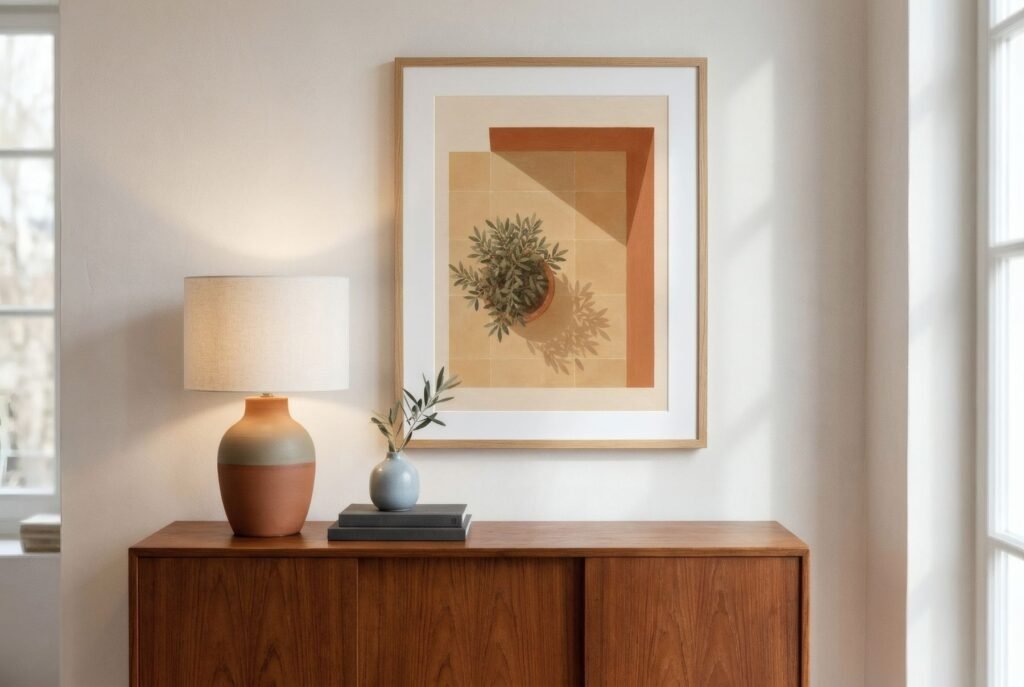
The most interesting homes with second-hand furniture mix eras. A 1960s teak sideboard with a contemporary print above it. A bentwood chair beside an abstract. An old pine wardrobe with a recent photograph. The contrast in time is exactly what makes each piece look better: the old furniture feels more special next to something new, and the new art gains depth beside something with a past.
Look for conversation, not copying
If the art needn’t be from the same period, it does help if it talks to the furniture. That conversation can come from a few places.
Colour. Aged wood has very particular tones: the honey of old pine, the red of mahogany, the warm brown of walnut, the gold of teak. Art that picks up one of those tones, or complements it, makes an immediate link. Earthy palettes, terracotta, ochre, olive, tend to sit beautifully with old wood.
Shape. Mid-century furniture has clean lines, soft curves, slender legs. Organic forms or modern geometric abstraction talk to that era without imitating it. Older pieces with mouldings and carving get on well with simple art that leaves them the limelight.
Spirit. A rustic piece and a calm print share stillness; a bold design classic and a graphic print share daring.
Steer clear of the theme
The most common risk with vintage furniture is drifting into theme: surrounding the 1970s sideboard with sunburst clocks, reproduction retro posters and lava lamps until the living room looks like the set of a period drama. Each object has charm on its own; together, they become fancy dress.
A simple way to avoid it is to keep a balance: if the furniture is second-hand, let the art, textiles or lighting be contemporary, or vice versa. Layers of time show best when they’re different.
The frame as a bridge
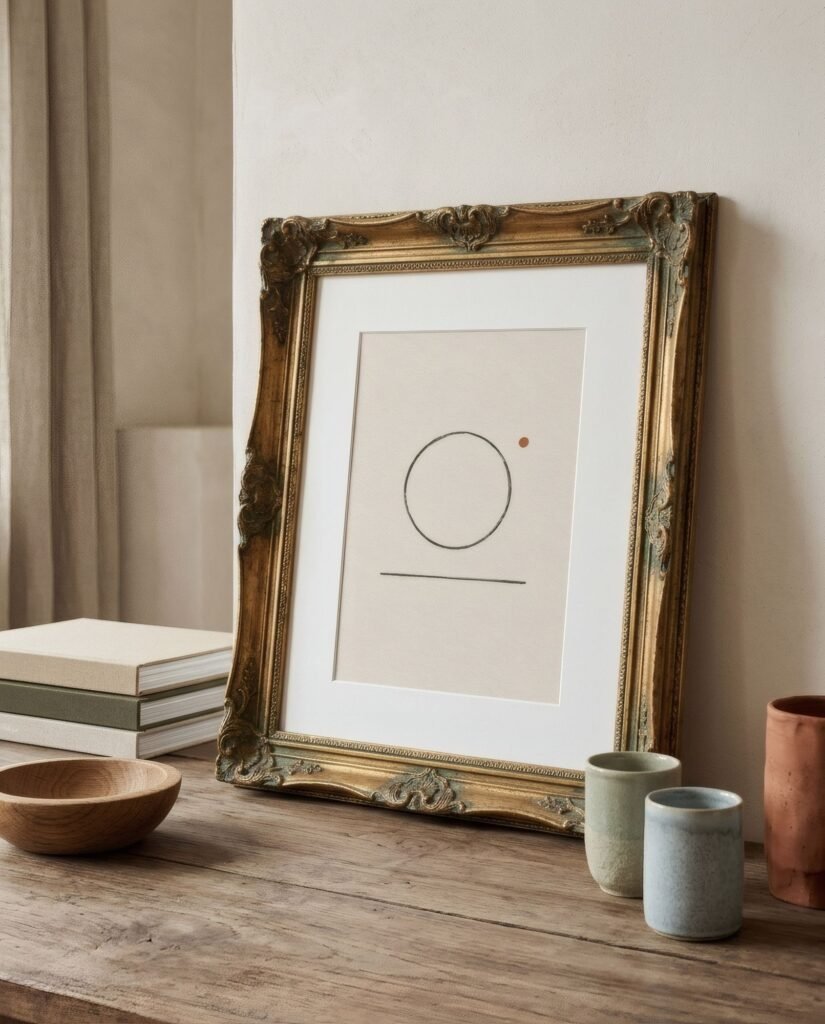
A frame can bridge art and furniture. A wooden frame in a tone close to the furniture connects the two. An old frame picked up at another flea market, with a contemporary print inside, is one of the loveliest combinations there is: old and new in a single object. Do check that the backing is in good condition, though, so it doesn’t pass dust or acidity on to the new paper. There’s more in mixing metal and wooden frames.
A home that gathers over time
Homes with second-hand furniture have a quality no shop can sell: they look as if they’ve come together slowly. Art can join that story as another layer, not the last, just the most recent. With a conversation of colour, shape or spirit, and no fear of mixing eras, the home gains something only time gives: depth. We explore this across styles in interior styles and art.
The terracotta and olive prints of Southern light tend to feel very much at home above old wood in warm tones.
Keep reading: Mixing Abstract Art with Vintage Interiors, Modern Mediterranean Interiors and Wall Art and Building a Gallery Wall That Evolves Over Time.