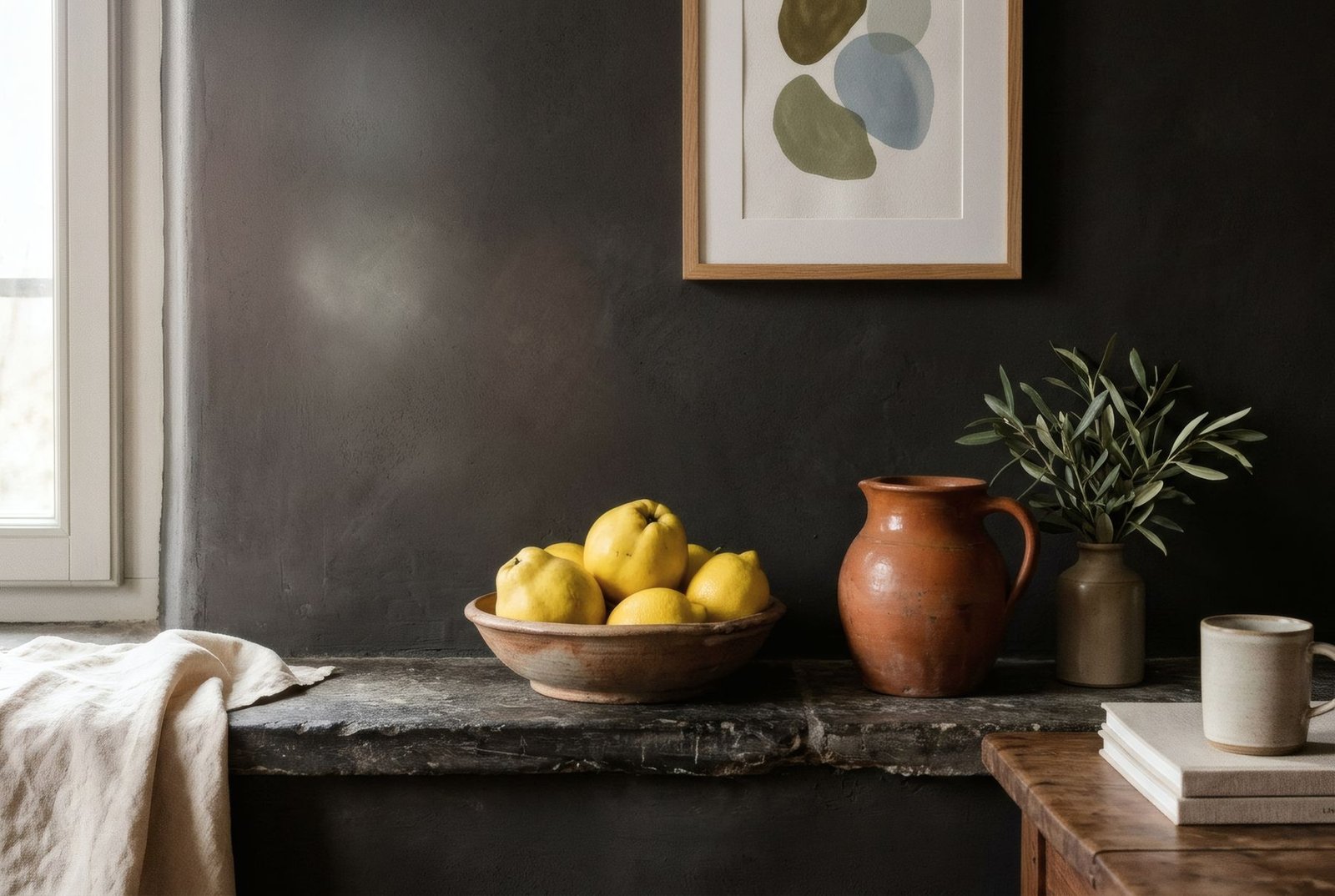
A quince hanging from a string. A cabbage suspended in the half-light. A cut melon, a cucumber balanced on the edge of a stone ledge. Few images are as humble as these, and few as haunting. More than four centuries ago in Toledo, a painter named Juan Sánchez Cotán painted scenes like this with a stillness so intense that they still seem to stop time. The still life looks like the most modest of genres: everyday objects, no people, no story. Yet it has proved one of the most resilient, reinventing itself again and again, all the way to contemporary photography.
A genre of things
A still life depicts inanimate objects: fruit, vegetables, flowers, game, vessels, books, instruments. The Spanish word, bodegón, comes from bodega, the place where food was stored; other languages call it «dead nature» or, like English, «still life».
There are precedents in antiquity, but the still life became an independent genre in Europe in the late sixteenth and seventeenth centuries, especially in the Low Countries and in Spain.
The Spanish tradition
The Spanish Golden Age still life has a character all its own: austere, silent, almost mystical. In the early seventeenth century, Sánchez Cotán set a few foods within a dark stone frame, lit by an intense side light, in an almost geometric order. A few decades later, Francisco de Zurbarán painted still lifes of extraordinary simplicity: a few vessels lined up on a table, lemons on a plate, in a light that makes each object seem almost sacred.
Against the abundance of Flemish and Dutch still lifes, crowded with delicacies, glassware and wealth, the Spanish still life chose restraint. And it’s that restraint that has influenced later art the most.
Vanitas and abundance
In the seventeenth-century Netherlands, the still life went other ways. Still lifes of abundance showed tables overflowing with food, silver and glass, a celebration of prosperity. And vanitas pictures added skulls, guttering candles, clocks or wilting flowers, reminders that life is short and pleasures fleeting. Many still lifes, even the most festive, had that double layer: celebrating the material while recalling its fragility.
The twentieth century: form and silence
In modern art, the still life became a laboratory. Cézanne used apples and jugs to rethink form and space. The Cubists took apart guitars, bottles and newspapers on the table. And the Italian Giorgio Morandi spent much of his life painting the same bottles, jugs and boxes over and over, in the subtlest variations of tone and light, turning still life into meditation.
Contemporary photography
Photography took up the still life almost from its invention, because motionless objects suited the long exposures of the early days. Today the genre is flourishing, in art photography as well as advertising and editorial work.
One interesting example is the German photographer Wolfgang Tillmans, who has worked with still life using everyday things: leftovers, flowers on a windowsill, fruit on a table. According to the Metropolitan Museum of Art, in the mid-1990s Tillmans went deeper into the genre and sought out the paintings of Zurbarán and Caravaggio. The Banco de España collection holds a work of his from 2001, New L.A. Still Life, which the collection itself links to the Spanish Baroque still-life tradition. Four centuries on, the stillness of Sánchez Cotán and Zurbarán is still inspiring artists.
Why it works at home
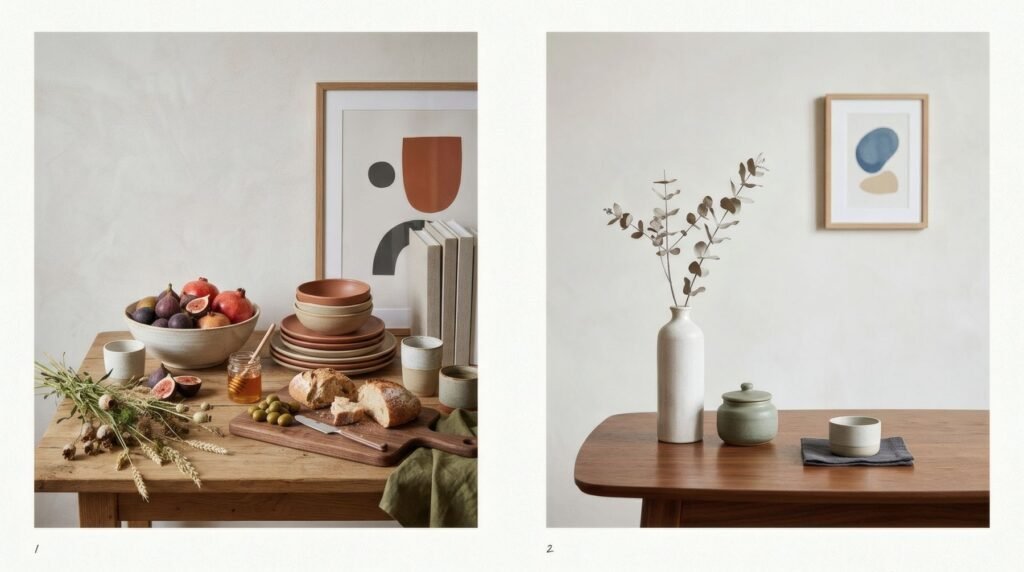
The still life has a quality that makes it particularly suited to the home: it speaks of the everyday. Fruit, flowers, vessels, tables: the things that surround us in our own kitchens. A still-life print in a kitchen or dining room talks to what happens there; in a living room, it brings a note of calm and attention to small things.
Its language, too, the side light, the restrained composition, the reduced palette, fits beautifully with calm interiors. And it lends itself to real-life arrangements: a still-life print above a sideboard with a few ceramics creates a play of mirrors between image and objects, as we describe in styling art prints with decorative ceramics.
The beauty of stillness
The still life teaches us to look at what we usually don’t: a lemon, a jug, light on a table. From seventeenth-century Toledo to today’s photography, the genre keeps proposing the same thing: pause. We look more widely at photography in photography as art at home.
To see the Spanish still-life tradition, the Museo del Prado in Madrid holds works by Zurbarán, Sánchez Cotán and other masters of the genre; in London, the National Gallery also has Spanish still lifes in its collection VERIFY.
Keep reading: Kitchen Wall Art: Placement and Practical Considerations and Shadows as a Compositional Element in Photography.