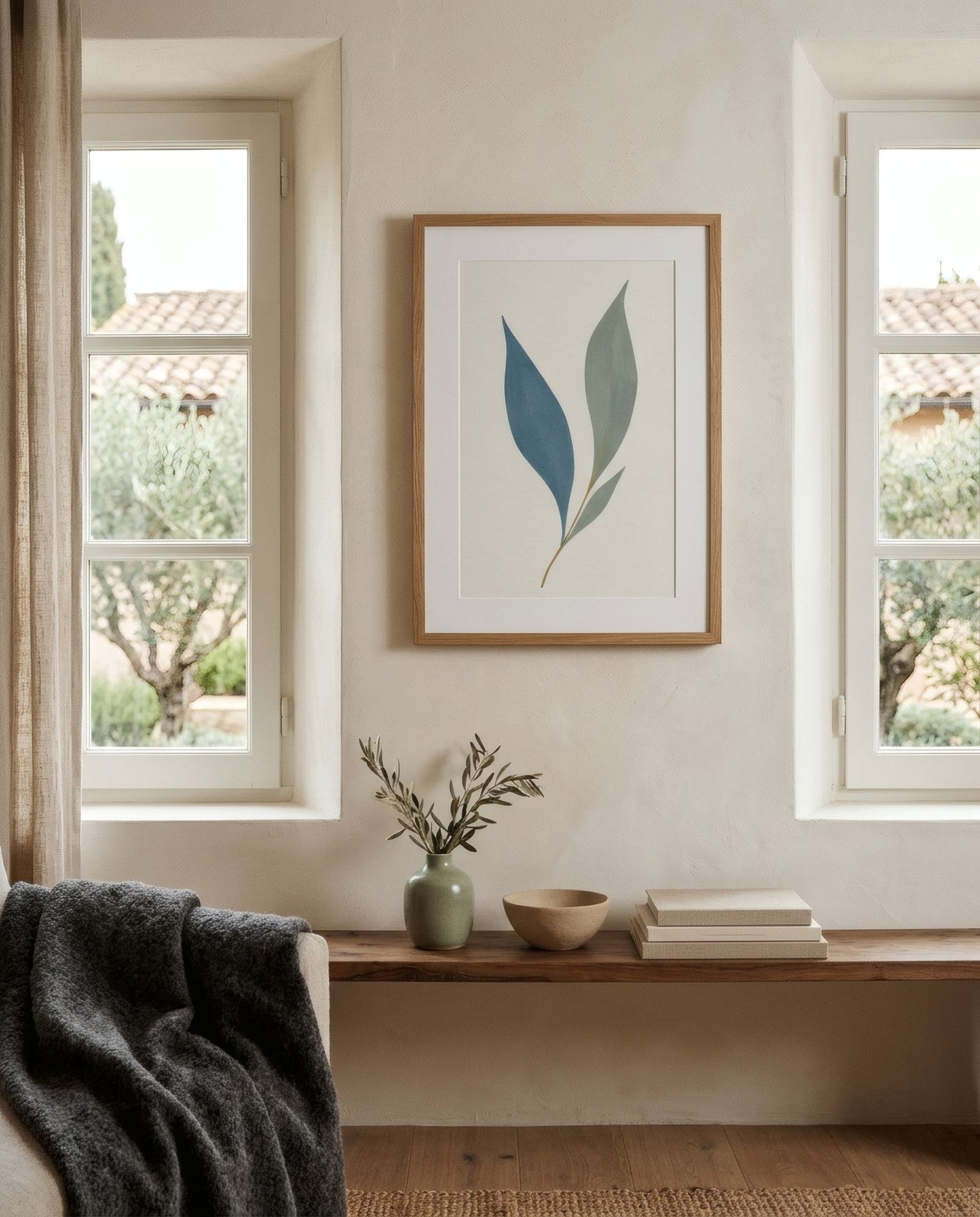
Few things are as disconcerting, when buying a print, as opening the parcel to find it’s landscape when you’d pictured it portrait. The measurements were right, «50 × 70 cm», but in your head the image was turned the other way. And the same area of paper, hung upright or on its side, changes a wall completely. Orientation sounds like a technicality, but it’s one of the most important decisions in choosing art: it shapes how a piece relates to the furniture, the ceiling and your eye.
Portrait, landscape and square
Printing commonly uses three terms. Portrait is taller than it is wide. Landscape is wider than it is tall. The names come from painting: portraits were usually painted upright, following the shape of a standing figure, and landscapes on their side, following the horizon. And square, with equal sides.
Bear in mind that these words describe shape, not subject. A landscape can be in portrait format, and a portrait in landscape.
Reading the measurements
Here’s the source of a lot of confusion. A print’s size is given as two numbers, but there’s no universal rule about which comes first. In many paper and frame catalogues, sizes are always written short side first, «30 × 40», «50 × 70», with no orientation implied: it’s a measure of area, not position.
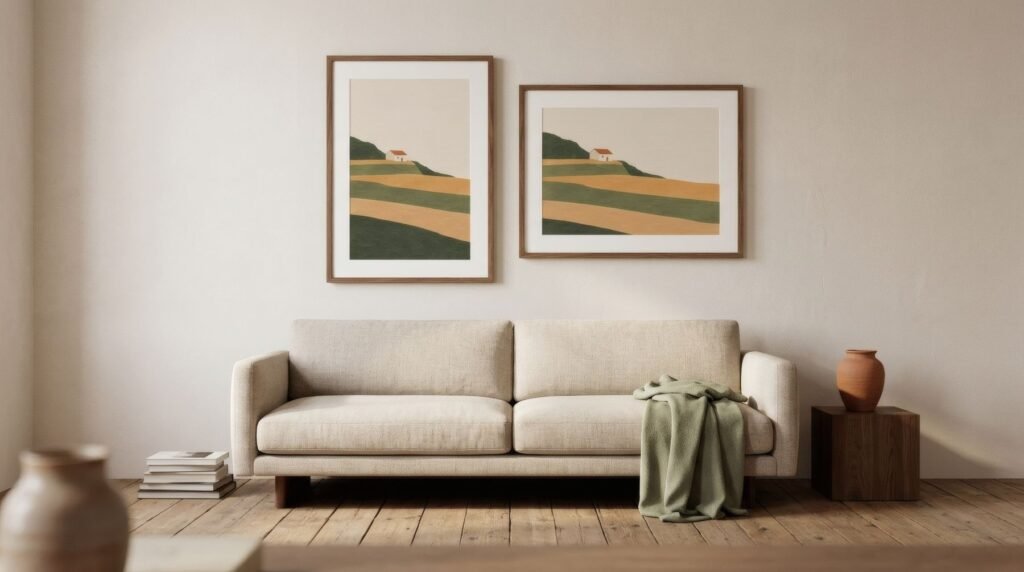
In the art world, by contrast, the museum convention is common: height by width. A «70 × 50» piece would be portrait; a «50 × 70», landscape. But not every shop follows it.
The practical advice is simple: don’t infer orientation from the numbers alone. Look at the product image, check whether the listing says «portrait» or «landscape», and if in doubt, ask. There’s more on formats in art print size guide.
Physical size versus visual relationship
There’s something less obvious worth understanding. A 50 × 70 cm (20 × 28 in) print has the same area whether portrait or landscape, but its presence on the wall is very different, because it relates differently to its surroundings.
In portrait, the piece stretches the wall upwards. It echoes vertical lines, doors, windows, columns, floor lamps, and makes ceilings feel higher. It takes up little width, so it fits narrow walls, between windows or beside a door.
In landscape, the piece widens the wall. It echoes horizontal lines, sofas, headboards, sideboards, worktops, and creates a sense of calm and stability. It needs more width but less height, which makes it ideal above low furniture or under sloping ceilings.
Square is neutral: it pushes in no direction. It works very well in groupings, grid series and spaces where balance is the aim.
Choosing for the space
To choose, look at the wall and ask which direction dominates.
Above a sofa or headboard, landscape nearly always works better, or two or three portrait prints together that form a horizontal rectangle as a group. On a narrow wall, between two windows or beside a door, portrait. In a hallway, either can work: landscape prints in a row follow the route, portrait ones spaced out create rhythm. We’ve looked at this in detail in styling landscape art prints above a sideboard and how to style a portrait print above low furniture.
The image has a say too
Finally, remember that orientation is part of the work. The artist chose it for a reason: a wide horizon asks for landscape, a standing figure for portrait. A print that exists in only one orientation shouldn’t be forced into the other; if your wall needs the other direction, find a different piece, or pair two.
Before you buy
Orientation is one of those decisions best made before you fall for a piece. Look at the wall, think about which direction it wants, check the listing, and if you’re unsure, cut paper to the exact size and tape it up for a few days.
In the Bendíra shop, each print lists its measurements in centimetres; check the product image to see its orientation before choosing a size.
Keep reading: A3 vs 30 × 40 cm Prints: Understanding the Difference.