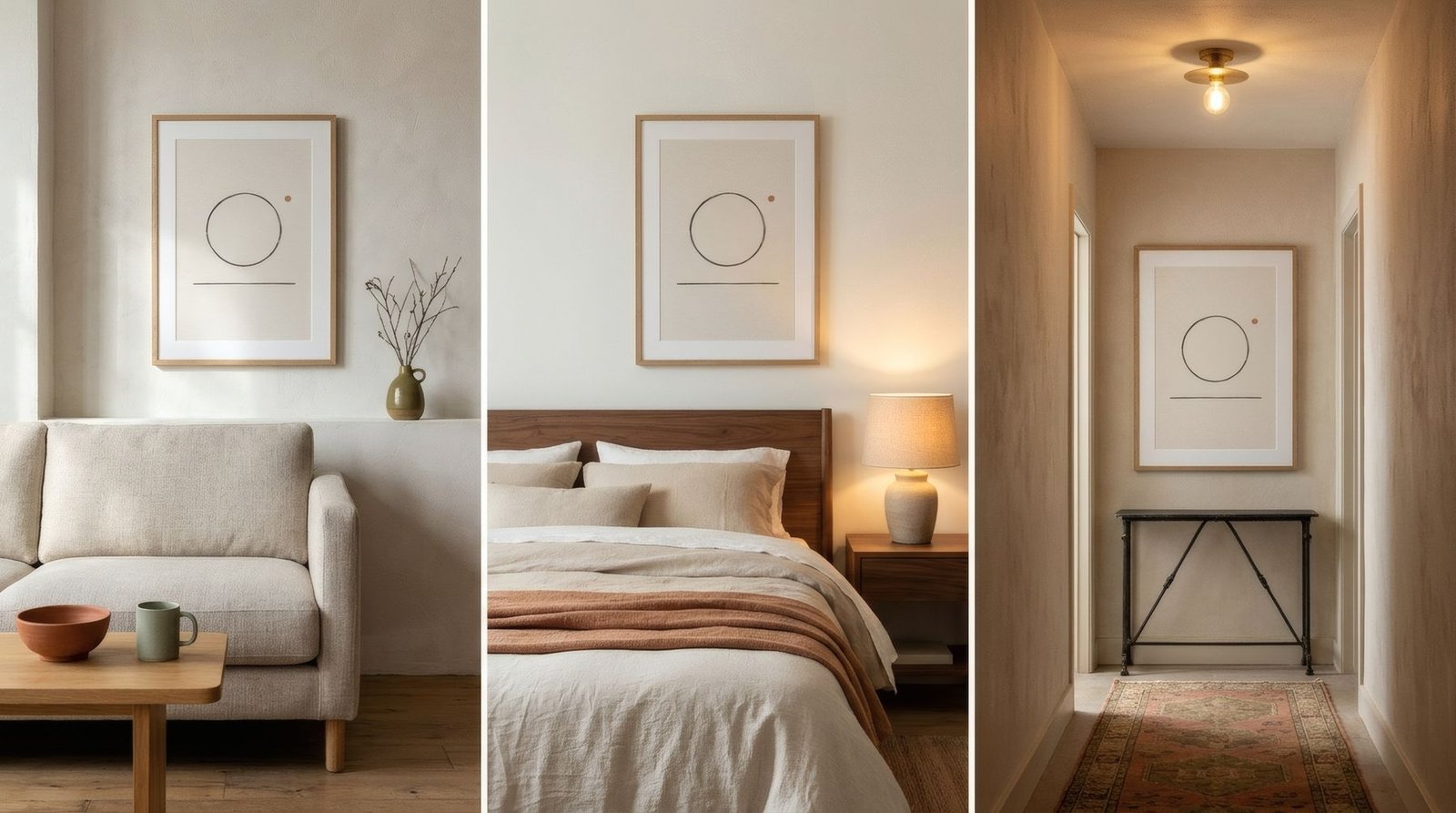
Imagine a simple print: soft hills in earthy tones, a pale sky, a band of olive. Now picture it in three places. First, above a linen sofa in a bright living room, beside a floor lamp and some sand-coloured cushions. Then in a bedroom, above the headboard, in the low light of a bedside lamp. And finally at the end of a narrow hallway, lit by a ceiling bulb, always seen in passing. Is it the same work? Yes. Does it look the same? Not at all. Understanding why helps you choose where to hang each piece, and see what you already own with fresh eyes.
What context changes
A work never exists in isolation. We always see it within a setting, and that setting changes it in several ways.
Light. As we saw in why printed colours look different under different light, the temperature and intensity of light alter colour. Light from a south-facing window, warm and abundant, will make ochres glow; the light of an internal hallway, cooler and scarcer, will mute them.
Surrounding colours. Neighbouring colours alter the work’s colour, through the same principle of simultaneous contrast that so interested the Delaunays. A terracotta beside a blue sofa looks warmer; beside a terracotta sofa, it melts in.
Distance. From the sofa, three metres away, you see the overall composition; in a hallway, half a metre away, you see the paper and the detail. The same work can seem serene from afar and richly textured up close.
How the room is used. In the living room, the work accompanies conversation and rest. In the bedroom, it’s the last thing you see before sleep. In the hallway, it’s a brief, repeated encounter. The same landscape is lived as company, as calm, or as surprise.
First room: the living room
Above a linen sofa, in a living room with good daylight, our hills print probably finds its brightest self. The earthy tones talk to the wood and sandy textiles, daylight warms them, and distance lets you take in the breadth of the landscape. Here the work is both focal point and window: it opens up the wall.
If the print is too small for the sofa, though, it loses its force. In the living room, scale matters a great deal, as we explain in how to choose the right size of art for any wall.
Second room: the bedroom
Above the headboard, the same print becomes more intimate. The bedside lamp, low and warm, lights only part of it, and the tones soften. It’s mostly seen lying down, or on entering the room, in less light. Here the landscape stops being a window and becomes a quiet horizon, almost a companion to sleep.
Bedrooms favour calm pieces, and this print is one. But if the room has dark walls or very patterned textiles, it may need a wider mount to stand out.
Third room: the hallway
At the end of a hallway, the print becomes something else. You see it head-on as you walk towards it, closer and closer, always in passing. Light is usually artificial and scarce. What you notice most here is detail: the texture of the paper, the marks, the shifts of colour. And the work takes on a new job: it gives the route a destination, turning a passageway into a small encounter.
In hallways, detailed and medium-sized pieces work especially well, because they’re seen close up. We go into this in hallway wall art.
A test at home
You don’t have to imagine it; you can try it. If you have a framed print, lean it in different spots around the house for a few days: on the bedroom chest of drawers, on the living-room floor, on a hallway ledge. Look at it at different times. You may well find your print has more than one personality, and that it shines more in one of those places than where it was. That’s exactly what we suggest in moving art around.
The work and its place
A work isn’t a fixed object but a relationship between image, light, space and viewer. That’s why choosing where to hang it matters almost as much as choosing it. The same print can be a window, a horizon or an encounter; it just needs the right place.
The Southern light prints, such as Olive hills, lend themselves to this exercise with their soft, versatile palette. Do not use generated images as if they were real product photos; wait for real photography to show a specific Bendíra print in three rooms.
Keep reading: How to Pair Wall Art with Wooden Furniture and Sonia Delaunay and the Art of Simultaneous Colour.