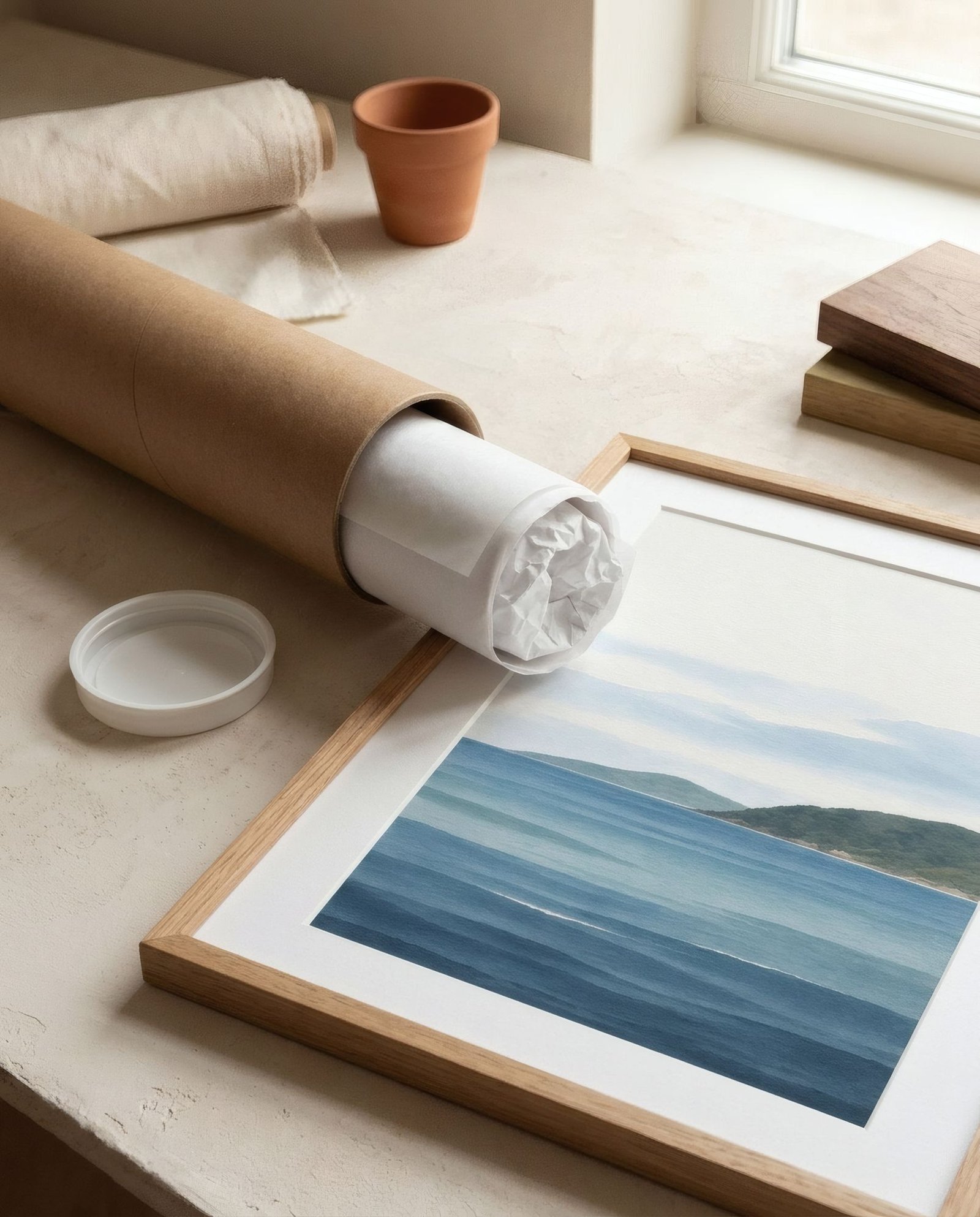
An unframed print is light, flat and easy to carry. That’s exactly why it’s easy to underestimate how vulnerable it is on the move. It fits in a backpack, a folder, a gap in the boot, and that’s where the trouble starts: a corner that scuffs, a book that slides on top, a curve that becomes a crease. Whether you’re moving house, have bought a print at a design fair, want to send one to someone far away or are taking it to the framer, there are simple ways to make sure it arrives intact.
Flat or rolled
The first decision is how to carry it. Each option has its advantages and limits.
Flat is the safest way for most prints, because the paper isn’t curved or stressed. It needs rigid packaging larger than the print, which makes it less practical for big formats or posting.
Rolled in a tube is common for large sizes and deliveries, because tubes are strong and compact. The downside is that the print will arrive with some curl that needs to relax before framing, and not every paper rolls well: very heavy stocks can mark. If you do roll it, roll it image side out, counter-intuitive as that seems: when unrolled, the curve then tends towards the back of the paper and the printed surface isn’t compressed.
If it’s travelling flat
The principle for flat transport is the sandwich: the print between two rigid surfaces larger than itself.
Lay the print on a sheet of acid-free tissue or glassine, which protects the printed surface from rubbing. Place it between two rigid boards, foam board or heavy corrugated card, that extend at least two or three centimetres beyond each edge to protect the corners. Tape the boards together, but never let the tape touch the print. If it’s going inside another box or suitcase, stand the package upright against one side and fill any gaps so it can’t move.
For a house move, mark the package as fragile and carry it in the car, not at the bottom of a box of books.
If it’s travelling in a tube
To roll a print, use a rigid cardboard tube with a generous diameter: the wider the tube, the less the paper is stressed. For medium prints, a tube of 7–10 cm (3–4 in) diameter usually works well.
First wrap the print in tissue or acid-free paper extending a few centimetres beyond the edges. Roll it gently, without tightening, around the protective sheet, image side out. Slide it into the tube without forcing and pack the ends with crumpled paper so it can’t slide about. Close with firm end caps.
What to avoid
A few common mistakes. Folding the print, even once and carefully: a fold is permanent. Putting tape on the paper to hold it to the board: it leaves marks and can tear fibres when removed. Wrapping it directly in bubble wrap: bubbles can leave impressions on matt papers or freshly printed inks; put it outside the board instead. Sealing it in plastic bags through temperature changes: condensation can form. And leaving it in a sunny car boot: excess heat isn’t good for paper.
Sending by courier
If you’re posting a print, remember that parcels are handled many times, stacked and sometimes bent. A padded envelope without stiffening isn’t enough: it needs rigid board inside, or a tube. Mark it «Do not bend» clearly, but don’t rely on that alone. And check the carrier’s terms on sizes and insurance, especially if the work has value. There’s more in how prints are shipped and what to expect on delivery.
On arrival
When it arrives, leave the print in its packaging for a while if it’s travelled through cold or heat, so it can acclimatise. Then unpack it on a clean table with clean hands, and if it’s rolled, let it relax under a light weight. We go through it step by step in how to handle art prints without creasing them.
Arriving as it left
Moving an unframed print is simple if you respect one idea: the paper should always travel supported, never folded or squeezed. A good board sandwich or a generous tube, a protective sheet and a little care are all it takes.
Bendíra ships its prints unframed and protected for transit.
Keep reading: How to Store Unframed Art Prints, Renter-Friendly Ways to Display Art Without Drilling and Art for Temporary Homes: Making Space Your Own.