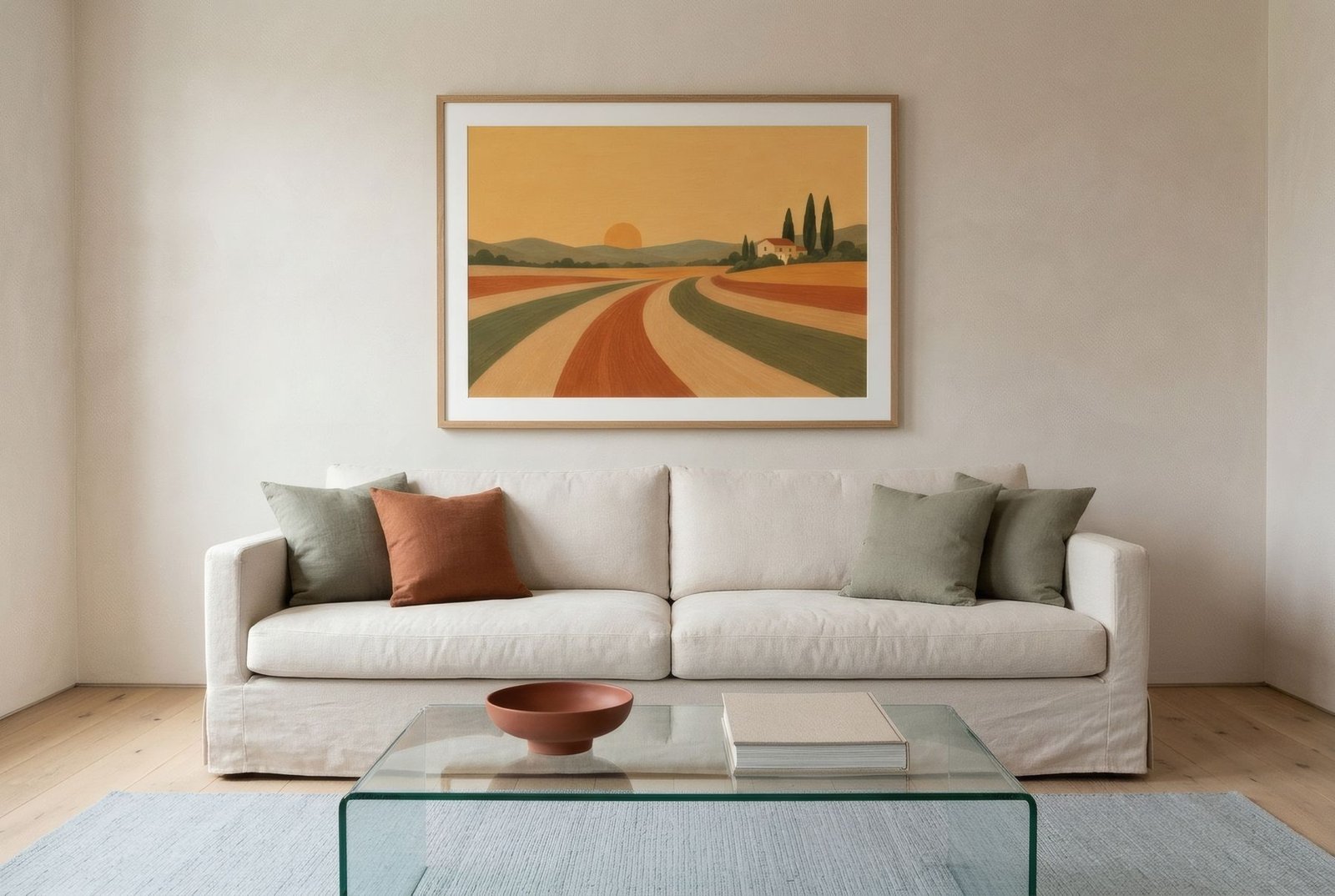
Interior designers have an exercise that anyone can try at home. Take everything out of a room, then bring back only what genuinely improves it. Almost always, far less comes back in than went out. An elegant living room is rarely a full one. It is a room where everything has a reason to be there, where the eye knows where to land first, and where there is room to breathe. Getting there means editing before adding, setting up a clear hierarchy and trusting one focal piece, very often a work of art, to organise the rest.
Elegance is not emptiness
It helps to clear up a misunderstanding first. A living room with few things is not empty or cold. It can be warm, personal and full of life. The difference is that what remains has been chosen rather than accumulated. It is the difference between a conversation and background noise: both make sound, but only one says anything.
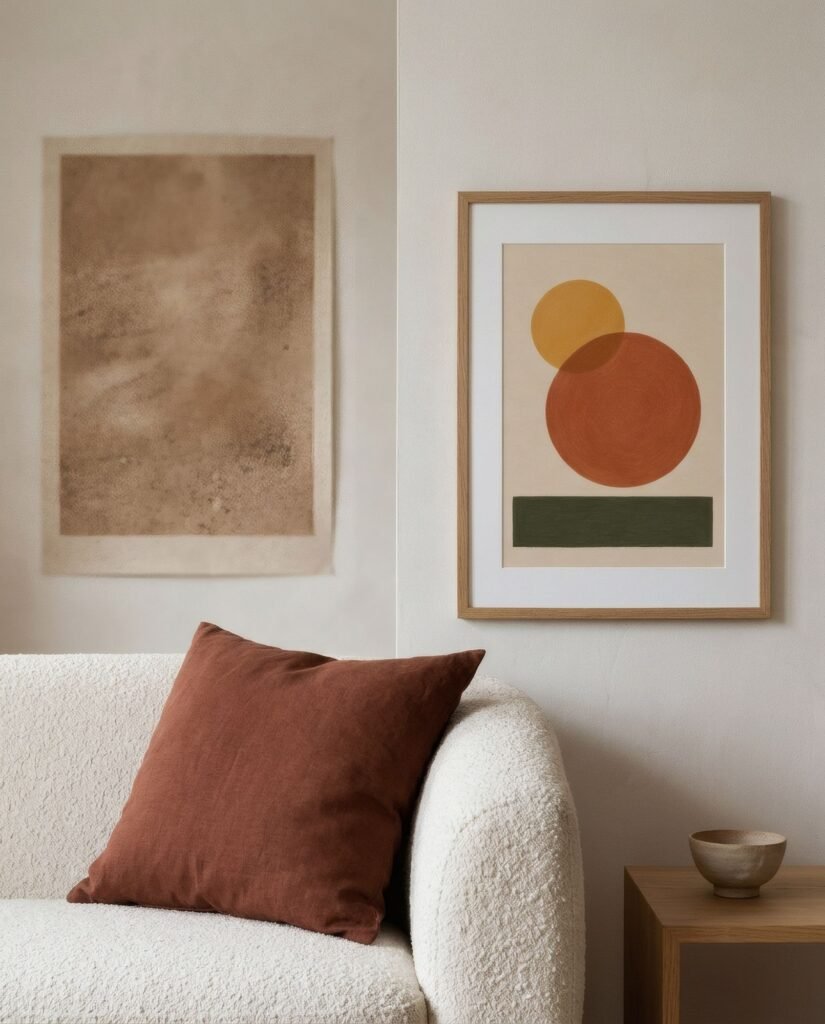
Elegance in this sense has a lot to do with clarity. A clear room makes sense at a glance: here you sit, here you read, here you look. That clarity is what brings calm, and it is why a simple room can, paradoxically, look more cared for than one full of beautiful things.
The art of editing
Editing a living room is a process, and it takes time. A good way to begin is to look at the room as if for the first time, from the doorway, and ask what a visitor notices in the first three seconds. If the answer is «a lot of things», there is work to do.
Then go object by object with one simple question: does this improve the room, or merely occupy it? Furniture you use stays. Things that carry meaning, such as a beloved book, an inherited pot or a photograph, stay too. Everything else, the things that are there because there was a gap, can be stored, given away or moved to another room where they may look better.
There is no need to do it all at once. Many homes are edited slowly, removing one object a week and noticing whether it is missed. It rarely is.
Visual hierarchy
Once edited, the room needs an order. In any well-composed space, some elements speak louder and others keep them company. That hierarchy lets the eye travel calmly instead of jumping about.
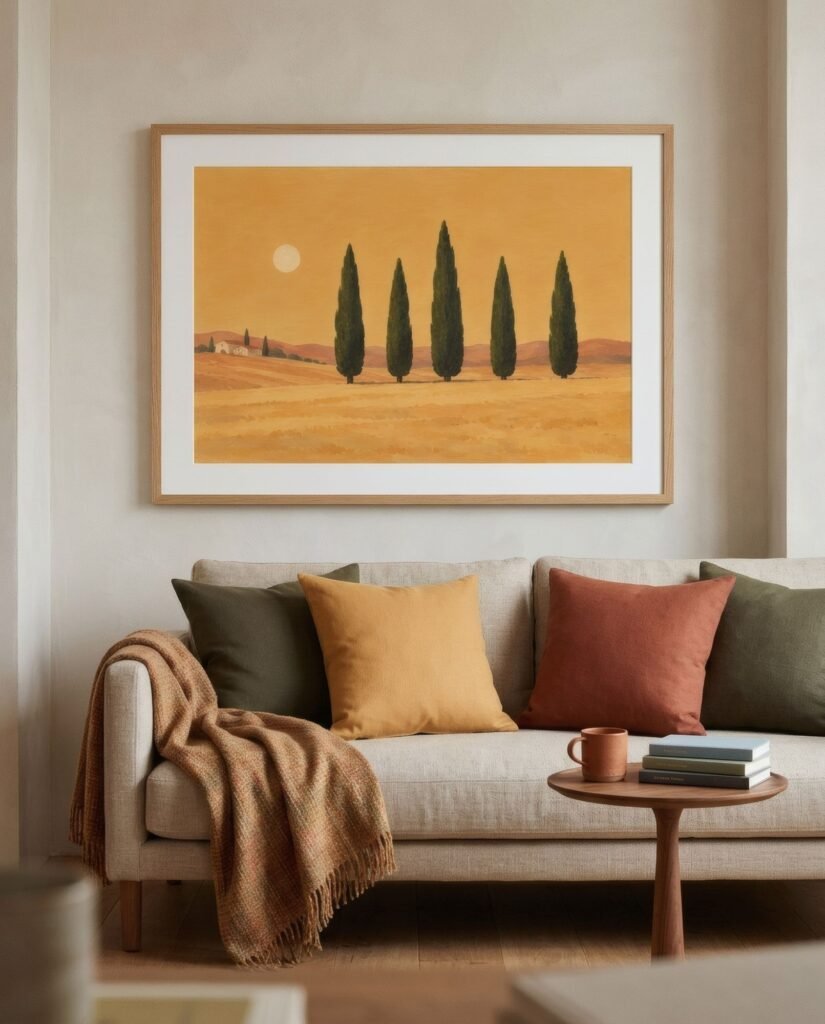
In most living rooms it works on three levels. First comes the focal point, whatever catches the eye as you walk in: an artwork, a fireplace, a window with a view, a bookcase. Then the main elements, the sofa, coffee table and rug, which give structure. Finally the accents: cushions, a lamp, a plant, a couple of objects on a surface. When too many things compete for the first level, the room feels restless. When one clearly leads, everything else finds its place.
One artwork at the centre
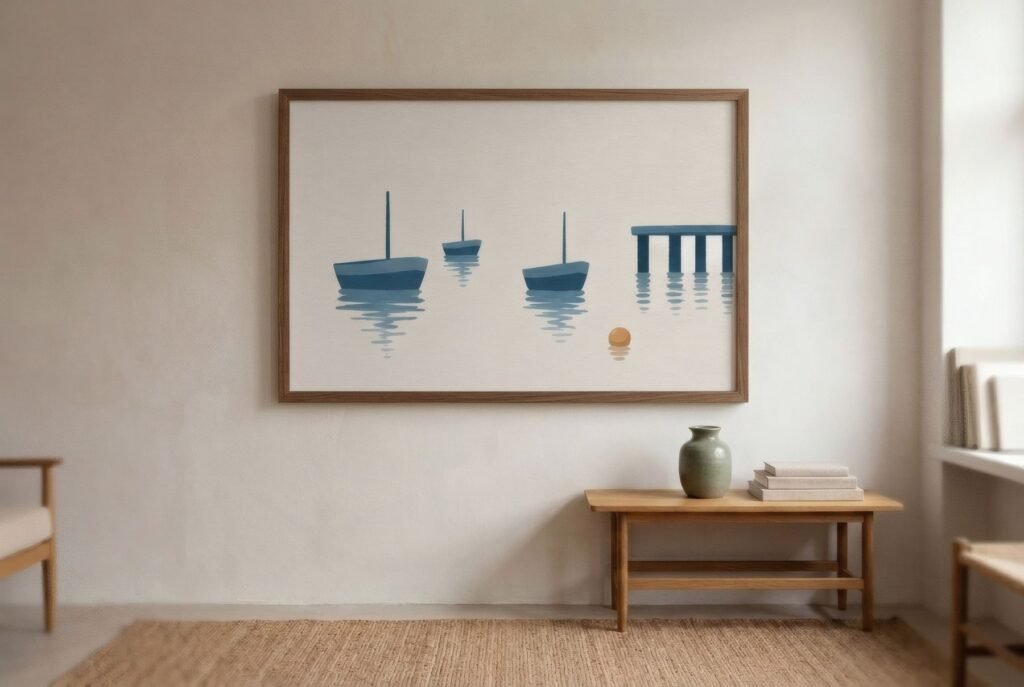
In a pared-back living room, a well-chosen artwork can be the perfect focal point. Unlike a fireplace or a window, it can be chosen and placed exactly where it is needed, and its palette can set the tone for the whole space.
To lead, it needs presence: a generous size in relation to the furniture beside it, usually half to two-thirds of the sofa’s width, and a clear position, generally on the wall you see on entering. The exact measurements are in how to choose wall art for your living room. What matters here is that this work does not compete with others on the same wall or the walls nearby. If there is more art in the room, let it be smaller and quieter, and leave no doubt about who is speaking.
Repeat to connect
A useful trick in minimal rooms is subtle repetition. If the main work has a terracotta in it, let that terracotta appear once or twice more in the room, in a cushion, a vase or the spine of a book. If it has a graphic black, repeat it in a lamp base or the frame of a small photograph. That repetition draws an invisible thread through the room, so that with very few things, everything seems meant to be together.
Empty space decorates too
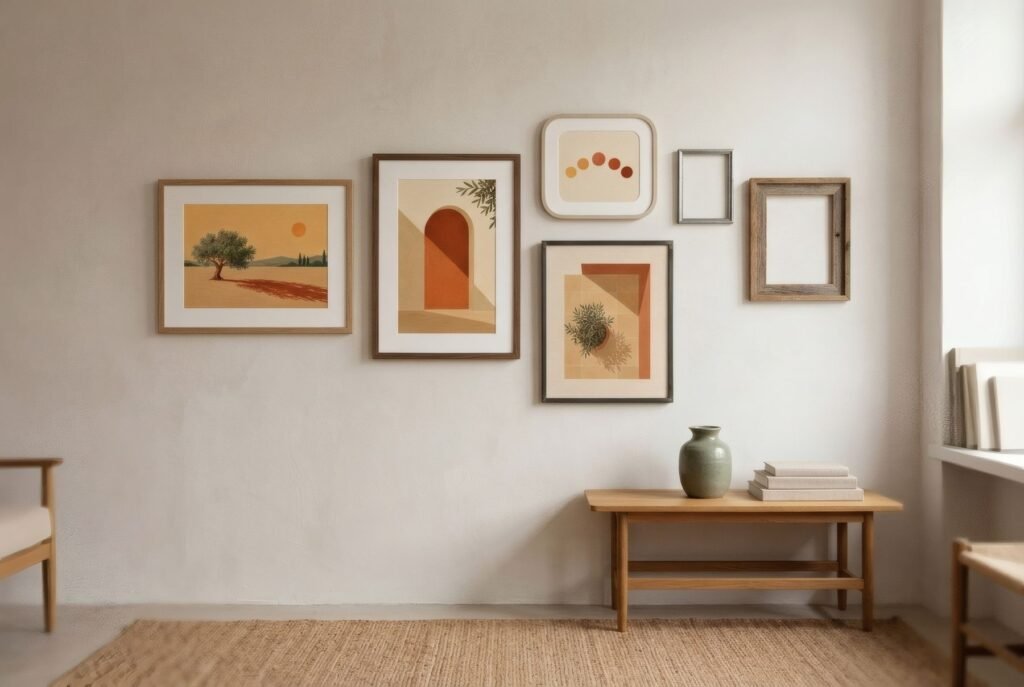
In an edited room, empty space is not a gap to fill but an element in its own right. A clear stretch of wall beside the main work makes it more visible. A bare sideboard lets the one object on it really be seen. An empty corner lets light move.
Learning to see that space as valuable, rather than as something missing, is perhaps the hardest step and the most transformative. We explore it more slowly in the beauty of giving art room to breathe.
A living room, before and after
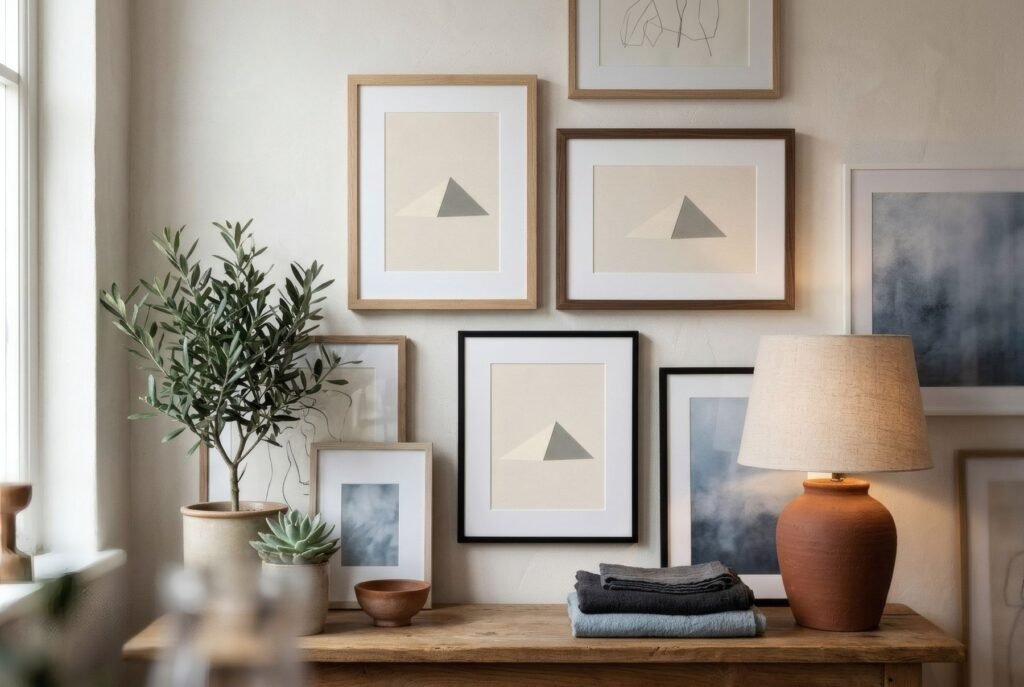
Picture a living room with a three-seater sofa, a coffee table, a bookcase, and a wall of six small frames in different sizes, plus several objects on every surface. After editing, the six frames give way to a single 50 × 70 cm print in sand and terracotta, set in a wide mount and a frame of around 70 × 90 cm, above the sofa. The bookcase loses half its ornaments and gains space between the books. On the coffee table, a book and a pot remain. A terracotta cushion repeats the accent in the print. The room holds fewer things and yet feels richer.
Fewer, but better
An elegant minimal living room is not achieved by buying something but by deciding what stays. Editing, ordering the hierarchy and letting one focal piece give the room its meaning are three gestures that transform any space, whatever its style or budget.
If you are looking for that central piece, Bendíra’s collections include prints with calm compositions that can lead a room, especially in the larger sizes with a generous mount.
Keep reading: Earth-Toned Interiors: Choosing the Right Art, Modern Mediterranean Interiors and Wall Art and Warm Minimalism: How to Decorate with Art.