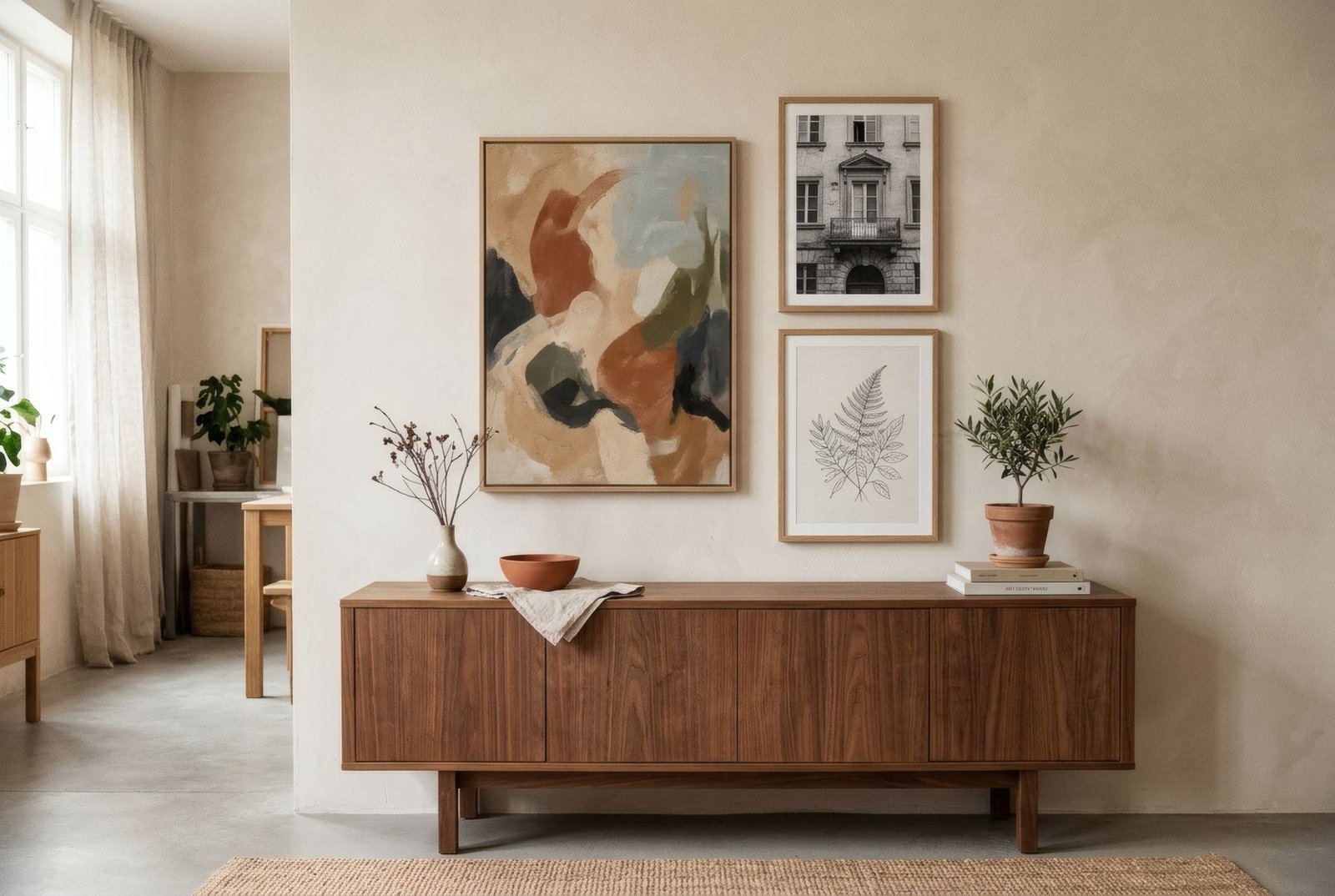
Different pieces of art sit happily together when they share at least one thing: a colour family, a frame finish, a medium, or a common line on the wall. Hold that one element constant and everything else is free to vary. Without it, a photograph, an etching and an abstract print look like three separate purchases rather than one considered wall.
So the first question is not which pieces, but what stays the same.
One constant, many variables
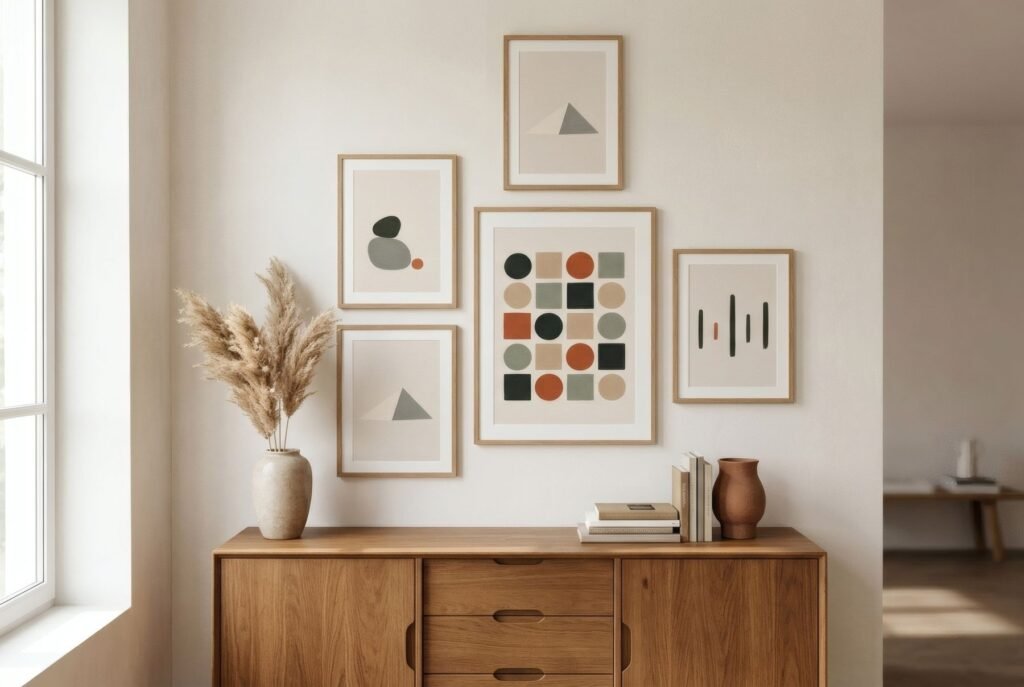
There are five threads you can use to hold a mixed wall together. One is enough, and two make it safer:
- Colour
- Frame
- Medium or technique
- Subject
- Alignment
The more you vary, whether sizes, eras or styles, the firmer that constant needs to be.
Mixing through colour
Colour is the most flexible thread. It does not mean every piece shares the same colours. It means they belong to the same family.
- A limited palette: two or three tones recurring across most works, such as terracotta, sand and olive spread across an abstract, a landscape photograph and a botanical drawing.
- A shared temperature: all warm or all cool, even when the actual colours differ. One cool piece in a warm group reads as a mistake if it is incidental, and as an accent if it is singular and well placed.
- Similar tonal value: works of similar lightness read together even when their colours are far apart. Black-and-white photographs are useful bridges between colourful pieces.
A quick check: photograph your arrangement on the floor and switch the image to black and white. Any piece that jumps out as a dark blot in a pale group will pull the wall off balance.
Mixing through frames
A single frame style is the quickest route to cohesion. The same natural wood profile can turn otherwise unrelated works into a family.
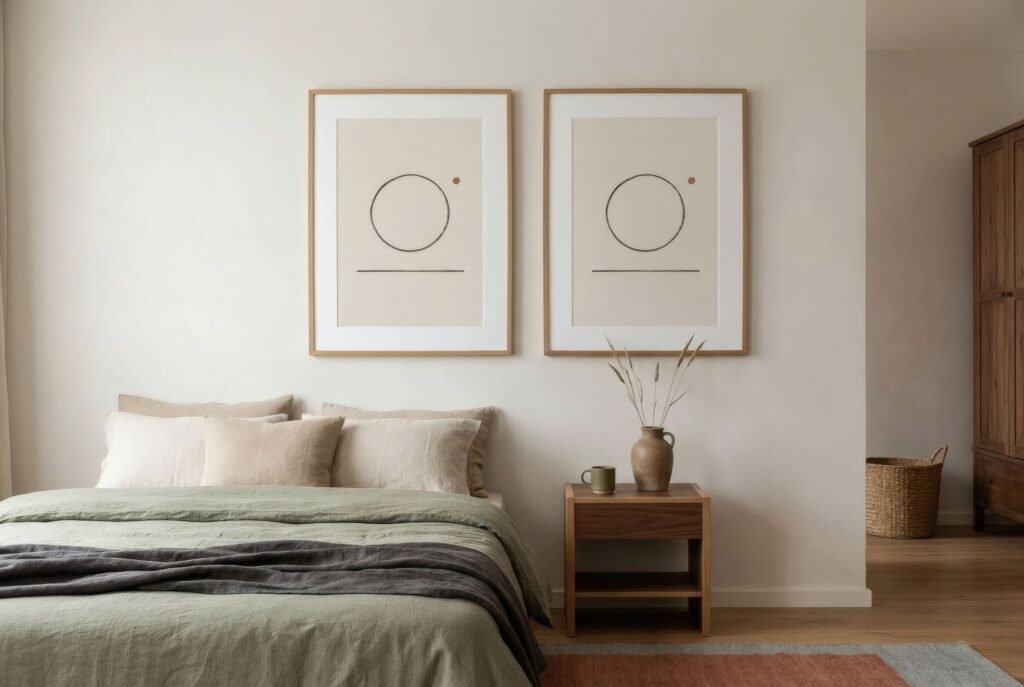
If you do not want identical frames:
- Same material, different profiles: all oak, some slim and some deeper.
- Same colour, different materials: all black, some wood and some aluminium.
What tends to fail is an unplanned mix of gilt, black, white and wood on one wall, at which point the frames stop supporting the art and start competing with it.
Mixing through medium or subject
A run of line drawings reads as a set, even if it includes portraits, objects and landscapes, because the hand is consistent. A shared subject does the same: botanical prints from different centuries, or one stretch of coastline shown in photography, printmaking and illustration.
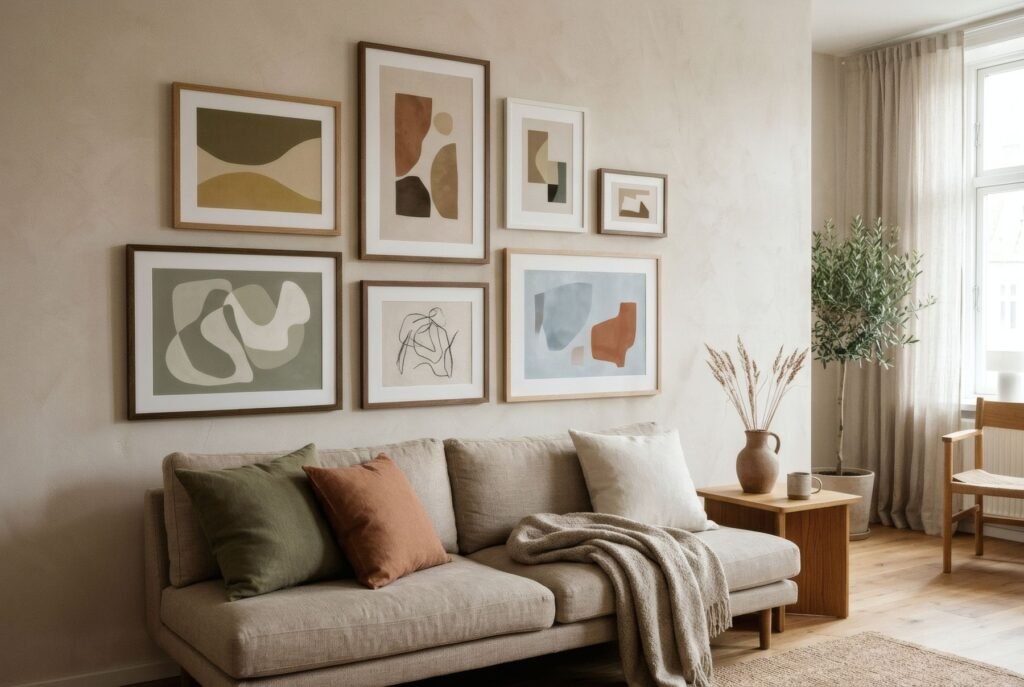
This approach gives the most personal walls, because the coherence is not obvious at first glance. It reveals itself as you look.
Mixing sizes: hierarchy and rhythm
Different sizes need a clear hierarchy. A group where every piece is similar but not identical in size feels more restless than one with obvious differences.
- An anchor: the largest or most intense piece, with the others arranged around it.
- Two or three scales at most: large, medium and small. Five different sizes lose the rhythm.
- Repetition: if you have two small pieces, make them the same format. Repetition calms variety.
- Constant spacing: 5–8 cm (2–3 in) between frames, whatever their size. Nothing unifies a group faster.
Think in visual weight, not just size. A small, very dark print can weigh as much as a large pale one. Place dense pieces on opposite sides of the arrangement, or on a diagonal, so the wall does not tip.
Mixing styles: contrast on purpose
An old portrait beside a contemporary abstract, or a vintage poster beside recent photography, can be the most interesting thing in a home. It works when the contrast looks intended.
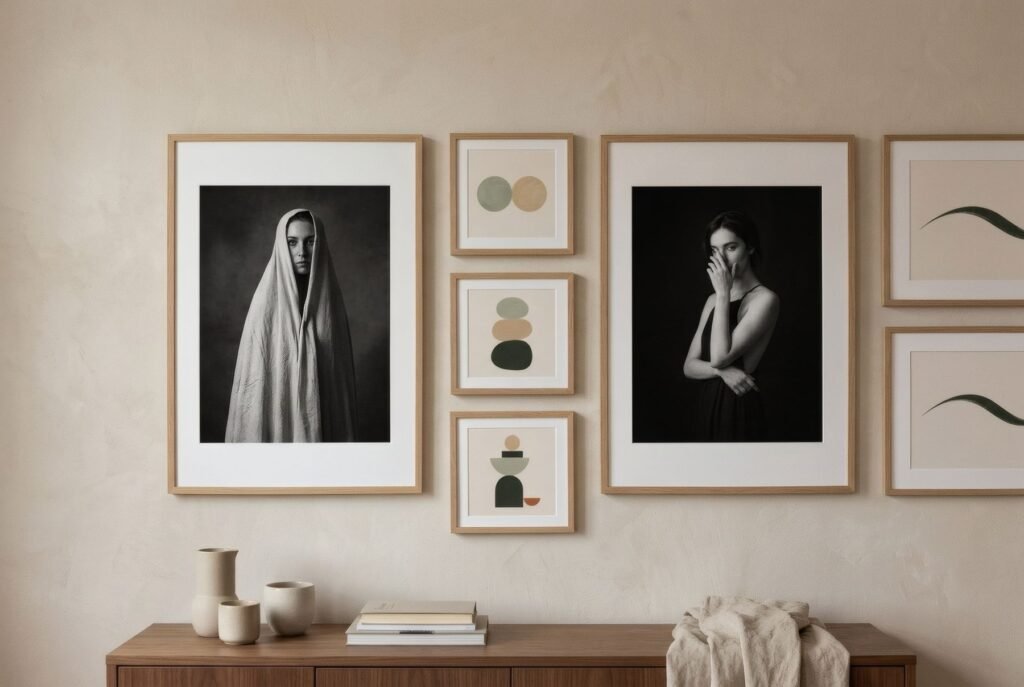
Pairings that tend to work:
- Classical and abstract, joined by a shared palette, such as an ochre-toned portrait beside a terracotta and cream abstract.
- Photography and drawing, joined by monochrome or by one frame style.
- Graphic prints and botanicals, joined by visible paper, generous mounts and fine lines.
What usually fails is splitting the wall into two style zones that never touch. If you are mixing, mix properly and interleave the pieces.
When a piece will not fit
Every collection has one work that refuses to settle. Before forcing it, try:
- Reframing it to bring it closer to the others.
- Giving it a wider mount so it sits slightly apart within the group.
- Taking it out and hanging it alone elsewhere, where its difference becomes a strength.
Not everything has to share a wall to belong to the same home.
A worked example
A 140 cm (55 in) wall above a sideboard:
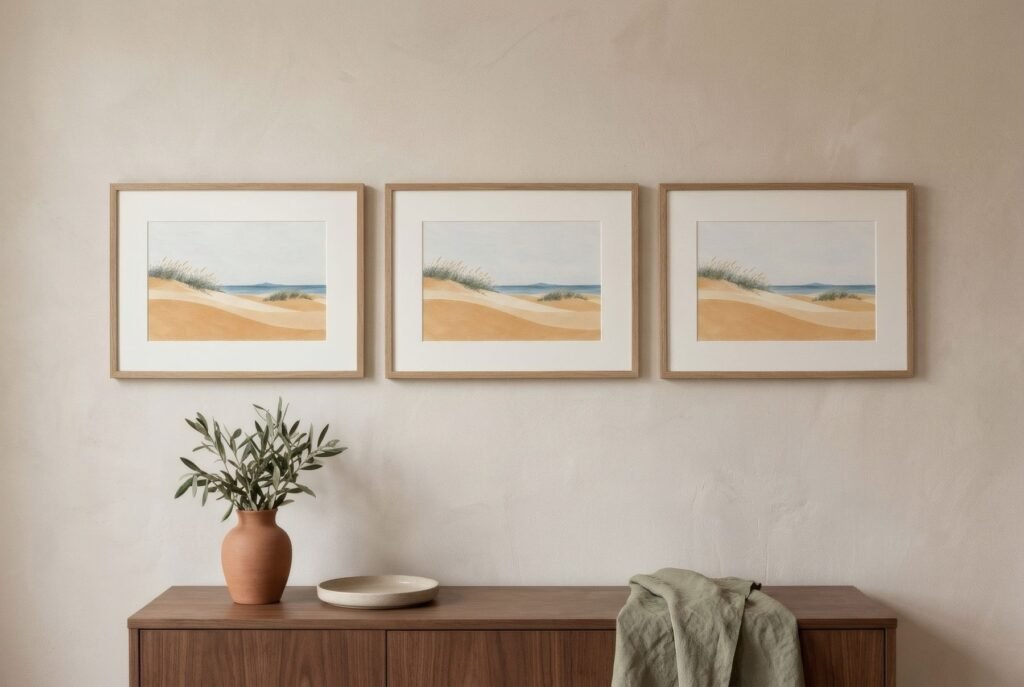
- Anchor: a 50 × 70 cm earth-toned abstract, portrait, set slightly left of centre.
- To the right, two stacked 30 × 40 cm prints: a black-and-white photograph of a façade and a fine-lined botanical illustration.
- 6 cm (2.5 in) between all three.
- Constants: a slim oak frame on each, and a terracotta that appears in both the abstract and the botanical.
Three pieces of different medium, size and era, held together by two constants.
Putting it on the wall
Once you have the selection, the planning method is the same as for any group: paper templates, measured gaps and a trial run before drilling. It is all set out in how to create a gallery wall at home, along with layouts that help you arrange wall art of mixed sizes.
If you are starting a mixed wall from scratch, it can help to begin with works that already share a palette. Bendíra’s collections are grouped by families of colour, so that first constant is already in place.
Keep reading: How to Choose the Right Art Print Size, Mixing Abstract Art with Vintage Interiors and Black and White Wall Art: Styling Ideas.