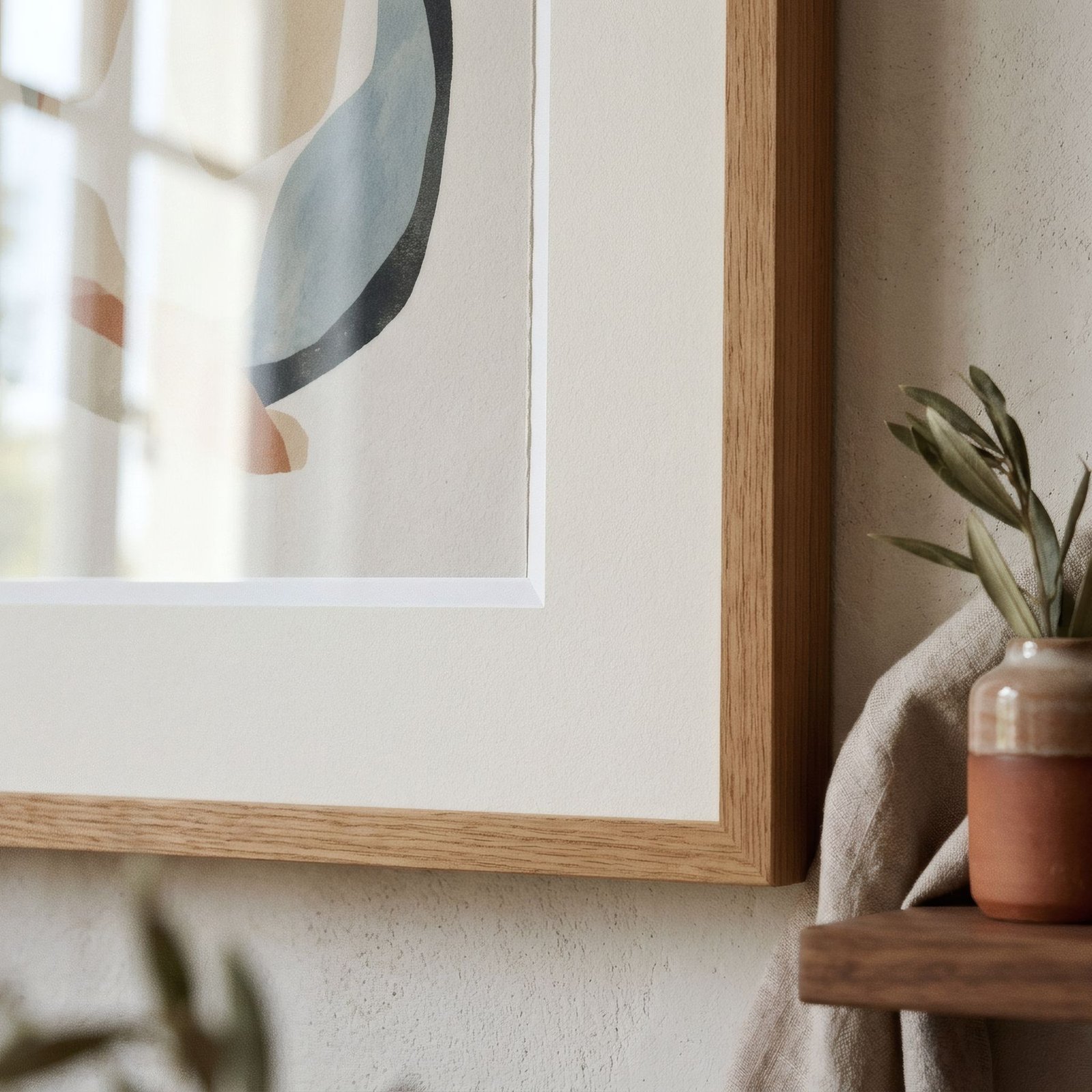
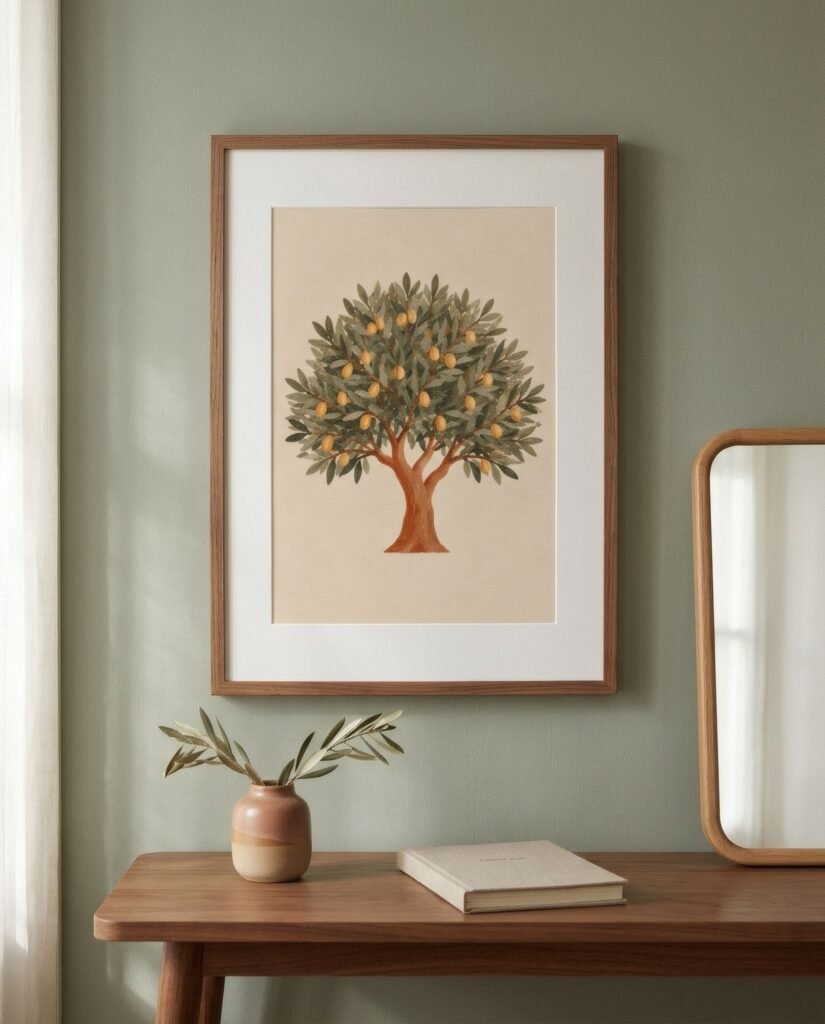
There is a part of framing that transforms a print almost more than the frame itself, yet many people do not know what it is called. It is the card, usually white or cream, that surrounds the image inside the frame, with a bevel-cut window through which the work shows. In the UK it is called a mount; in the US, a mat. It does two jobs at once. Aesthetically, it gives the work air, presence and elegance; for conservation, it keeps the print away from the glass and protects it. Knowing when to use one, and how to choose its width and colour, is one of the best tools for framing well.
The aesthetic job: air and presence
The first reason to use a mount is visual. By surrounding the image with a neutral margin, it separates the work from frame and wall, creating breathing space that draws the eye to the work. It is like the silence before a note: it helps you hear what follows.
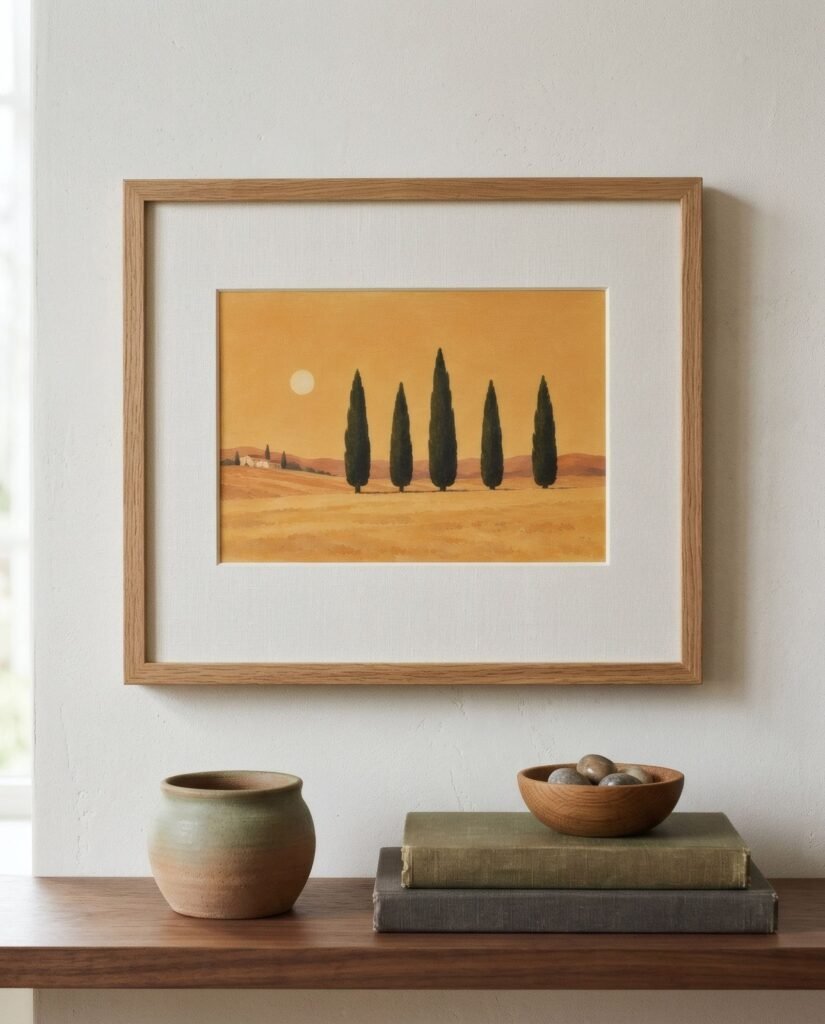
A mount also adds presence. A small print with a wide mount inside a larger frame gains scale on the wall without enlarging the image. That is why mounts are so common for small, delicate works such as drawings, etchings, photographs and botanical prints. We touch on this in how to choose the right art print size.
It unifies, too. In a gallery wall of differently sized works, mounts that equalise outer dimensions let every piece share the same frame and read as a set.
The conservation job: distance from the glass
The second job is less visible but very important. A print in direct contact with glass can suffer as humidity changes: condensation can make the paper stick to the glass, ripple or mark. A mount creates a small air gap between work and glazing that prevents that contact.
For this conservation role to be real, the material matters. Low-quality mounts can contain acids that, over time, yellow and migrate into the paper of the work, leaving a brown line around the window. That is why acid-free or conservation-grade mount board, often called museum board, is recommended for works you want to keep. More on care in how to care for your art prints.
Width
There is no single right measurement, but there are useful guidelines. For small and medium prints, a mount of 5–8 cm (2–3 in) per side usually feels balanced. For small works you want to make a feature of, a wider mount of 10 cm (4 in) or more gives an elegant gallery feel. At large sizes the mount can be proportionally narrower, or left out altogether.
The mount should be clearly wider than the frame moulding; if they are similar, the result can look indecisive.
There is also a traditional framing convention of making the bottom margin slightly wider than the others, sometimes by a centimetre or more. Visually, it offsets the eye’s tendency to perceive a rectangle’s centre as slightly higher than it really is, and gives the work a sense of stability. It is often called bottom weighting.
Colour
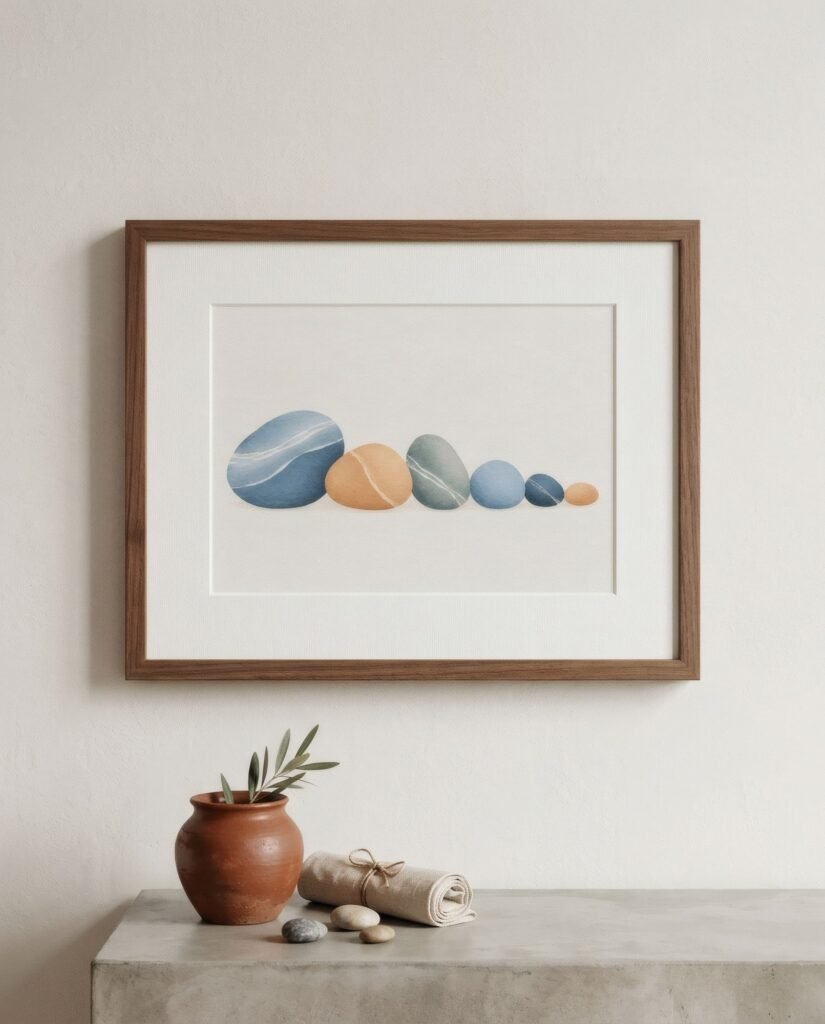
White and warm whites such as bone, ivory and cream are by far the most used, because they are neutral and leave the work centre stage. Choose a white that suits the print’s paper: a very pure white beside an ivory paper can make the print look yellowed, and vice versa.
Black or dark greys work with black-and-white photography or high-contrast graphic works, and add drama.
Colours are less common and riskier. They can work if they pick up a tone from the work and are used with intent, but they easily compete with the image.
Variations
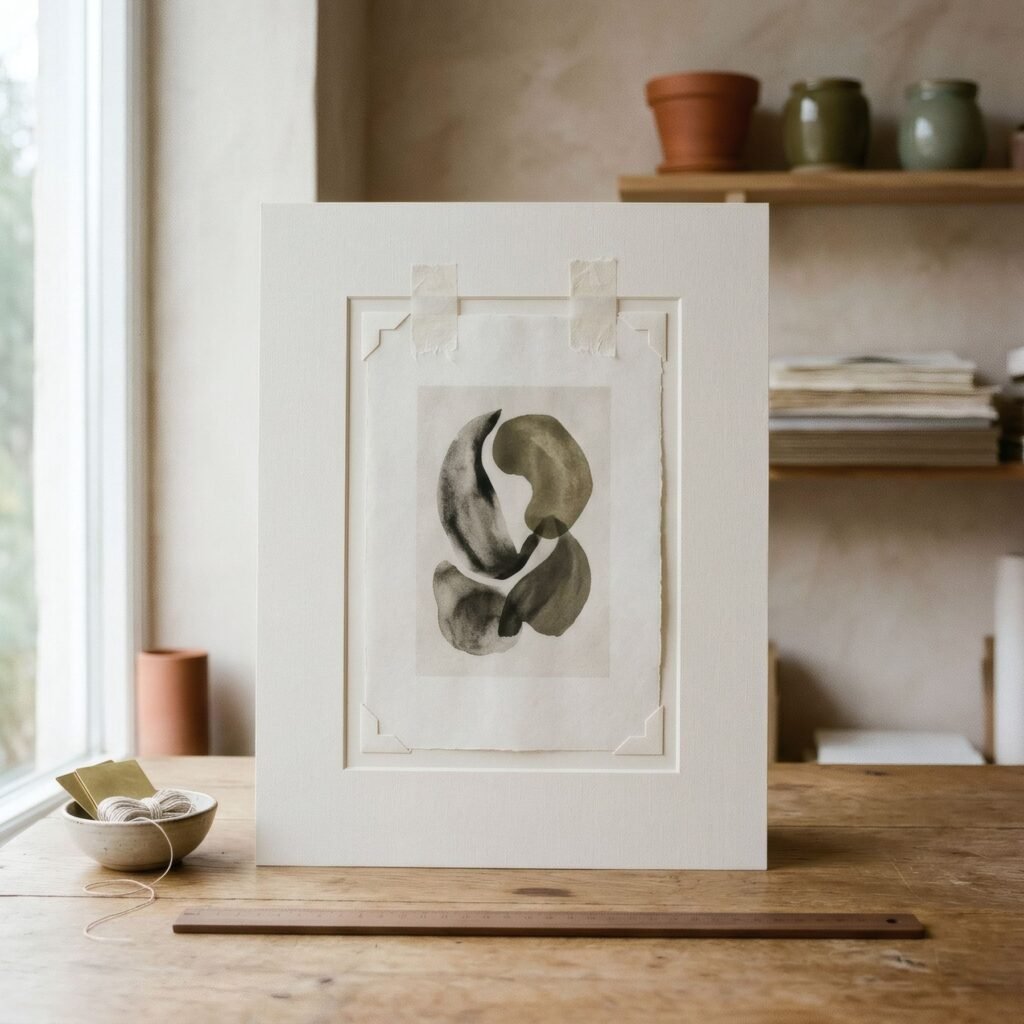
Besides the classic mount, there are some interesting variations. A double mount layers two boards with windows of different sizes, so a thin line of another colour appears around the image. A float mount has a window larger than the paper, showing the whole print and its edges as if floating. And the bevel cut, at about 45 degrees, revealing the white core of the board, is the most common finish, giving that fine, luminous edge around the image.
When not to use one
A mount is not always needed. Large works, posters and strongly graphic pieces often look better without one, full bleed in the frame or in a float frame. And some very contemporary framing styles prefer the image directly beneath the glass, with hidden spacers maintaining the gap.
A small frame of light
The mount may be the most underrated element of framing: it brings air, presence, coherence and protection all at once. Well chosen, it turns a simple print into a work that looks far more significant.
Bendíra prints are supplied unframed in standard sizes, so they can be framed with or without a mount in easy-to-find ready-made frames.
Keep reading: How to Measure an Art Print Before Buying a Frame, Glass vs Acrylic for Framing Art Prints and Framed vs Unframed Art Prints: Which to Choose?.