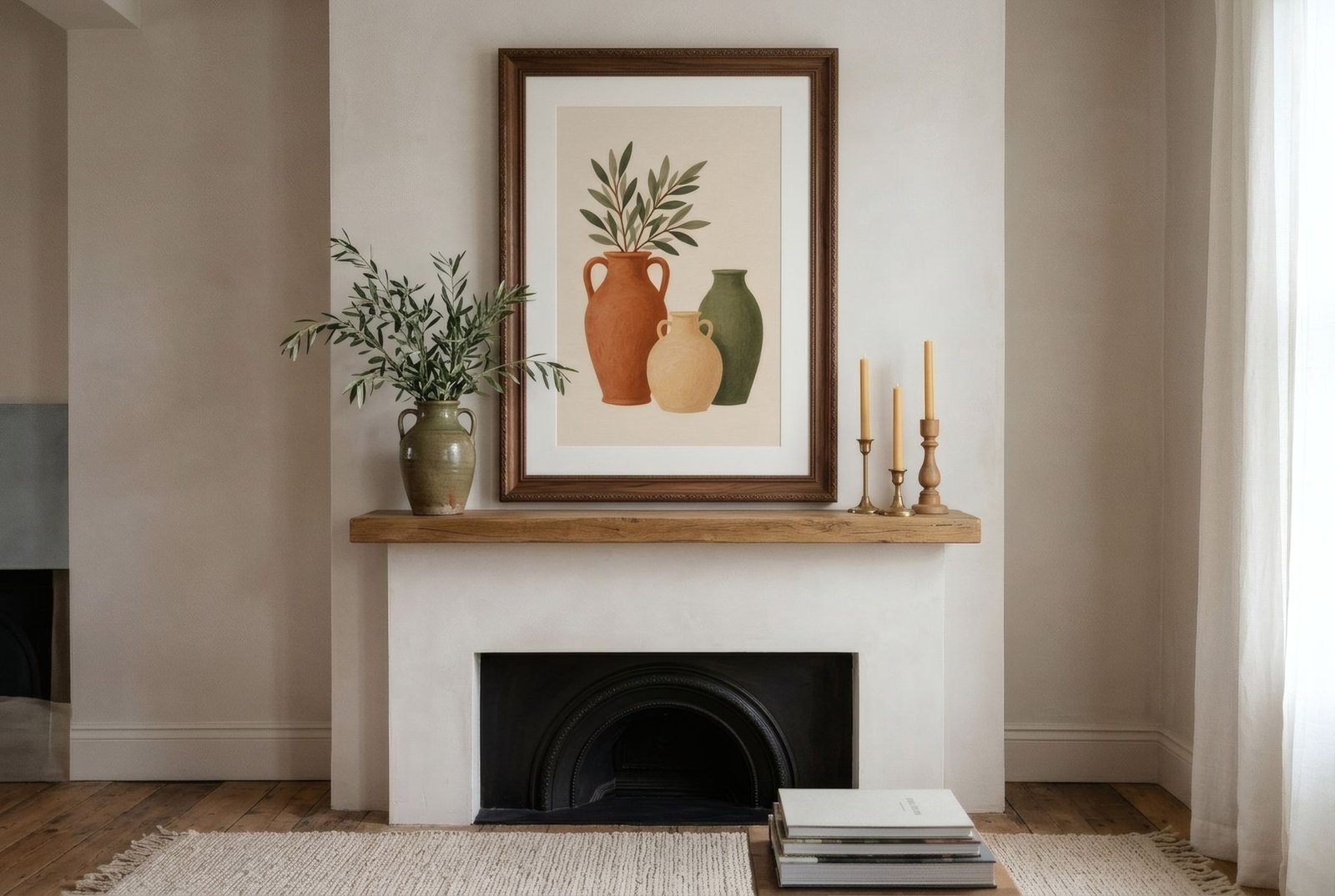
For centuries the fireplace was the heart of the home: where food was cooked, the family kept warm and stories were told. Many are rarely lit now, or only on a few winter evenings, yet they still hold the room. Walk into a living room with a fireplace and your eye goes there before anywhere else. That makes the chimney breast, almost always, the most important spot in the house for art. It’s also one of the places that needs the most thought, because along with all that attention comes heat.
A focal point that’s already there
A fireplace gives you something other walls don’t: an axis. The mantelpiece draws a clear horizontal line, the opening marks the centre, and the chimney breast above is a surface framed by the architecture itself. That makes composition much easier. The most classic option, and almost always a good one, is a single piece centred above the mantel, completing the symmetry.
On size, the guideline is similar to other furniture: art tends to look right when it covers between half and two-thirds of the mantel’s width. Above a 140 cm (55 in) mantelpiece, that’s something around 70–90 cm (28–35 in) wide, whether a large print with a mount or a generous frame. Too small above an imposing fireplace and the art looks timid; too wide and it overruns the architecture.
The mantelpiece as a stage
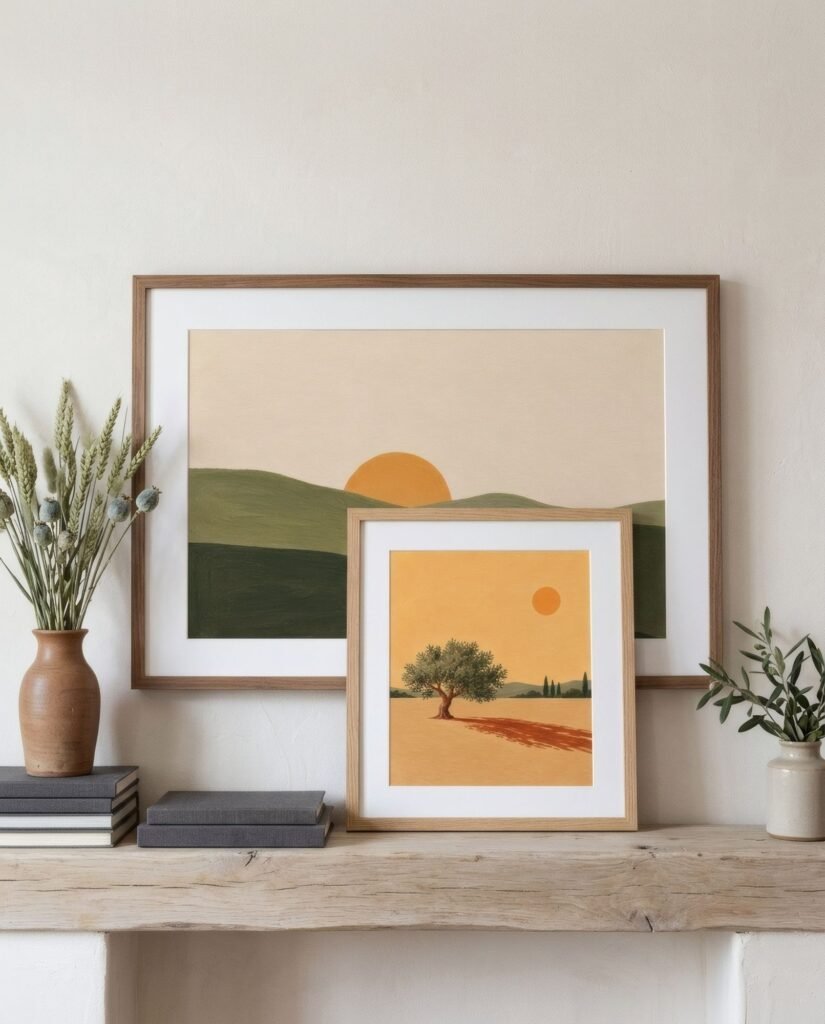
A mantel lets you do something lovely: combine hung art with objects. A candlestick, a vase of branches, a few books, a piece of pottery. And leaning art too, which has become hugely popular for its relaxed, changeable feel. A large print propped against the wall on the mantel, with a smaller one overlapping in front to one side, creates depth and lets you rearrange without holes.
If you do hang the piece, a gap of 15–25 cm (6–10 in) between mantel and the bottom of the frame works well, just as with a sideboard. With tall objects on the mantel, it can be a little more.
Symmetry or not
A fireplace practically asks for symmetry, and a centred piece flanked by a matching pair of objects says order and calm. But asymmetry works too: the art shifted to one side and balanced on the other by something tall, a plant or a lamp. It’s a more contemporary, more lively arrangement. What matters is that the whole thing feels balanced, even if the two sides aren’t identical. We look at both approaches in symmetrical vs asymmetrical gallery walls.
Heat: the less romantic part
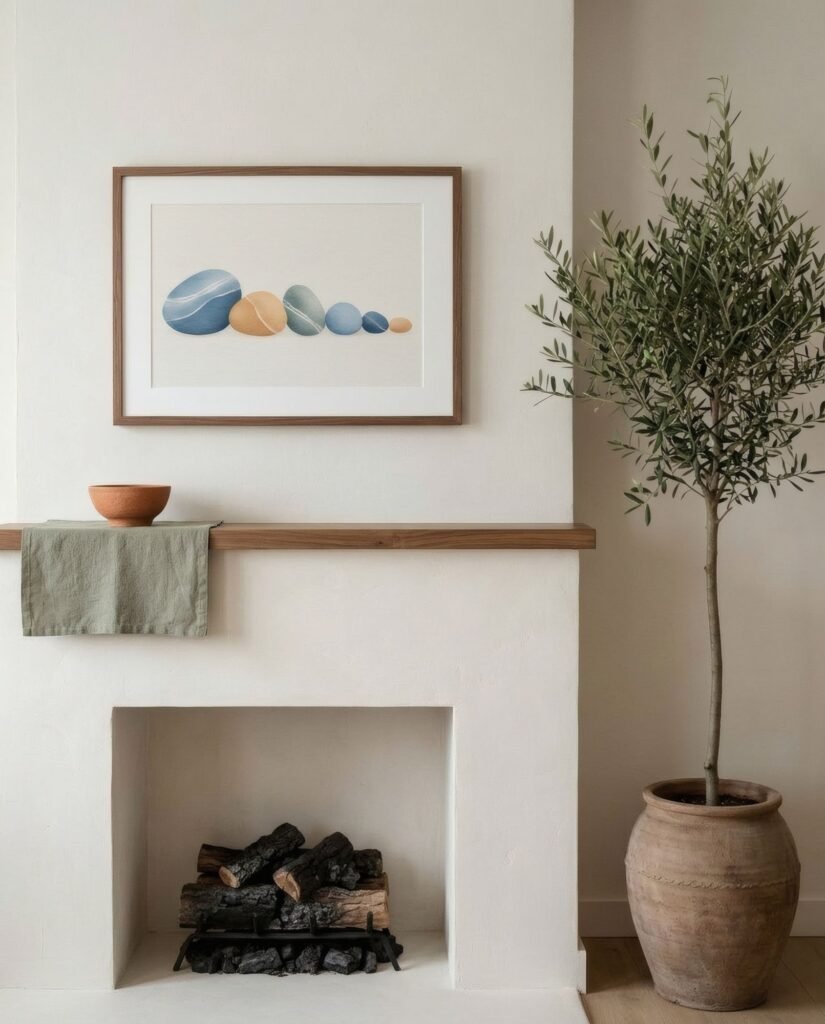
Here’s where the chimney breast differs from every other wall. If the fire is used, hot air rises up the wall, and the area directly above the opening can get properly warm, as well as catching smoke and soot when the draw isn’t perfect. Paper and ink don’t enjoy heat or smoke: over time they can yellow, cockle or discolour.
A few sensible precautions. Touch the wall once the fire has been going a while: if it’s warm to the hand, it’s not a good place for a print. Leave a generous gap between the opening and the art; the more you use the fire, the more space it needs. A deep mantelshelf helps by deflecting some of the heat and smoke. And always frame with glass and a well-sealed back to keep soot out.
If in doubt, or if the fire is lit every day, the more cautious approach is to give the chimney breast to something that copes better with heat, a mirror or a ceramic piece, and hang prints in the alcoves either side, where far less heat reaches.
With decorative or sealed fireplaces that are never lit, none of this applies, and the wall can be treated like any other.
Don’t forget the alcoves
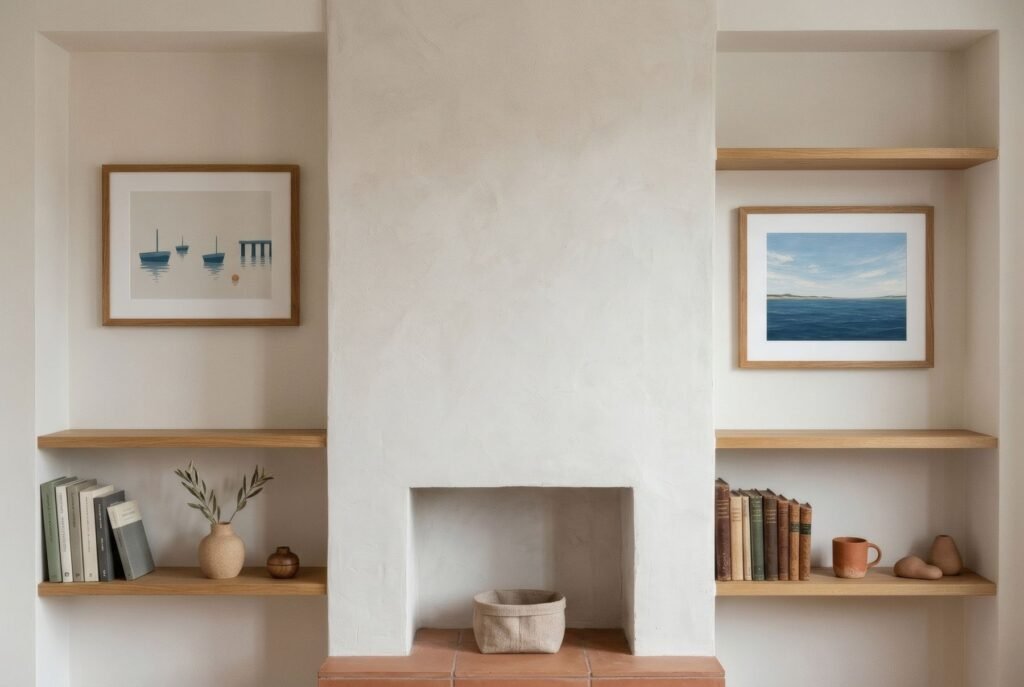
Many fireplaces have alcoves either side, often with built-in shelves. They’re perfect for smaller pieces, propped among the books or hung in the middle of the recess, and the heat there is much lower. A matching pair of portrait prints, one each side, reinforces the fireplace’s symmetry without crowding it.
The heart of the room
Dressing the wall above a fireplace means dressing the place everything else faces. With well-judged scale, a calmly styled mantel and a little caution about heat, that focal point becomes the heart of the house, lit or not.
For a wall like this, a Bendíra 50 × 70 cm print with a generous mount has enough presence, framed to your taste and behind glass.
Keep reading: How to Protect Art Prints from Sunlight and Moisture, How to Display Art Prints on Shelves and Ledges and How to Choose the Right Art Print Size.