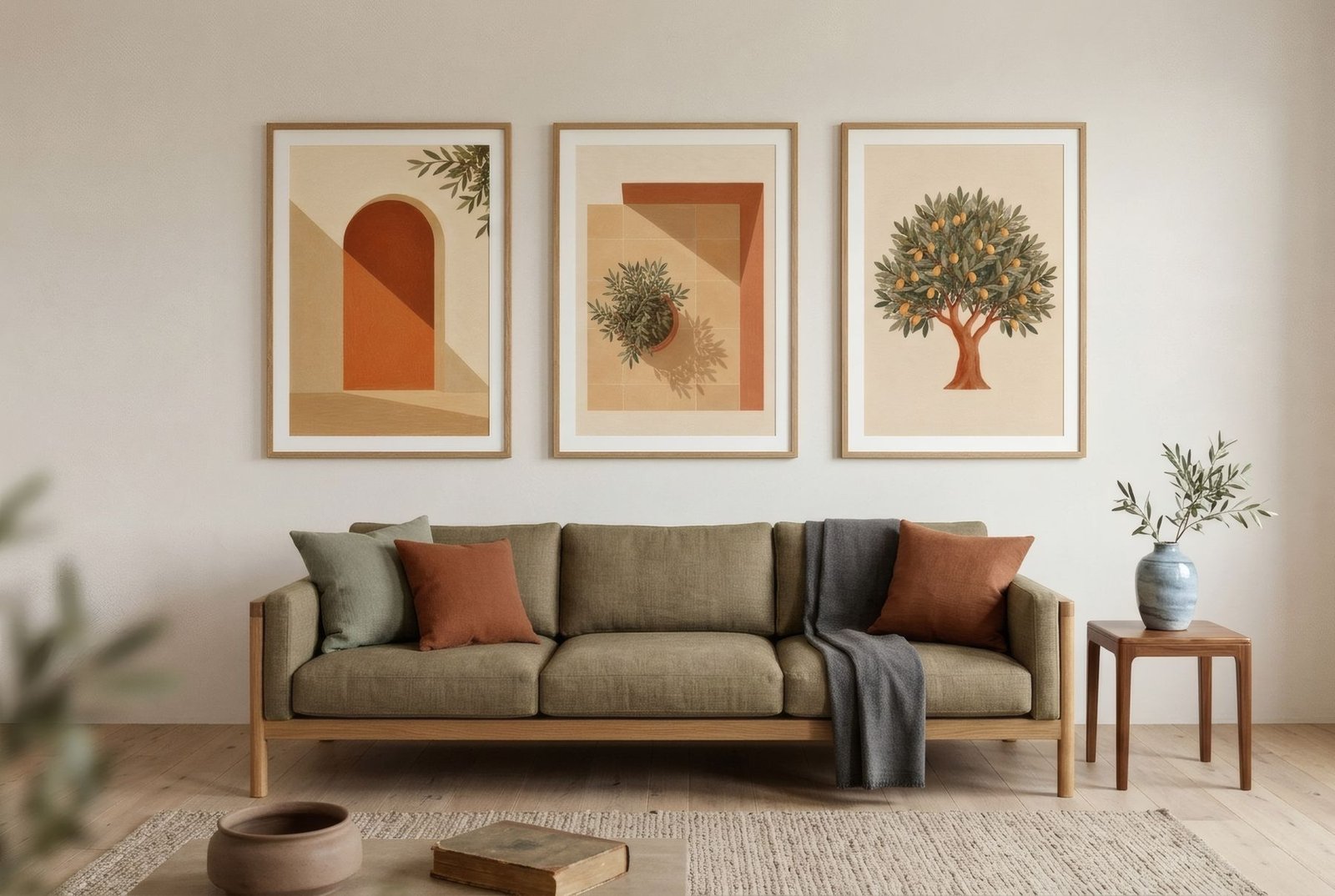
There is something about the number three that feels especially harmonious. Beginning, middle and end. Left, centre and right. A triptych, three works designed to be seen together, draws on that harmony and turns it into rhythm. It has more movement than a pair and more order than a gallery wall, and it can fill a long wall with a presence few arrangements can match. But it is demanding too. The three pieces must relate well, the spacing must be immaculate and the whole must be proportioned to the space. Knowing when to use it and how to hang it is what turns a triptych from pleasant into memorable.
A form with a history
The word triptych comes from the Greek for «three-fold». In European art history it is associated above all with medieval and Renaissance altarpieces: three painted panels, often with side wings that could close over the centre. That structure, a centre accompanied by two sides, has inspired artists ever since, and lives on in interiors as one of the most balanced arrangements for a wall.
Three ways to think of a triptych
One image split into three. A single composition, such as a landscape, a form or a horizon, divided into three pieces that together make one continuous image. It is the most striking version and the most demanding, since any slip in alignment or spacing breaks the continuity.
A series of three. Three independent works sharing subject, palette and style: three variations on a form, three times of day, three views of one coastline. Each could stand alone, but together they tell more.
A centre with two wings. Inspired by classical altarpieces, a larger central work flanked by two smaller ones. It creates a clear hierarchy and a very serene symmetry.
When it works
Triptychs shine on long, horizontal walls where a single work would have to be huge to fill the space. Above a three-seater sofa, a wide double bed, a long sideboard or a dining table, three pieces in a row fill the space naturally and rhythmically.
They also work in wide hallways and on dining room walls seen from a distance. And vertically, three pieces stacked in a column can resolve tall, narrow walls with real elegance.
They work less well on small walls, where three pieces would be squeezed, or on walls broken up by doors and windows, where there is no long enough uninterrupted stretch.
Calculating the width
Before choosing the works, calculate how much space the whole will take. The sum is simple: the width of the three framed pieces plus the two gaps between them.
For example, three 50 × 70 cm portrait prints in slim frames each measure about 55 cm wide. With 6 cm gaps, the whole spans 55 + 6 + 55 + 6 + 55 = 177 cm (about 70 in). Above a 240 cm (94 in) sofa, that falls neatly within the balanced band of half to two-thirds of the furniture. Three 30 × 40 cm portrait prints would come to about 115 cm (45 in), suitable for a two-seater or a sideboard of around 180 cm.
Spacing
In a triptych, the gaps are what people notice most, and they must be exactly equal. As a guide, 5–8 cm (2–3 in) works in most cases. For a single image split into three, keep the gaps small so the continuity is felt. For three independent works, they can be a little wider.
What never works is uneven spacing. A centimetre’s difference between one gap and the other is enough to make the whole look careless.
Alignment and height
The three pieces must be perfectly aligned: along top and bottom edges if they are the same size, or along a central horizontal axis if the centre is larger. Hang the group as if it were one work, with its centre at eye level on an open wall, or its bottom edge 15–25 cm (6–10 in) above the furniture.
To hang it without mistakes, paper templates are almost essential. Cut them to the exact size of each frame, mark the hanging point on each, and tape them to the wall at the measured spacing. Details in how to create a gallery wall at home.
Choosing the three works
For a triptych, the safest choice is three works of the same size and frame that belong to a series or clearly share a palette and language. If each is very different, the group loses unity and reads as three separate works in a line.
Think about sequence: which work goes in the centre, which at the sides. Often the most intense or most balanced works best in the middle, with the sides accompanying it. There might also be a progression, light to dark or one time of day to another, that the eye follows from left to right.
A rhythm for the wall
A well-composed triptych turns a wall into a small sequence, a three-beat rhythm the eye travels calmly. With the width well calculated, perfect spacing and three works that understand each other, it can be the most elegant arrangement in a home.
If this form appeals, Bendíra’s collections bring together prints that share a palette and atmosphere and can be combined in threes, at 50 × 70 or 30 × 40 cm.
Keep reading: How to Style a Pair of Art Prints, How to Display Art Prints on Shelves and Ledges and How to Decorate a Large Wall with Art.