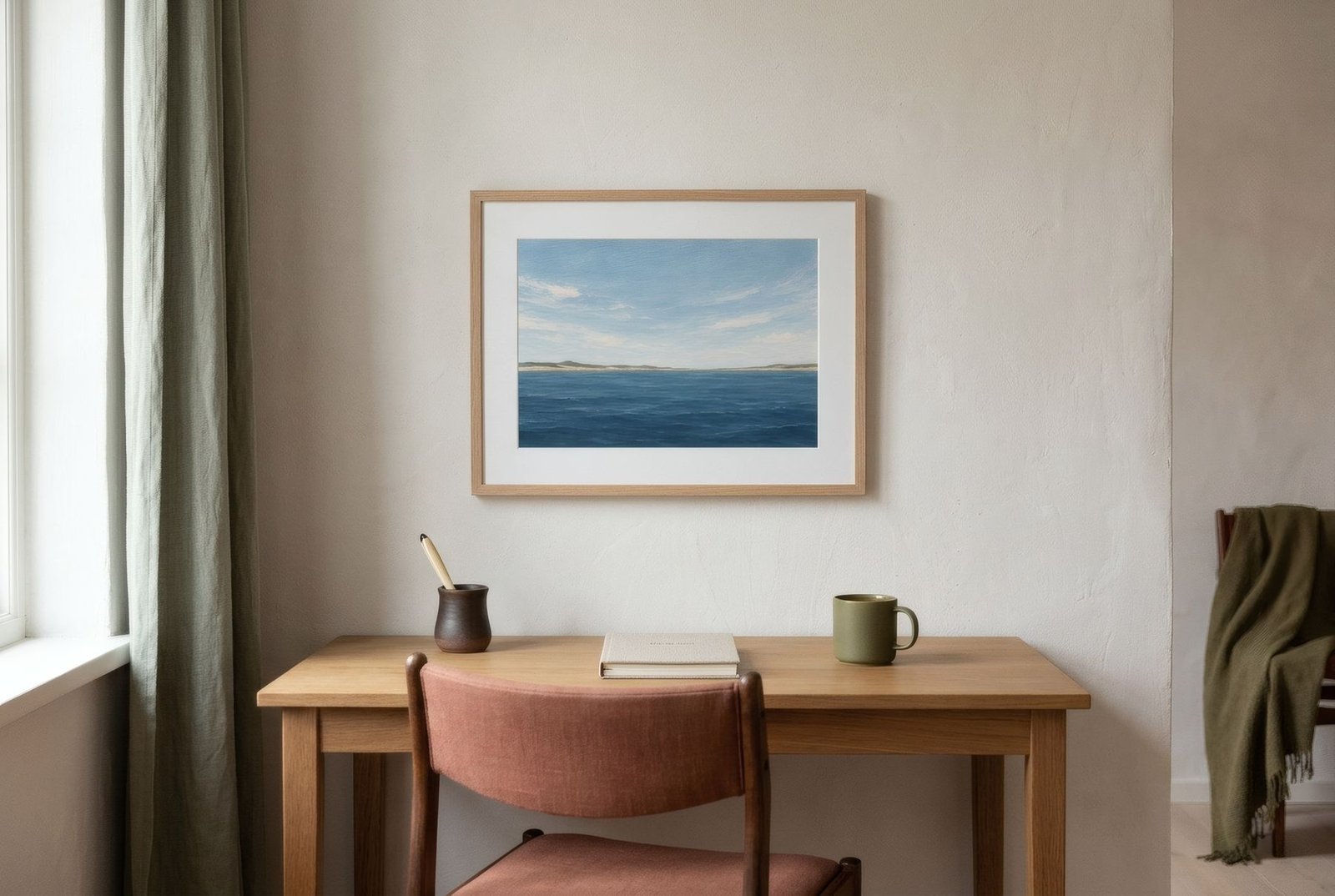
Since working from home became normal for so many people, the desk corner has stopped being somewhere you pass through. We spend hours there, sometimes more than in the living room. Yet it is often the least considered space in the house: a desk, a chair, a screen, and a bare wall or one covered in sticky notes. A little art can change that a great deal, provided it is chosen with care. A home office calls for works that keep you company without demanding attention, placed where you will actually see them, and increasingly chosen with an eye on what appears behind you on a video call.
Where you look while working
Start by understanding how you look in a workspace. Most of the time your eyes are on the screen or the page. Now and then you look up to think, rest your eyes or simply switch off for a second. Those moments are what matter.
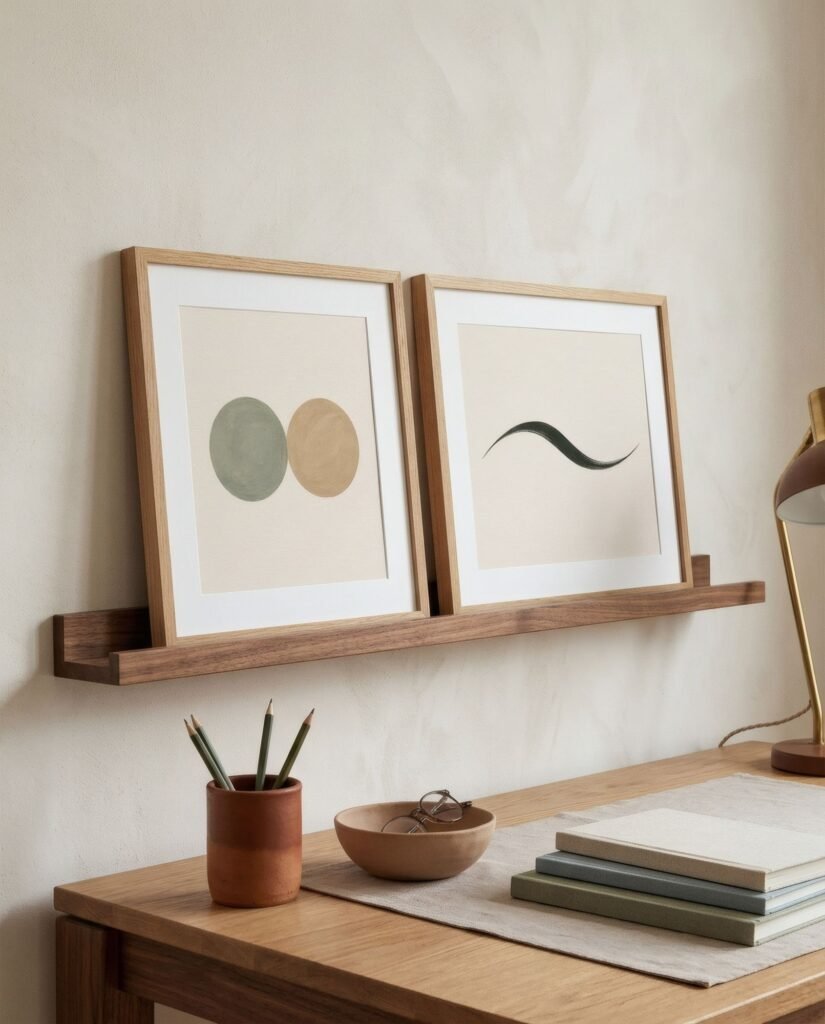
So think about three positions. The wall in front of the desk, the one you see when you look up, is the most important. The side wall, which appears when you turn your head or lean back, is ideal for a work you discover from time to time. And the wall behind you is what others see on video calls.
The wall in front
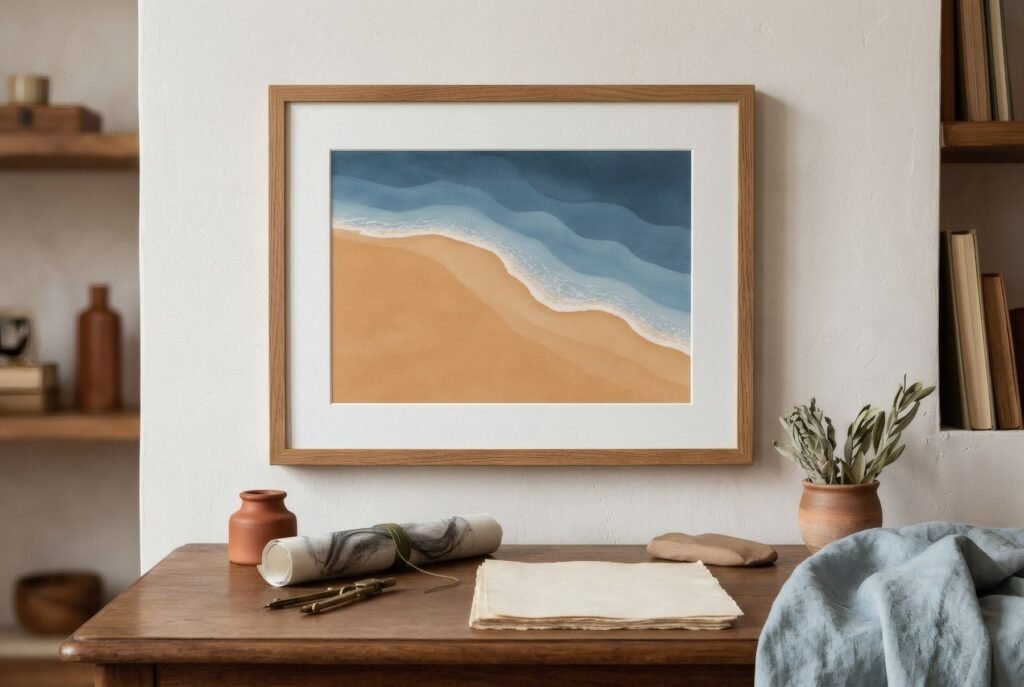
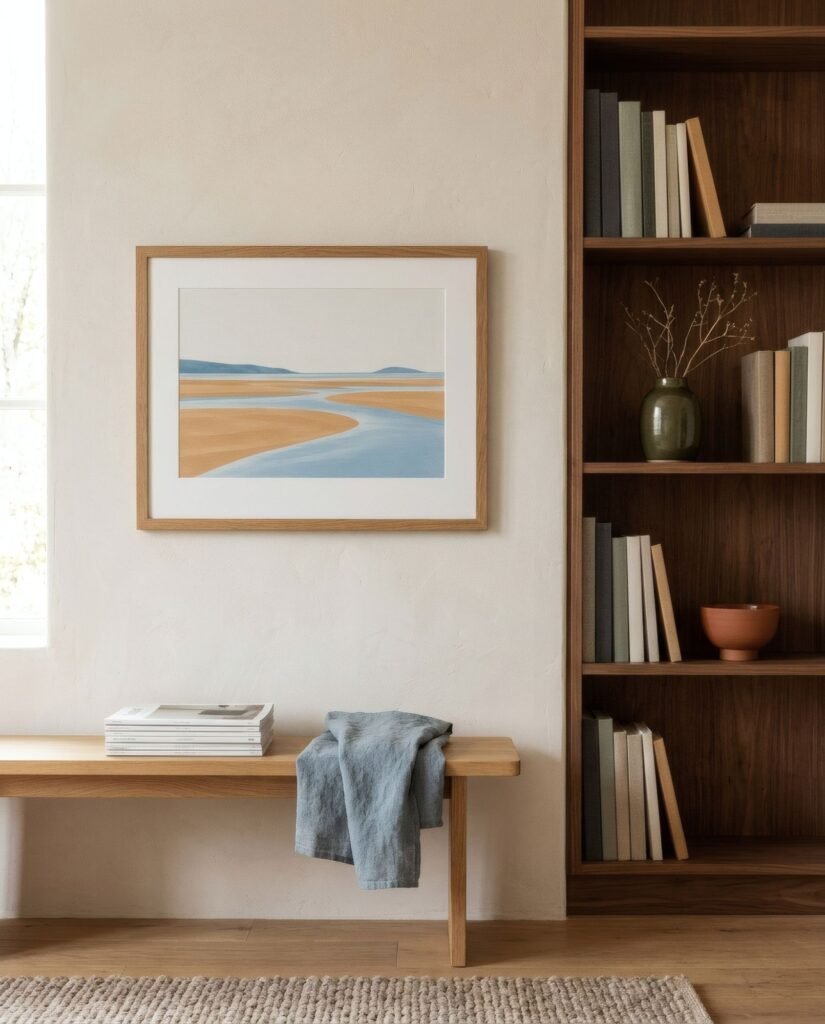
If your desk faces a wall, that wall is what you will see most. Calm works with simple composition and a quiet palette suit it well: a wide landscape, an abstract of few forms, a horizon line. These are images the eye can rest on without getting caught.
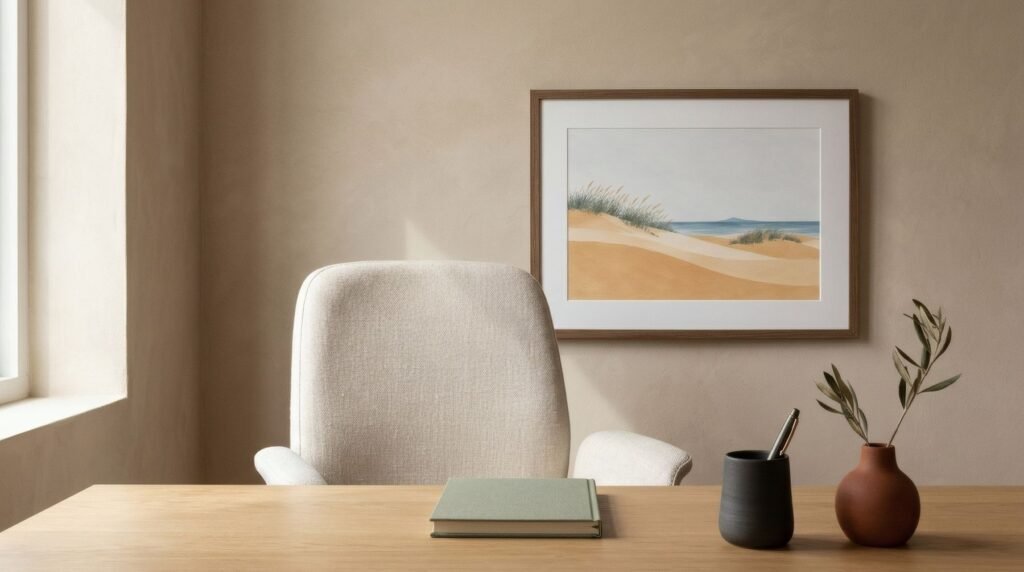
In this position, it is best to avoid works dense with detail, heavy with text or very high in contrast, which can tug at your eye just when you need to concentrate. There are no universal rules, because everyone is different, but many people’s experience suggests that in front of a desk, less is more.
As for height, if you work seated, the centre of the work can drop to around 120–135 cm (47–53 in) from the floor so it sits in your line of sight when you look up. If a shelf or monitor blocks part of the wall, place the work above it, without hanging it too high.
The side wall
A wall beside the desk is perfect for a work with more personality. Because it is outside your main line of sight, it does not compete with the work, but it appears when you turn or stand. It might be a piece that inspires you, reminds you of something or that you simply enjoy looking at during breaks.
The video-call wall
For many people, the wall behind the chair has become a kind of shop window. It is what colleagues, clients and family see in every call. It need not become a stage set, but it deserves some thought.
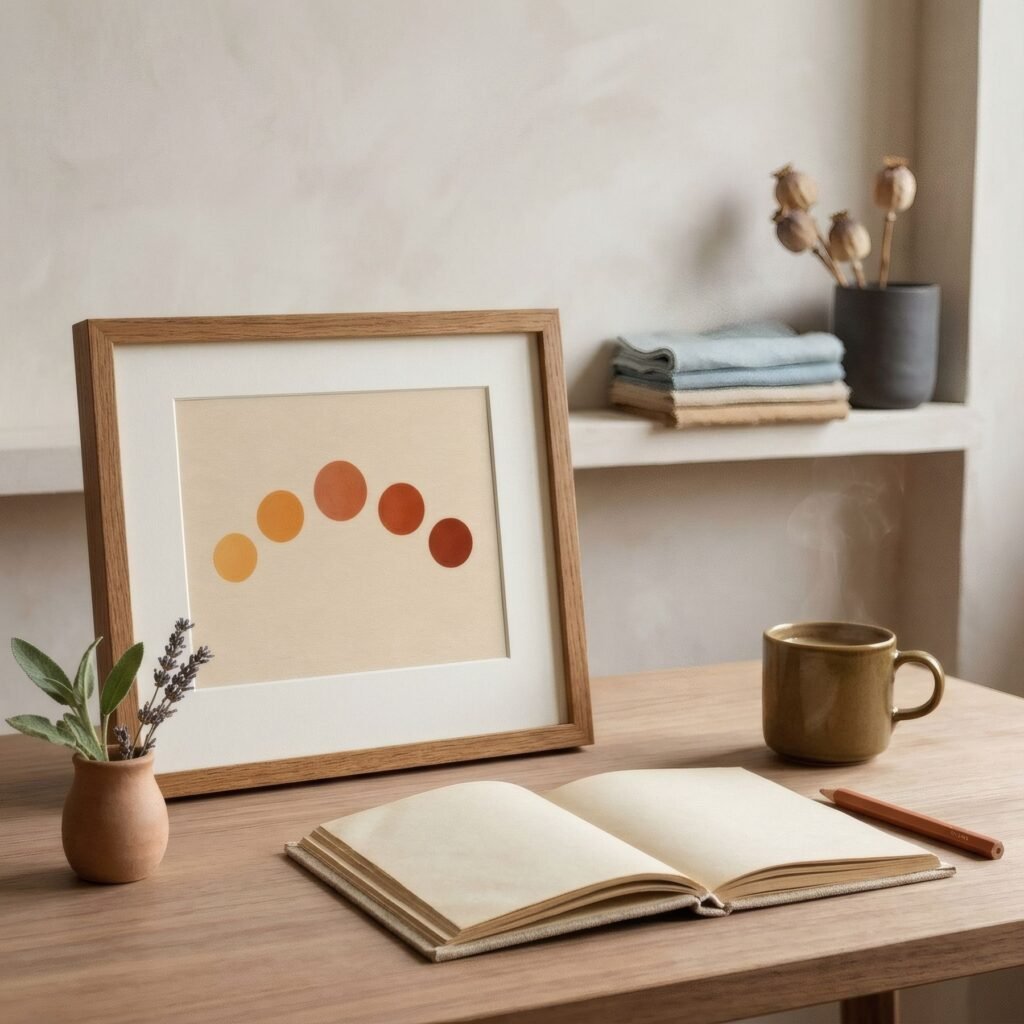
A single work, or a pair, usually reads better on camera than a crowded wall, which can look confusing in a small frame. Avoid having the work directly behind your head, as if sprouting from it, and prefer a slightly offset position. Clear forms and soft colours read better on screen than heavily detailed images. Watch for glare, too: glass facing a window or lamp can flash on camera, so a matt finish or anti-reflective glazing is a good idea.
Which images
Pared-back works tend to suit workspaces especially well: calm abstracts, simple forms, spacious landscapes, finely drawn botanicals. They bring calm and order without demanding attention.
There is room for something personal too: a small work that reminds you why you do what you do, a photograph of a beloved place, a drawing by someone close. Keep it small and secondary, on the desk or the side wall, so it keeps you company without taking over.
Flexibility
A narrow picture ledge above the desk or on the side wall lets you swap works with the moment or the project and avoids lots of holes. It is a practical answer for workspaces that are often part of another room, a corner of the living room or bedroom. We explore it in how to display art prints on shelves and ledges.
Light
The desk is often by a window, to make the most of daylight. That can affect a work if direct sun falls on it for hours, so protect it or choose a wall out of the sun. And again, watch for reflections: a glazed work on the wall in front can reflect the screen or the window.
A space that is also yours
Working from home does not mean giving up on that space being beautiful. A well-chosen work, placed where you will see it when you look up, can make the hours at the desk feel a little more your own.
If you are looking for something calm for your workspace, Bendíra’s Quiet forms collection brings together prints of minimal lines and gentle forms, made to keep you company without distraction.
Keep reading: How to Choose Wall Art for a Dining Room, How to Style a Pair of Art Prints and How High Should You Hang Pictures?.