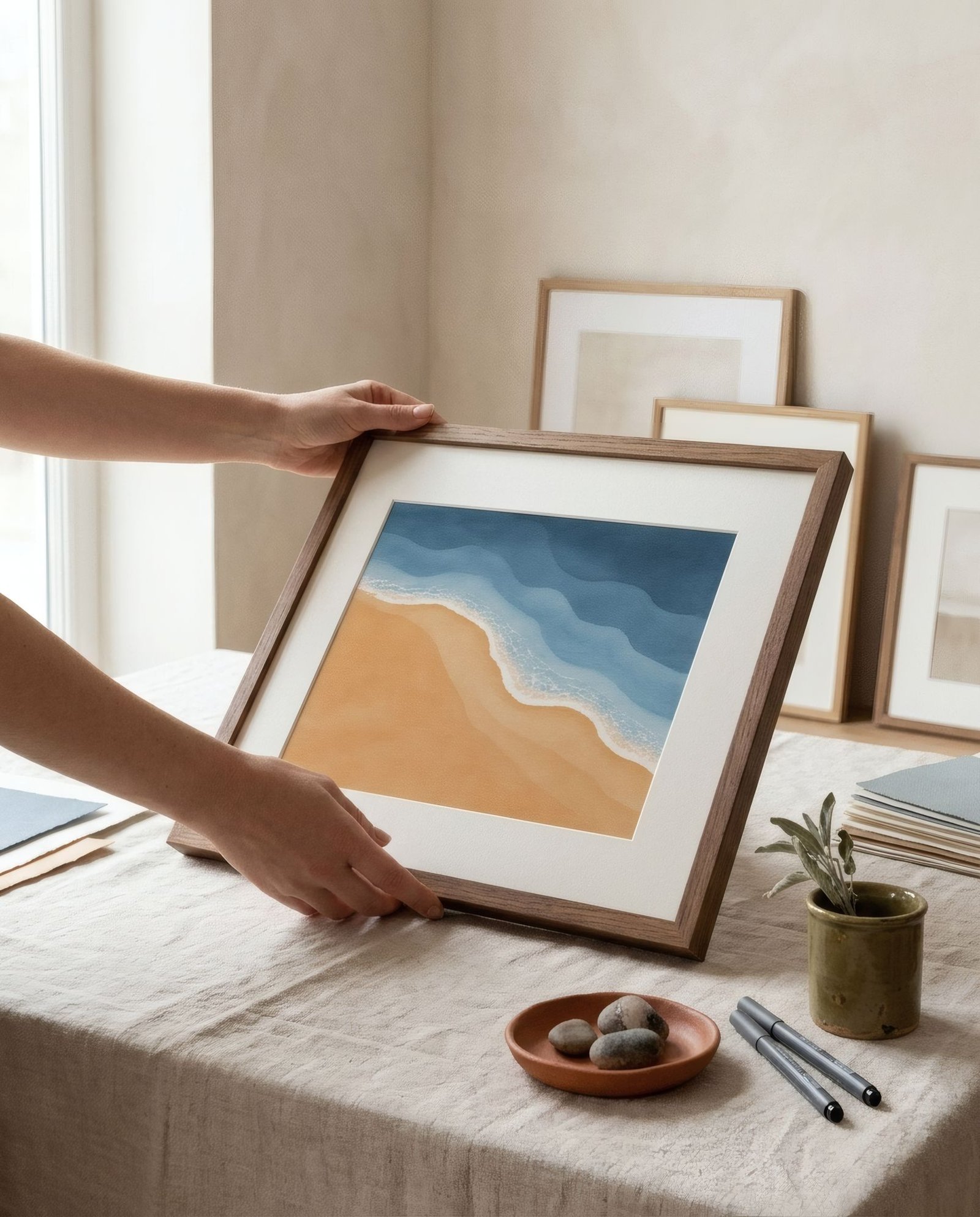
For a long time, talking about art and talking about accessibility seemed like contradictions. You either bought an original, expensive and exclusive, or made do with a hastily printed poster on thin paper that rippled within months. There was little room between the two. Today that room exists, and it is exactly where we want to be. We sometimes call it accessible premium: works carefully designed and printed, yet made so that anyone who wants to live with art at home can do so. It is not a sales formula but a way of working, with concrete decisions behind it that we think are worth explaining.
What we mean by quality
Quality in a print is not a word on a label. It is the sum of many small decisions, most of them invisible to the person who buys it.
It begins with design: each image is composed with attention to form, colour and space, imagining how it will look on a real wall, not only on a screen. It continues with file preparation, so the image has the right resolution and colour for the size it will be printed. Then comes paper: we choose a matte fine-art paper with body and a glare-free surface that lets the work be seen clearly. And it ends with final care: we print in our own studio, trim each print and check it by hand before it is sent.
None of these steps is spectacular alone. Together they make the difference between a printed image and a print made to live in a home.
What makes a fair price possible
Accessibility does not come from cutting those corners, but from other choices.
The first is honesty about what a print is. A print is a printed reproduction of a work, not a unique original or a numbered original print. That lets it be offered at a very different price from an original, without pretending to be something it is not. We explain the difference in what is an art print? art prints vs posters.
The second is format. We offer our prints in standard sizes that fit easy-to-find ready-made frames, so no one is obliged to pay for bespoke framing, though they can choose it if they wish.
The third is scale. We are a small studio working without large overheads, which lets us concentrate on what matters.
What we do not promise
Being accessible also means being clear about what we do not offer. We do not sell originals or signed limited editions. We do not promise a print will rise in value; it is not an investment but a work to enjoy. And we do not promise it will last for ever unchanged, because no paper does: its condition also depends on where and how it is hung, as we explain in how to care for your art prints.
We believe that clarity is part of quality. A brand that says exactly what it offers lets people choose with confidence.
Why accessibility matters to us
It matters because we believe living with art should not be a privilege. A beautiful image on the wall of a home can change how you live in it, and that possibility should be open to anyone: someone furnishing a first flat, someone looking for a meaningful gift, someone slowly building a collection of their own.
The history of printed art is, in large part, a history of that widening access. From engraving to lithography to digital printing, each technical advance has let more people live with images. We like to think we are part, in our small way, of that long tradition.
Quality you can see and touch
In the end, the best way to judge a print is to see and touch it: the crispness of its lines, the smoothness of its gradients, the body of the paper, the neatness of its edges. If you would like to know what to look for, we set it out in what makes a high-quality art print?.
We invite you to explore our prints and see for yourself, at your own pace.
Keep reading: Our Perspective on Contemporary Design, Paper, Ink and the Beauty of Tangible Art and How to Build an Affordable Personal Art Collection.