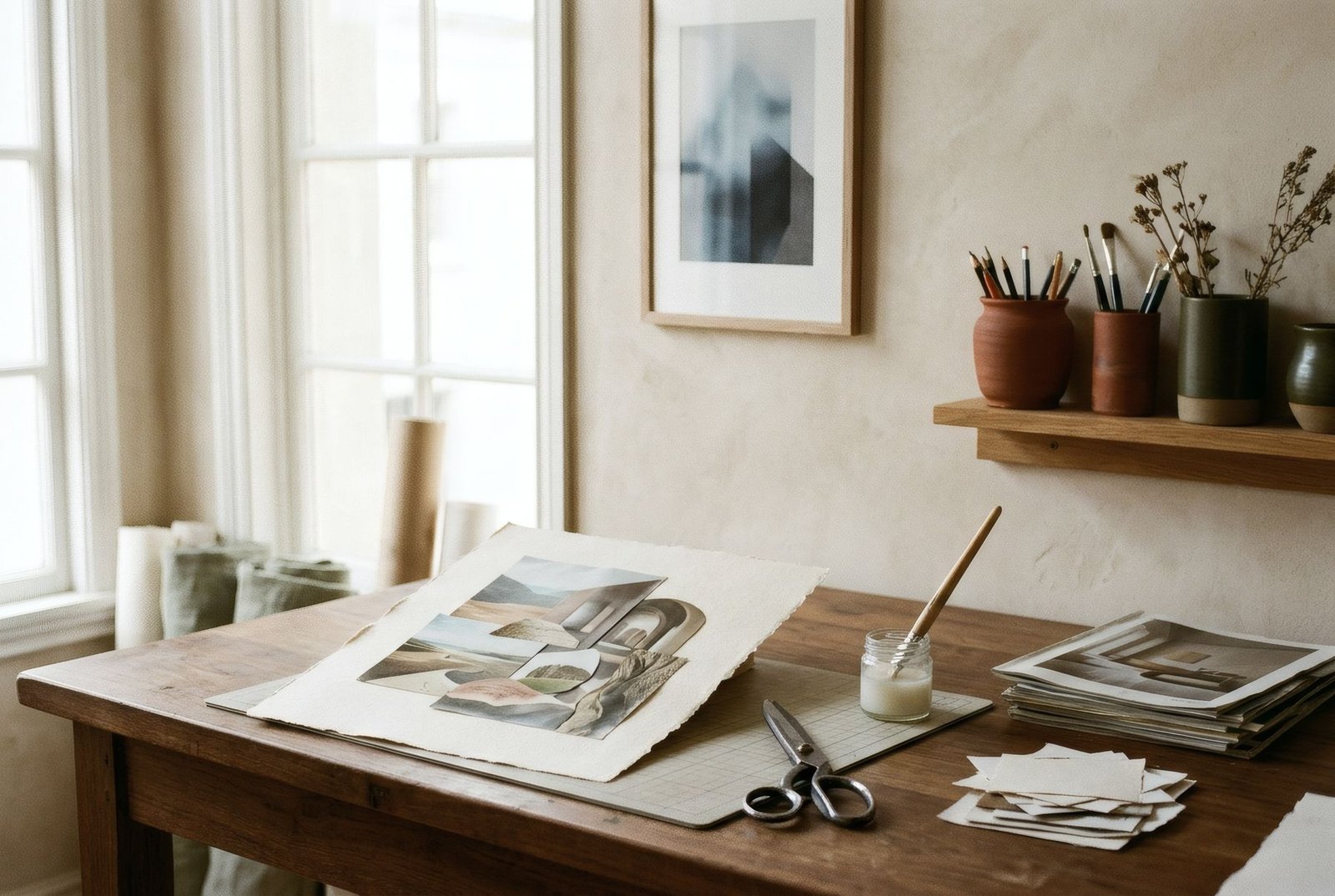
Open almost any design magazine, essay collection or experimental record sleeve and you’ll probably find a photomontage: fragments of photographs cut out and combined to make an image that never existed. A head floating over a city, a giant hand holding a building, a crowd pouring from a mouth. Today they’re made on screen in minutes. But the technique was born a little over a century ago, with scissors, glue and illustrated magazines, just as printed photography was beginning to flood everyday life. And it was born with a clear purpose: to say something.
Collage, photomontage, montage
Start with the words. Collage, from the French coller, to stick, means building a work by gluing different materials onto a surface: paper, fabric, cuttings, objects. The Cubists, Picasso and Braque, brought it into painting around 1912.
Photomontage is a particular kind of collage where the main material is photographs, usually cut from newspapers and magazines, combined to create a new image with its own meaning. It isn’t just sticking photos down: the collision of fragments should produce something new, often ironic, critical or poetic.
Then there’s darkroom montage, combining negatives during printing, a tradition going back to the nineteenth century. Avant-garde photomontage, by contrast, celebrated its cuts and seams: it didn’t want to fool you; it wanted you to see the scissors.
Berlin, Dada and the scissors
Photomontage as an art form emerged in Berlin after the First World War, in the Dada circle. Berlin’s Dadaists, amid political and social upheaval, took photographs from the illustrated press and cut them up to rearrange the world with irony and fury.
The most emblematic work is probably Hannah Höch’s Cut with the Kitchen Knife Dada through the Last Weimar Beer-Belly Cultural Epoch of Germany, of 1919–20, now in Berlin’s Nationalgalerie. It’s a large photomontage, more than a metre high, made from mass-media clippings: industrial machinery, politicians, artists, dancers, wheels, words. According to MoMA, Höch metaphorically turns her scissors into a kitchen knife cutting through the traditionally male domains of politics and public life. It was shown at the First International Dada Fair in Berlin in 1920.
Heartfield and the AIZ covers
If Höch took photomontage into art, John Heartfield took it to the newsstand. From 1930 he contributed regularly to the AIZ, the Arbeiter-Illustrierte-Zeitung, a mass-circulation workers’ illustrated magazine, designing many covers and inside pages. His anti-Nazi montages, such as Adolf, the Superman (1932), in which an X-ray reveals Hitler’s chest full of coins, are among the most forceful political satire of the century. After 1933 he worked from Prague, and later in exile in England.
Heartfield proved photomontage could be an editorial weapon: an image able to compress a whole argument into a single cover.
Rodchenko and the book
In 1920s Russia, Alexander Rodchenko applied photomontage to books and posters. In 1923 he illustrated Pro eto (About This), a love poem by Vladimir Mayakovsky, with photomontages that MoMA describes as Rodchenko’s first used in book design. The cover features a photograph of Lilya Brik. That book pointed the way: cut photography, combined with type and flat colour, became central to modern graphic design.
From manifesto to magazine cover
Through the twentieth century, photomontage moved from the avant-garde into editorial design. Magazine covers, book jackets, film posters, record sleeves: the photographic cut-out became a standard way to express complex ideas in a single image. With digital editing the technique became open to anyone, and its look, with cut edges, impossible scale and flat backgrounds, remains very present in contemporary editorial illustration.
A note on archives
Photomontage is made from other people’s images, which raises an important question today. Photographs have authors and often rights. The avant-garde cut up the press without asking, in a different legal context and with a different intent. Anyone making photomontage to publish or sell today should work with their own images, public-domain photographs, or archives that allow reuse, such as the open-access programmes of some museums and libraries. We explain more in public domain art: what you can and can’t do.
The meaning of the cut
Photomontage taught us something we now take for granted: that an image can be built from fragments, and that the cut, the visible seam, communicates too. On a wall, a good photomontage still has that power to surprise: showing the world as it isn’t, so we can see it better. There’s more context in photography as art at home.
If you’d like to explore further, MoMA’s online collection lets you page through Pro eto.
Keep reading: Collage Art: Layers, Materials and Composition, The Ulm School and the Legacy of Functional Design and The Art of the Travel Poster: A Brief Visual History.