In December 1915, in Petrograd, today’s St Petersburg, an exhibition opened with an enigmatic title: 0.10: The Last Futurist Exhibition of Painting. Among the works were thirty-five abstract paintings by Kazimir Malevich. And high in the corner of one room, in the spot where Russian households hung their religious icons, was a picture showing nothing but a black square on a white ground. More than a century later it remains one of the most argued-over images in art history. With it, Suprematism was born in public.
Painting’s zero point
To understand Suprematism, picture the context. By the early twentieth century, European painting had spent decades dismantling traditional representation: the Impressionists dissolved form into light, the Cubists fractured objects, the Futurists set them in motion. But all of them still started, in some way, from the visible world.
Malevich wanted to take the final step: painting that represented nothing. No objects, no landscapes, no figures. Only pure geometric form, colour and space. The exhibition’s title, 0.10, alluded to beginning again from zero, as Tate explains. The black square was, for him, that zero point: the end of painting as imitation and the start of something new.
He called it Suprematism because it asserted the «supremacy» of pure feeling in art, above the depiction of the world.
The Black Square and its mysteries
The Black Square has a layered history. Malevich dated it 1913, but Tate considers June 1915 the most likely date it was painted. The original, in the Tretyakov Gallery in Moscow, is so cracked it can’t travel; Malevich himself painted further versions years later.
Its placement wasn’t accidental. Hung high across a corner, in the «beautiful corner» where Russian families kept their icons, it occupied an almost sacred position. It was a statement: the new abstract painting was taking the place of the spiritual image.
Floating forms
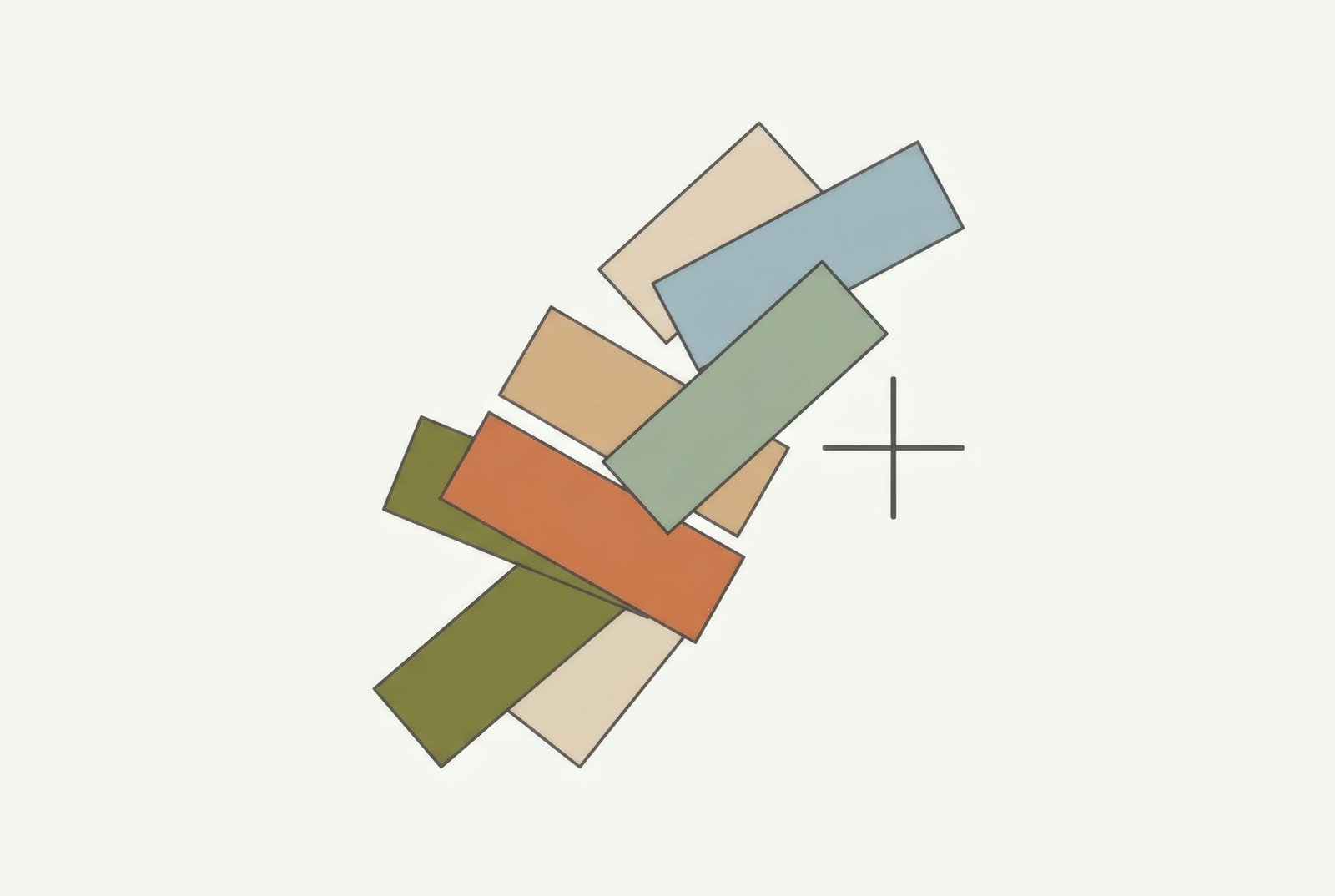
After the black square, Malevich’s Suprematist work filled with rectangles, crosses, circles and bars of pure colour that seem to float on a white ground, weightless, with no floor and no horizon. The white isn’t a wall; it’s an infinite, almost cosmic space. The shapes tilt, overlap and gather along diagonals that suggest movement and tension.
In 1918 Malevich pushed the idea to its limit with Suprematist Composition: White on White, now at MoMA in New York: a slightly tilted white square on a ground of another white. The form almost disappears. It marks the move from coloured to monochrome Suprematism.
A movement, not just a look
Here’s the important distinction, and the one most often lost today. Suprematism wasn’t a decorative style of geometric shapes. It was a movement with a theory, manifestos and an almost philosophical ambition: to transform art and, through it, life.
After the 1917 Revolution, Malevich and his followers took those ideas into teaching and design. In Vitebsk, where he ran the art school, the UNOVIS group formed and published Suprematism: 34 Drawings in 1920, probably printed by El Lissitzky, according to MoMA. Suprematist forms moved into posters, ceramics, textiles and imagined architecture. The influence ran on into Constructivism, the Bauhaus and much of modern graphic design. We set this in wider context in twentieth-century avant-gardes and art at home.
The Suprematist look today
Today, geometric shapes floating on white are everywhere: on posters, prints, fabrics. Many are described as «Suprematist», but it’s worth making a distinction. One thing is the historical movement, with its radicalism and revolutionary context; another is a geometric-inspired aesthetic that borrows some of its shapes without its programme.
Nothing wrong with the second, as long as the two aren’t confused. A print with coloured rectangles floating on white can be lovely and owe a great deal to Malevich, but it isn’t Suprematism in the strict sense, just as a straight-lined sofa isn’t Bauhaus on its own.
Looking at a black square
Suprematism asks for something unusual: to look at a work that depicts nothing and let it work on its own terms. The shapes, the colour, the tension of a diagonal, the white space. It can be disconcerting at first. But that experience, of looking at something purely visual, underpins almost all the abstract art that followed, including what we hang at home today.
The geometric shapes of Bendíra’s Quiet forms aren’t Suprematism, but they share one conviction with it: that a few well-placed forms can be enough.
Keep reading: Geometric Art: Shapes, Colour and Composition, Bauhaus: Its History and Influence on Modern Design and The Ulm School and the Legacy of Functional Design.