There’s something freeing about open-plan living. With no walls in the way, light travels through the whole home, conversation flows between kitchen and sofa, and the sense of space is hard to beat. But that openness brings a challenge: when everything is one room, where does the sitting area end and the dining area begin? How do you stop a big space feeling like a warehouse with furniture in it? Rugs, lighting and the arrangement of furniture do much of the work. Art can do the rest, and it does it in a particular way: by organising where we look.
Think in sight lines
In an open-plan space, almost any spot gives a view of several walls at once. So rather than asking «what goes on this wall», it helps to ask what can be seen from each place where people stop.
There are three or four fixed points in nearly every open-plan room: the entrance, where you take in the whole space for the first time; the sofa, where you look for hours; the dining table, where you sit facing a particular wall; and, with an open kitchen, the work area, from which you see the rest of the room.
Imagine a line running from each of those points to the wall in front of it. Those are your sight lines, and they’re where art has most impact.
An anchor for each zone
The most effective way to zone with art is to give each area its own visual anchor: a piece, or a group, that reads as the centre of that area.
In the living area, the anchor is usually the piece above the sofa, or on the wall facing it. In the dining area, a piece above the sideboard or on the wall the table faces. In an open kitchen, a smaller print beside the table or breakfast bar. Each anchor stakes out its territory: the eye understands that the space around that piece belongs to that function.
It helps if the anchors differ a little from one another: in size, orientation or composition. A large landscape piece above the sofa and a portrait one in the dining area, for example, help tell the two spaces apart.
A thread that ties it together
But an open-plan space isn’t three separate rooms; it’s one. If each zone has entirely different art, with palettes and styles that don’t relate, the whole thing fragments and you lose the best of the openness.
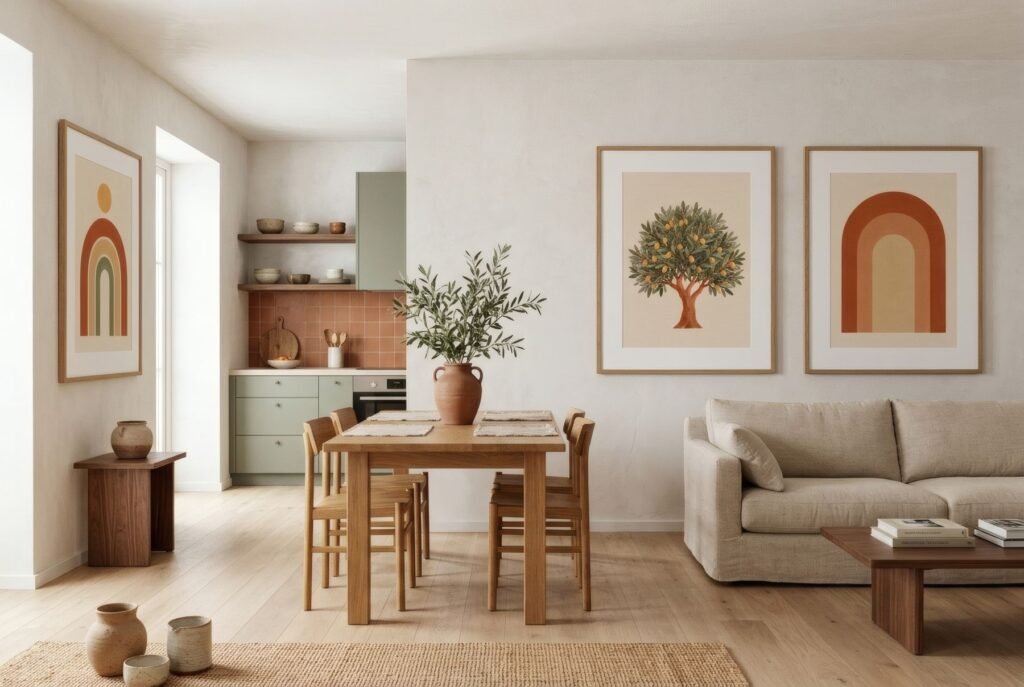
So alongside difference, you need a common thread. It might be palette: the three anchors share two or three colours, even if each has its own accent. It might be frames: the same finish throughout. Or it might be style: pieces from the same family, earthy abstracts across the whole space, say, with variations in shape.
The idea is that from the entrance you see a coherent whole; from each zone, a place with its own identity.
The missing walls
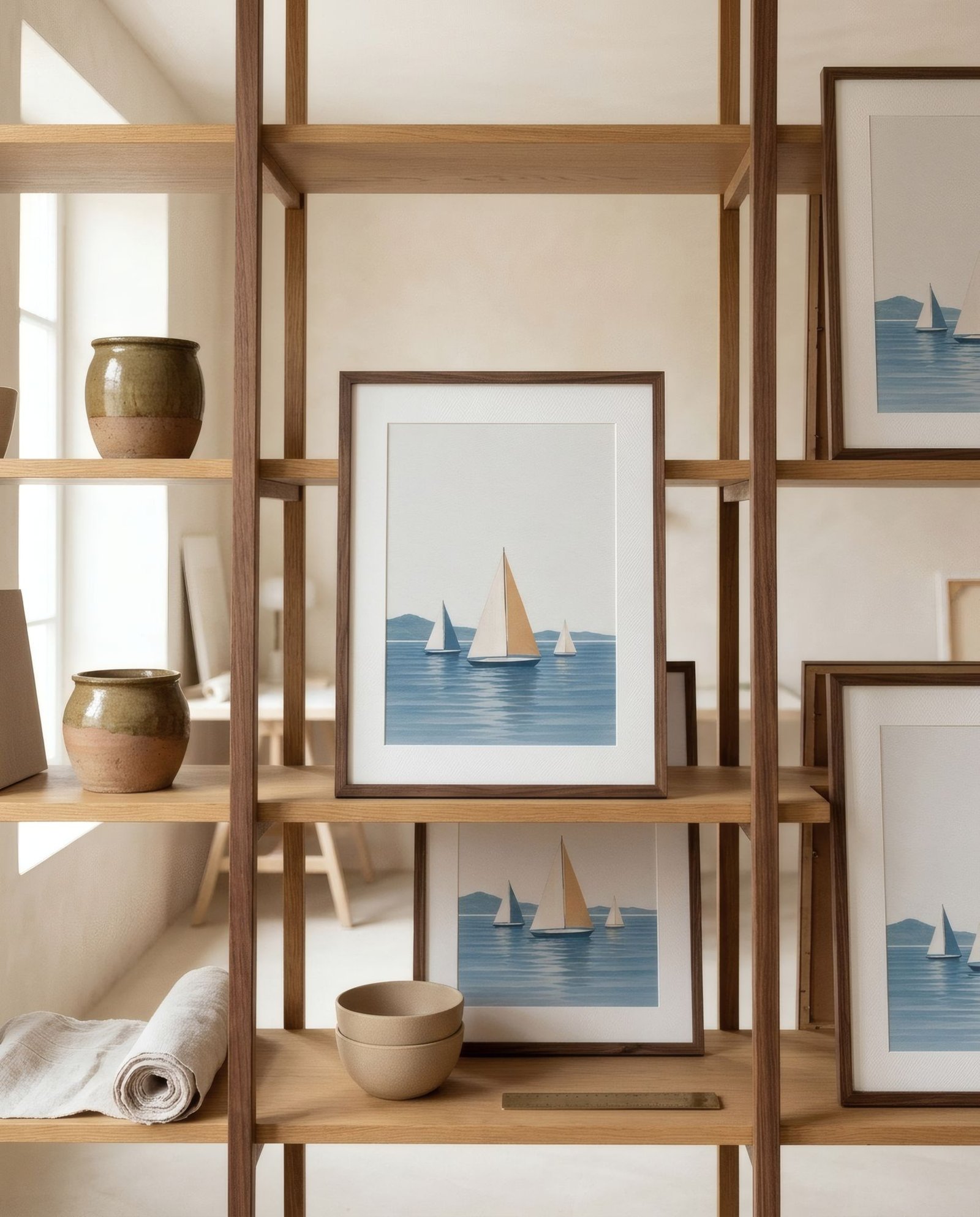
One challenge of open-plan living is fewer walls. Where there used to be a partition, there’s now air. That means making the most of the walls you have, and sometimes finding alternatives: open shelving that separates zones can hold prints leaned on its shelves, visible from both sides; a column can take a narrow portrait piece; a kitchen island can have a small print propped at one end.
What doesn’t help is filling every available wall. In an open space, emptiness zones too: a bare wall between two areas acts as a pause and helps separate them.
Scale for a big space
Open-plan rooms tend to be large, and the art needs to measure up. A small print on the wall of a seven-metre living-dining room disappears. Better generous pieces, or groups that read as a unit. There’s more in how to choose the right size of art for any wall.
Organising the gaze
In an open-plan space, art does something it rarely does in a closed room: it organises the way our eyes travel through the space. An anchor per zone, a thread that ties it together and a few empty walls to breathe are enough to make openness feel ordered. For more ideas on open spaces, see art for open-plan spaces.
With a single Bendíra collection spread across the zones, such as Southern light, it’s easy to keep that thread of colour running between living, dining and kitchen.
Keep reading: How to Choose Wall Art for a Dining Room and Home Studio Wall Art: Choosing Art for Focus.