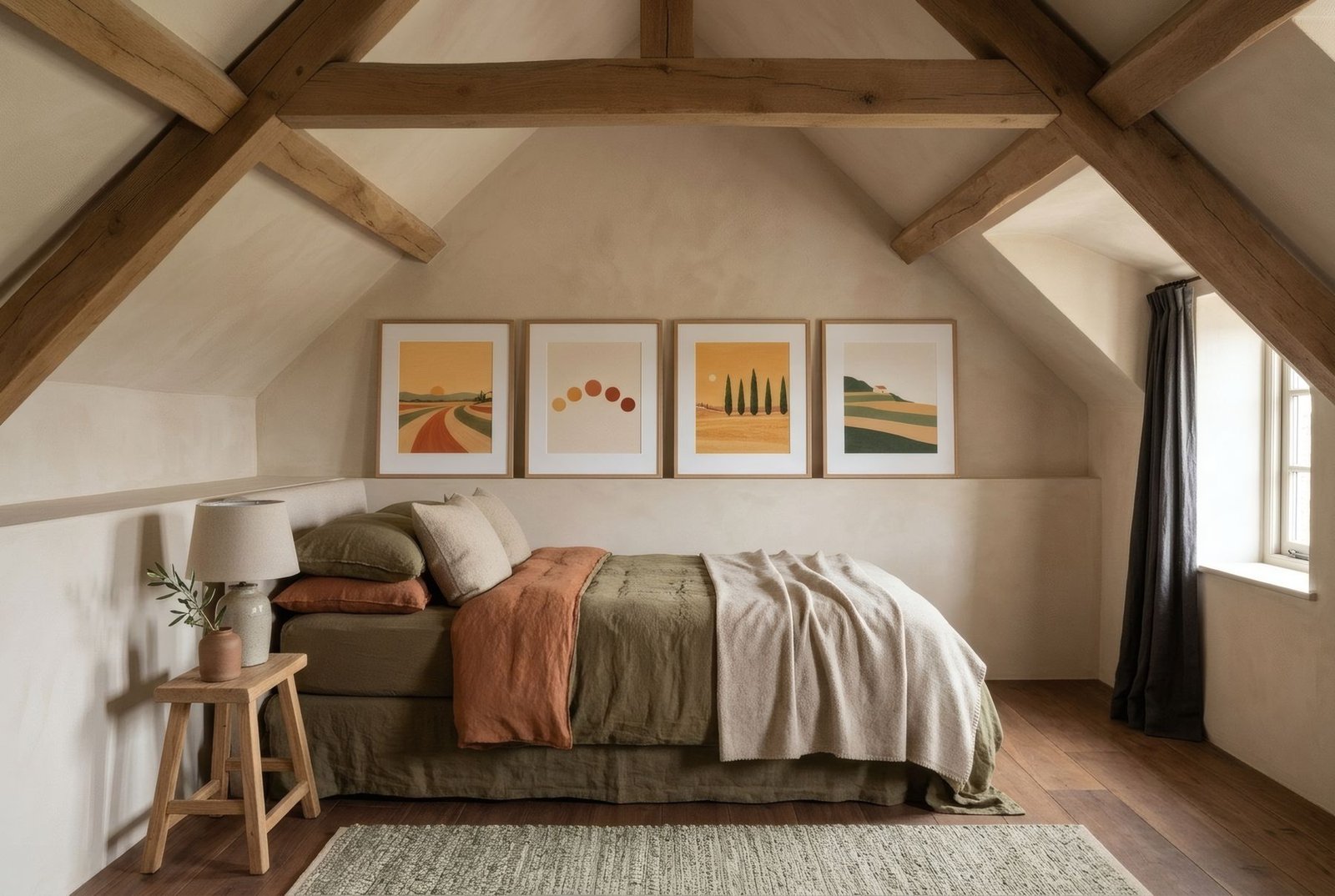
Loft rooms have a charm all their own. The ceiling that slopes down to one side, the beams, the skylight opening onto the sky: they feel tucked away, almost secret, and plenty of people choose them for exactly that reason, as a bedroom, a study or a reading nook. When it comes to hanging art, though, the geometry gets tricky. The walls aren’t rectangles, the height changes along a single stretch, and the instinct to centre things at eye level stops working. You have to look at the space differently.
Read the geometry first
An attic room usually has three kinds of surface. The full-height end walls, often gable-shaped, which give you a decent vertical area. The knee walls, the low walls where the slope begins, often only 80 cm to 1.2 m (2 ft 7 in to 4 ft) high. And the sloping ceiling itself, which is generally no place for pictures.
Start by working out where there’s enough vertical wall. Almost always, the best home for your main piece is a full-height end wall. There you can hang a portrait or landscape print using the same logic as any room, centred on the wall’s axis, which in an attic usually lines up with the highest point of the ceiling.
Knee walls: landscape and leaning
The low walls under the slope are a gift if you use them well. Their height sits right at the eye line of someone sitting or lying down: perfect in a bedroom, where the bed often runs along them, or beside an armchair.
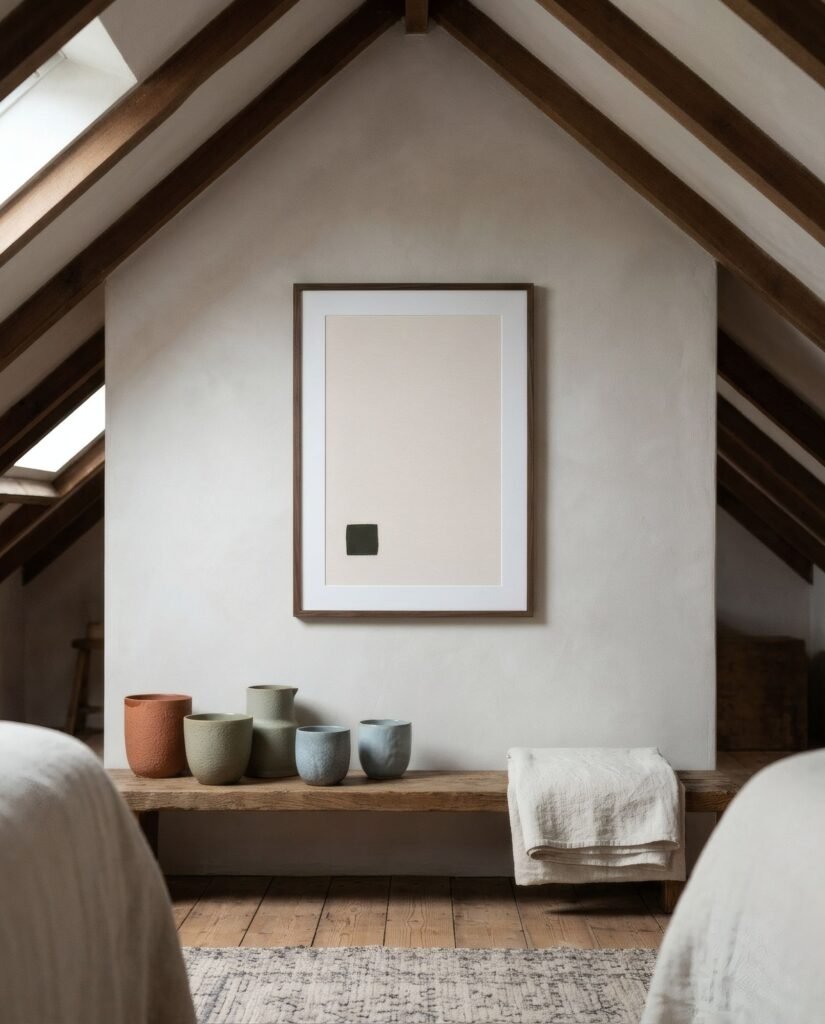
Landscape prints work particularly well here, following the direction of the wall, as does a row of small pieces aligned along their bottom edges. It’s also the ideal place to lean rather than hang: a slim ledge along the knee wall, with several prints propped on it, gives a continuous, flexible line that adapts to any height. If the slope starts very low, always leave some air between the top of the frame and the start of the ceiling; a print that grazes the slope looks squashed.
Which line to follow
In an attic, the key question is what to line things up with. There are three possible lines, and choosing one gives the room coherence.
The floor or furniture line: align the art by its bottom edges, at a consistent height above the bed, desk or chest of drawers. It’s the calmest option and nearly always the right one, because the irregular ceiling stays above and the ordered base sits below.
The slope: step several pieces down following the pitch, each slightly lower than the last. It’s riskier, but on a long wall with a clear slope it can create a lovely rhythm. It works best with pieces of the same size and frame, so the only thing that changes is the height.
The central axis: on gable-shaped walls, a single piece centred on the vertical axis. Symmetrical and serene.
What doesn’t work is mixing all three on one wall. The eye looks for an order, and if it can’t find one, the room feels more irregular than it really is.
Scale: don’t fill every gap
A common mistake is trying to fill every triangle of wall with something. In a loft room the slope already brings plenty of movement, and a wall crowded with pieces of different sizes adds to the sense of being hemmed in. Better to choose a few surfaces, give each one a well-sized piece, and let the rest breathe. As with low ceilings, which we cover in art for rooms with low ceilings, empty space is part of the composition.
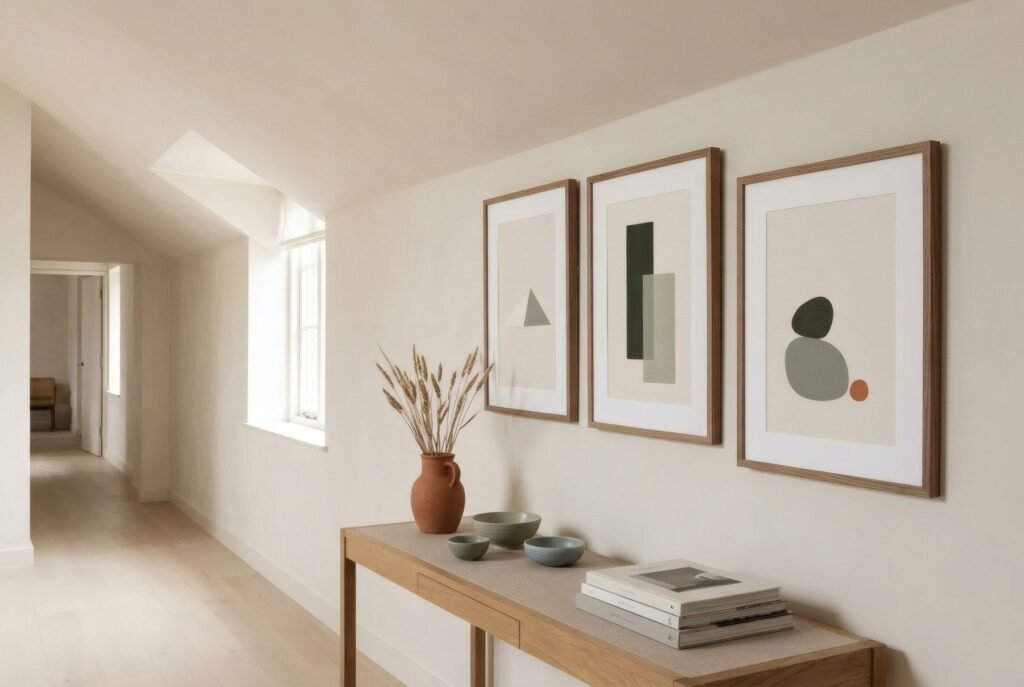
Skylights
Roof windows let in a lot of light from above, sometimes direct. Watch where the sun falls through the day and avoid hanging prints there, to protect the paper. Overhead light is wonderful, though, for seeing art on walls that don’t get direct sun, with no glare from the front.
A room with character
Decorating a loft room means accepting its geometry rather than fighting it. With a main piece on the tallest wall, one clear line to organise the rest and the nerve to leave some spaces empty, the sloping ceiling stops being an obstacle and becomes part of the charm.
For low attic walls, Bendíra’s A4 and A3 prints, leaned along a ledge, suit the reduced heights well.
Keep reading: How to Decorate a Narrow Wall with Prints, How to Display Art Prints on Shelves and Ledges and Bedroom Wall Art Ideas for a Cosy Space.