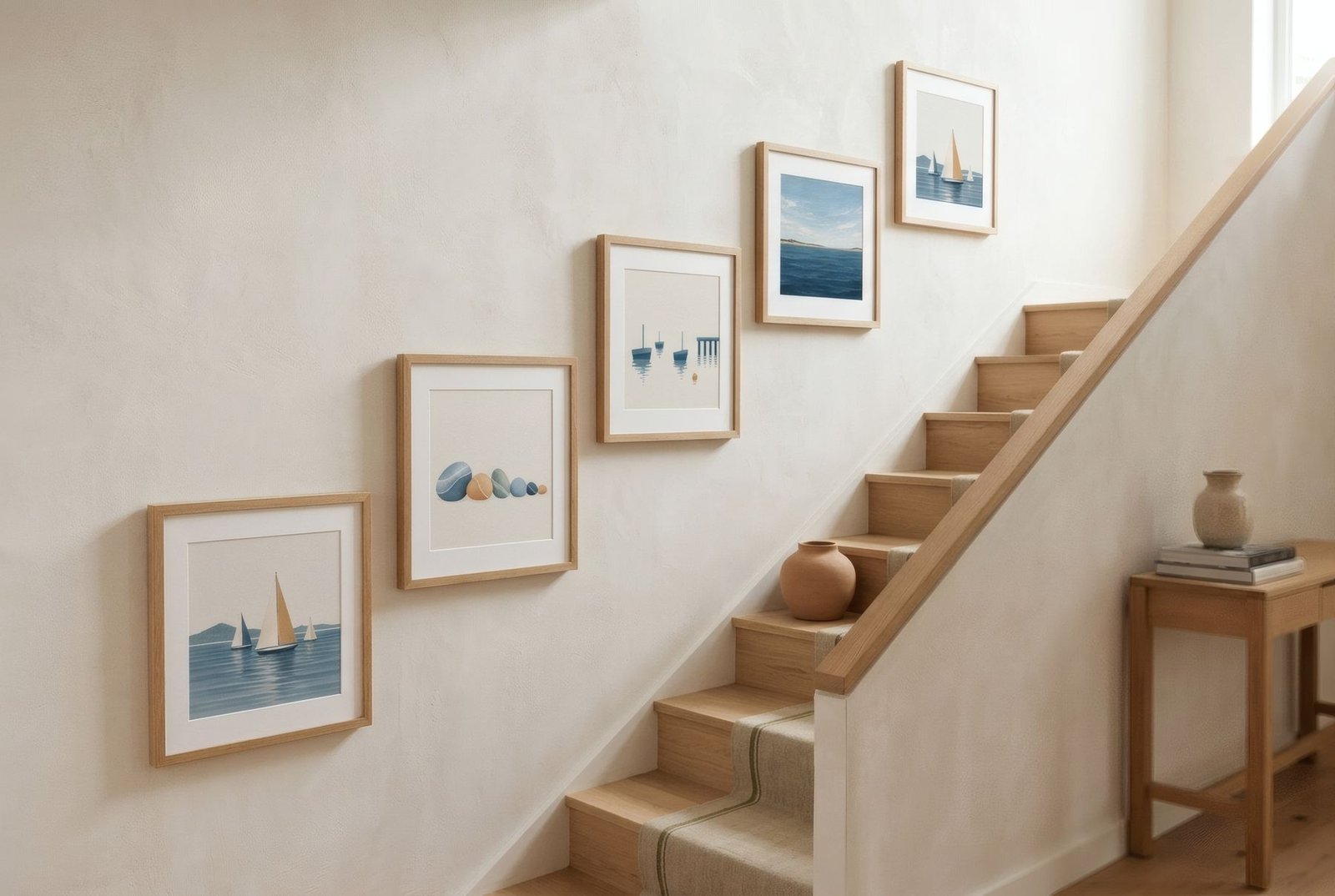
A staircase is a wall you travel along diagonally. Nobody stands in front of it as they would in front of the sofa. You discover it step by step, sometimes in a hurry with shopping in hand, sometimes slowly at night with half the lights off. When the stairs turn, with several flights and landings, the challenge multiplies: this is no longer one wall but a sequence of walls changing direction. The staircase wall art that works best follows that movement: pieces that track the slope, a steady rhythm that gives the climb a sense of purpose, and a pause or two on the landings, all hung so that no one knocks them on the way past.
Think of the stairs as a journey
Before choosing anything, walk up and down a couple of times and notice what you see. Which wall appears first from the bottom? What faces you on each landing? Where does your head turn naturally? The answers sketch a journey with distinct moments: the start, the climb, the pauses and the arrival.
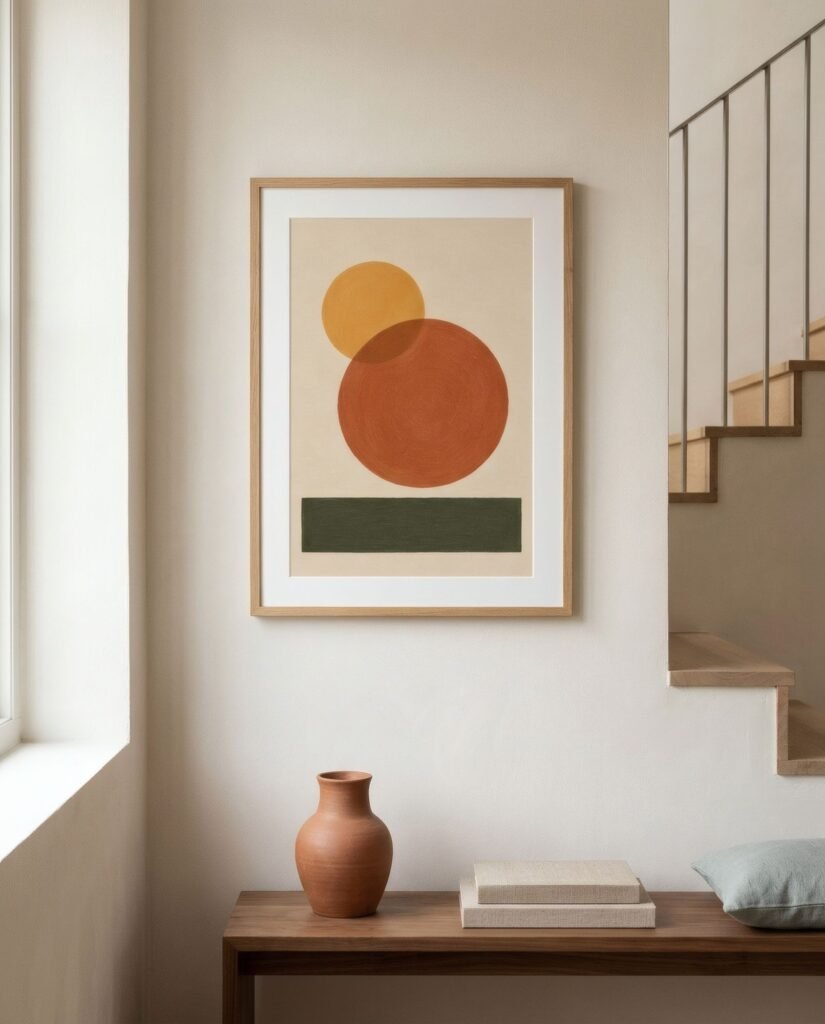
On stairs with several flights, it is often loveliest to treat the whole as one story in chapters. The long flight wants rhythm; the landing, a piece that invites you to pause; the final wall, sometimes, the work with the most presence, the one that greets you at the top.
Follow the slope
On the sloping flights, the most useful rule is simple: let the art follow the line of the stairs. Take the nosing of each step as your reference and hang the centre of each piece the same vertical distance above its own step, usually around 145–155 cm (57–61 in). The imaginary line joining the centres then runs parallel to the pitch, so the arrangement moves with the stairs rather than against them. There is more detail in how high should you hang pictures?.
There are two ways to arrange pieces on a flight. One is the series: identical frames and formats, with the same horizontal spacing between them. It is the calmest option and the one that best marks the rhythm of the climb. The other is the diagonal gallery: pieces of different sizes grouped into a free arrangement whose overall outline follows the slope, like a tilted block. It has more personality but needs careful planning with paper templates.
Landings: places to pause
Landings are the journey’s resting points, and art can underline that. A single portrait piece, well proportioned to the wall and hung at normal eye level, works beautifully, inviting you to look up before you turn and carry on. On generous landings, a work with some presence can become the focal point of the whole staircase; on narrow ones, a medium piece that does not crowd is better.
If the landing has a window, it is usually the star. Then a print to one side, aligned with the window, keeps it company without competing.
Scale and distance
On stairs, art is seen from very close, often less than a metre away, and nearly always in motion. Small and medium formats therefore tend to work better than very large ones, which force you to look from too near. The exception is a wall seen from below or from a distance, such as the end wall of a flight or a double-height space above the first steps, where a larger piece reads comfortably.
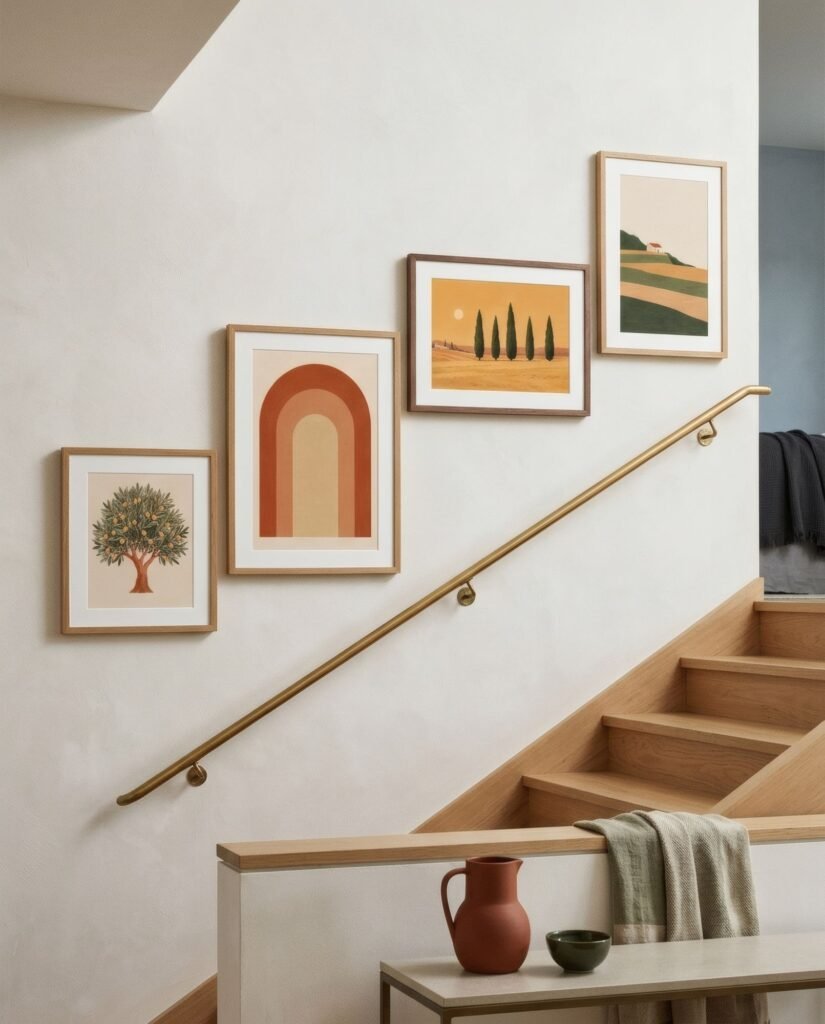
Safety: stairs are a thoroughfare
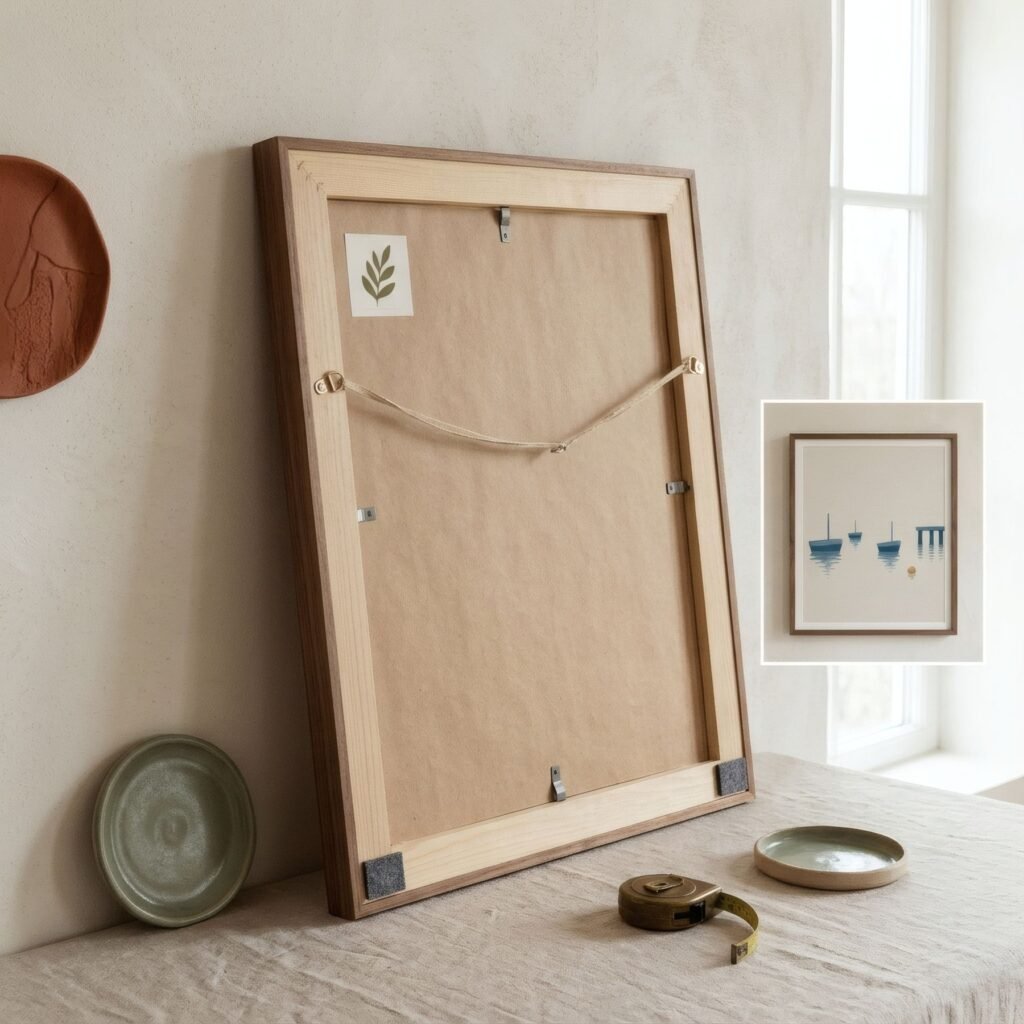
This is where caution matters most. People climb stairs carrying bags, children and laundry, often in a rush. A frame that sticks out or falls can cause an accident. Use firm fixings and two hanging points on medium and large frames, choose shallow frames that sit close to the wall, prefer acrylic to glass, and avoid hanging pieces at elbow height, where they are easily knocked by whatever you are carrying. On narrow stairs, fewer and flatter pieces are always wiser.
Light
Many staircases get little daylight. Pale-ground works, or those with good contrast, read better in low light, and a wall light on the landing or a soft strip of light along the flight can transform the journey. Watch for wall lights reflecting in glazing, especially on pieces seen at an angle as you climb.
What kind of work
Stairs lend themselves to series: botanical prints, photographs from one trip, variations on one form, the same landscape across the seasons. A series turns the climb into a small narrative sequence. Family keepsakes mixed with graphic prints also work well, provided they share frames or a palette.
A staircase with a story
A well-dressed staircase stops being merely a way through. With pieces following the slope, a clear rhythm on the flights, a pause on the landings and a little light, it becomes one of the most pleasant journeys in the house.
If you are looking for pieces that work as a series, Bendíra’s collections bring together prints that share a palette and a visual language, and the A4, A3 and 30 × 40 cm sizes suit stairs and landings well.
Keep reading: How to Create a Gallery Wall at Home, How to Choose Art for a Hallway or Entryway and How to Decorate a Narrow Wall with Prints.