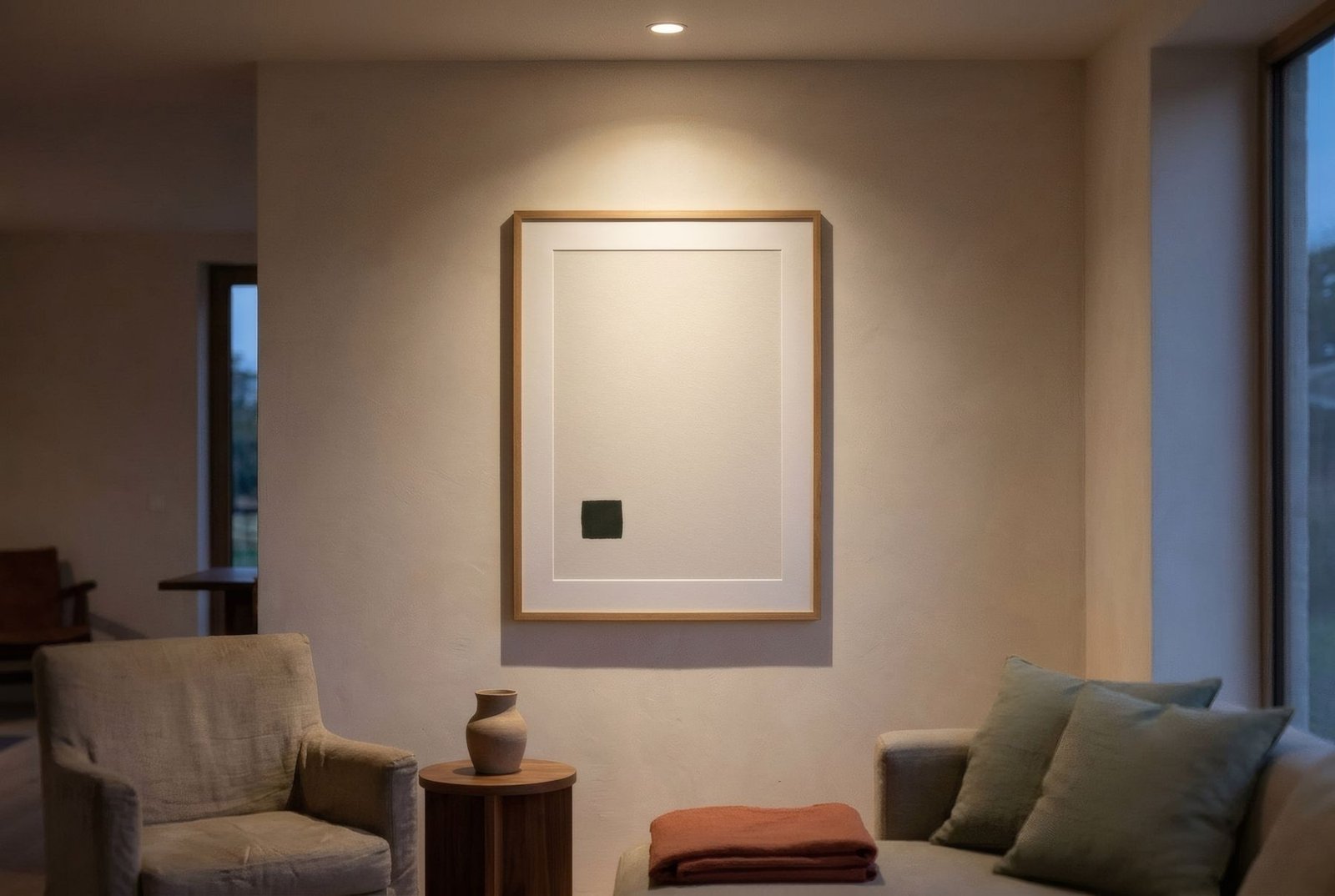
Anyone who has tried to look at a framed print hanging opposite a window knows the disappointment: instead of the picture, you see the street, the sofa, yourself. Light is what lets us see art, and it’s also what can hide it. Museums put enormous effort into getting that balance right. At home you needn’t go nearly so far, but a couple of principles about angles and types of light make a surprising difference to how your pictures look.
Where glare comes from
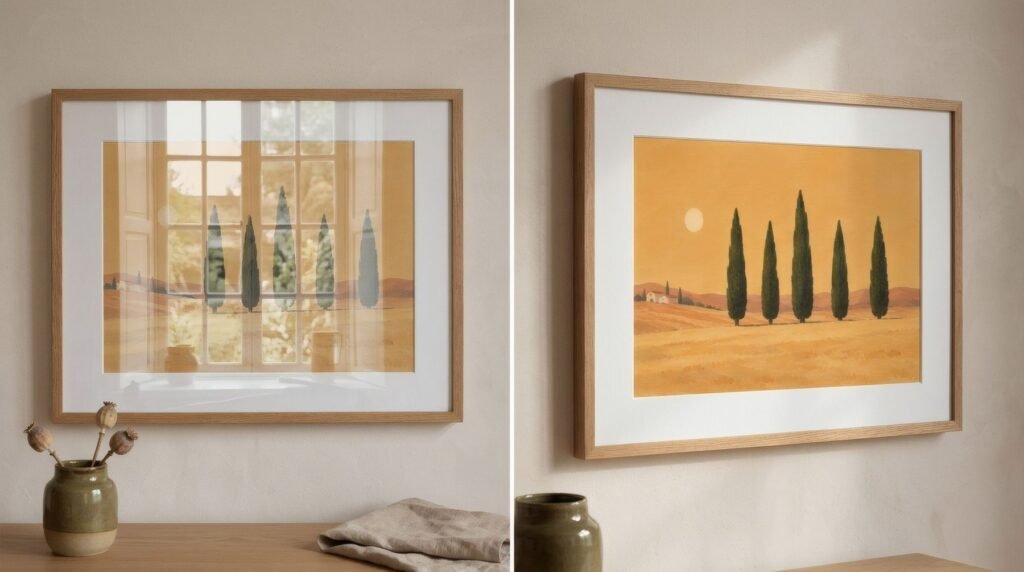
Glare happens when a light source, a window, a lamp, a spotlight, bounces off the glass and lands straight in your eyes. It works like a snooker ball off a cushion: the angle at which light hits the glass is the angle at which it leaves. Put a window directly opposite a picture and the reflection heads straight for whoever is looking.
Once you see that, almost every fix follows: change the angle of the light, change the position of the picture, or change the glass.
Daylight: an ally to keep an eye on
The best light for looking at art is usually natural, indirect and diffuse. A print on a wall at right angles to the window receives light that grazes across it and barely reflects. A print opposite the window, on the other hand, becomes a mirror for much of the day.
Direct sunlight, though, is also what does paper the most harm. Sun falling on a print for hours at a time can fade colours over the years. So the ideal wall gets daylight indirectly, never direct sun. There’s more on this in how to protect a print from sunlight.
Artificial light: the thirty-degree rule
To light a picture with a spotlight or lamp, the classic guideline is to aim the light from above at around 30 degrees from vertical. At that angle the light washes over the surface and the reflection bounces down towards the floor, away from the eyes of someone standing. A steeper angle grazes too much and the frame throws a shadow across the top; a shallower one sends the reflection back up into your line of sight.
In practice, that means placing a ceiling spotlight some distance out from the wall, closer the lower your ceiling, rather than tight against it or in the middle of the room.
Ways to light art at home
There are several approaches, from simple to more involved.
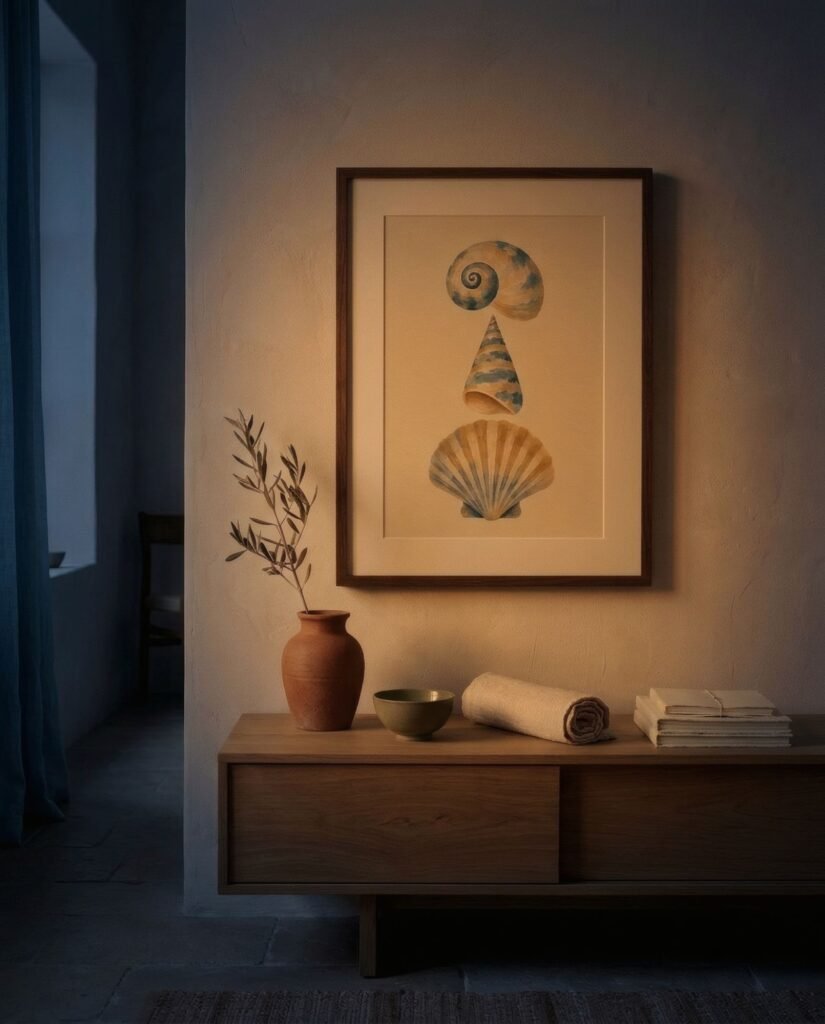
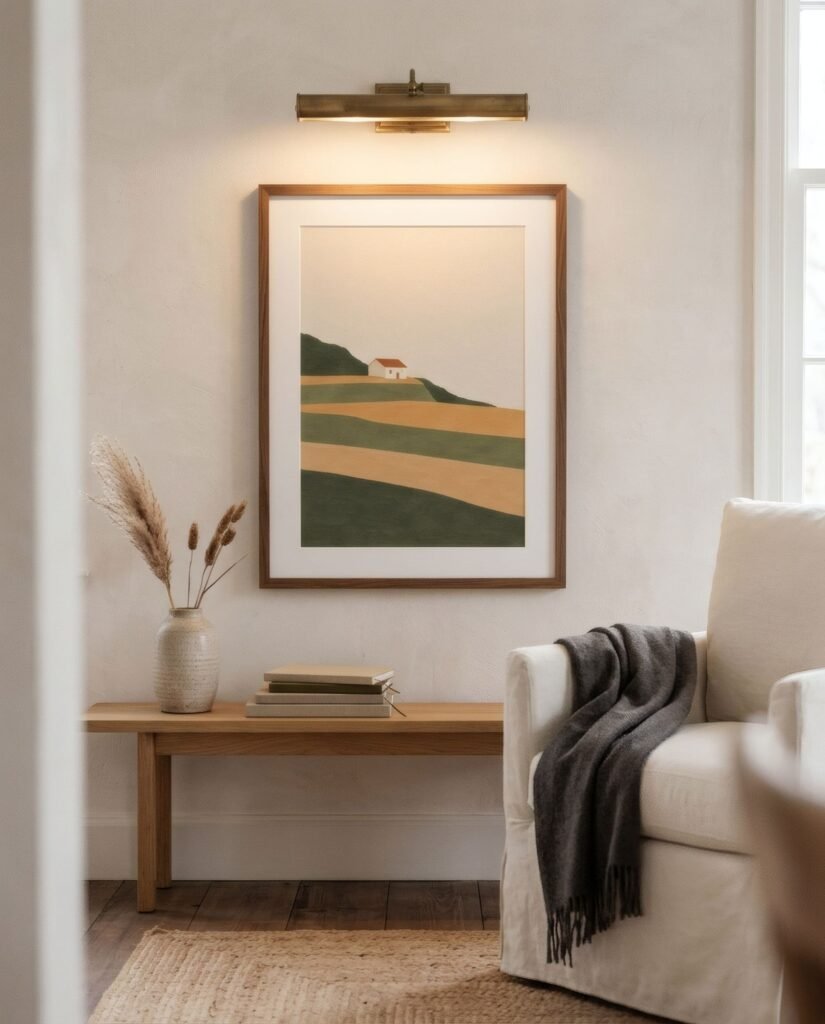
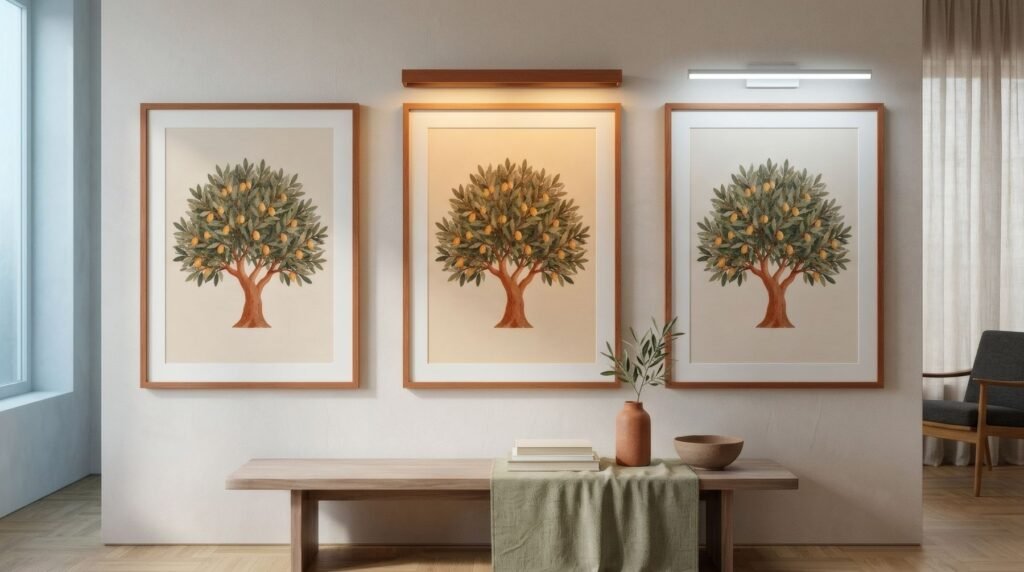
Picture lights, the little arms fixed above a frame, are the traditional answer. They give a lovely, library-like warmth, though they mostly light the top of the picture. Adjustable spotlights in the ceiling or on a track let you direct the light precisely and change it when you change the art. Floor or table lamps nearby, with a shade, give a more diffuse light that washes the whole wall; they don’t single the picture out, but they fold it into a warm atmosphere.
As for bulbs, modern LEDs are the sensible choice: they give off very little heat or ultraviolet, both concerns where paper is involved. A warm to neutral colour temperature, around 2,700–3,000 K, flatters earthy tones and matt papers. And a high colour rendering index, shown as CRI, helps colours look true.
When the glass is the problem
Sometimes neither the picture nor the light can move. Then the answer is in the frame. Anti-reflective glass cuts reflections dramatically and lets you see the work almost as if nothing were there; it costs more, but on an awkward wall it can be worth every penny. Some versions add UV filtering, useful if the piece gets any daylight. Acrylic comes in anti-reflective versions too. And tilting the frame forward slightly, with the bottom edge a centimetre or two off the wall, is sometimes enough to send a lamp’s reflection elsewhere.
Seeing the work properly
Lighting art at home doesn’t call for a museum fit-out. Choose the wall carefully, aim the light from a kind angle and, if you need to, change the glass. Then, at last, when you look at the print, you’ll see the print.
Bendíra prints are made on matt fine art paper, whose surface doesn’t add any shine of its own to whatever the glass might bring.
Keep reading: How to Reduce Glare on Framed Art, How to Photograph an Art Print Without Glare and Why Printed Colours Look Different Under Different Light.