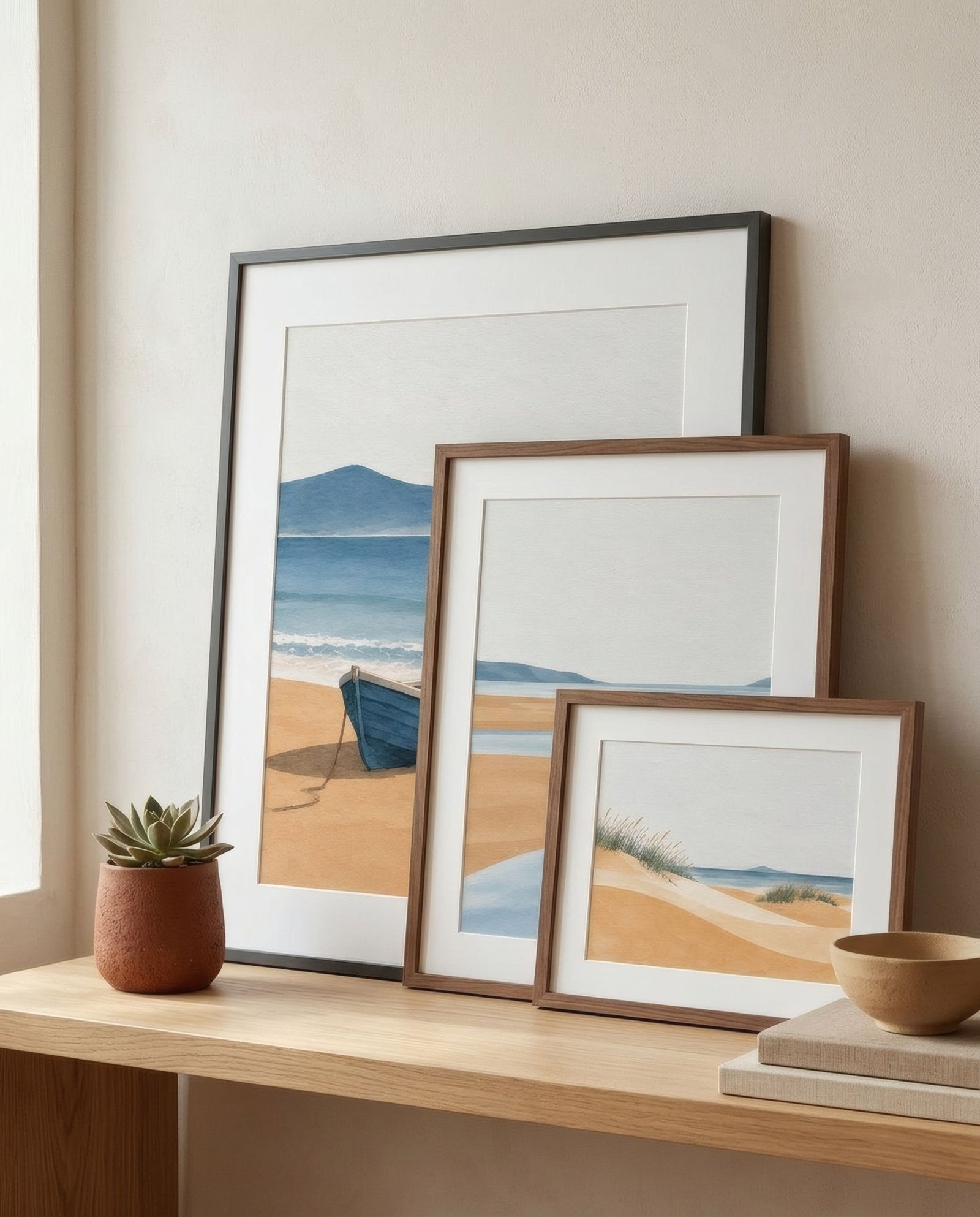
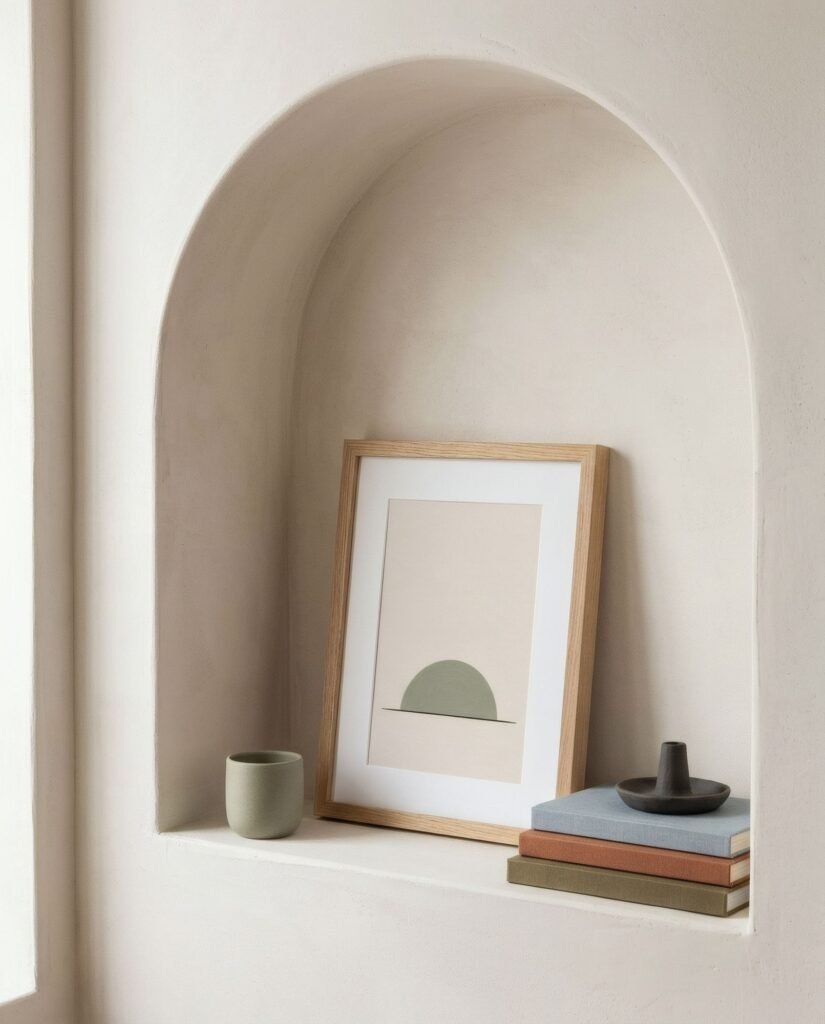
Not all art has to be nailed to the wall. A print leaning on a shelf, a picture ledge or a chest of drawers has a relaxed, very contemporary feel, as if it had just arrived and someone had set it down to enjoy for a while. It has practical advantages too. You can change works easily, layer them, play with depth and avoid holes, which is invaluable in rentals or on walls that are hard to drill. To make it work, take care over composition, which tends towards clutter if left unplanned, and over safety, because a leaning print can fall if it is not properly settled.
Picture ledges: the most versatile option
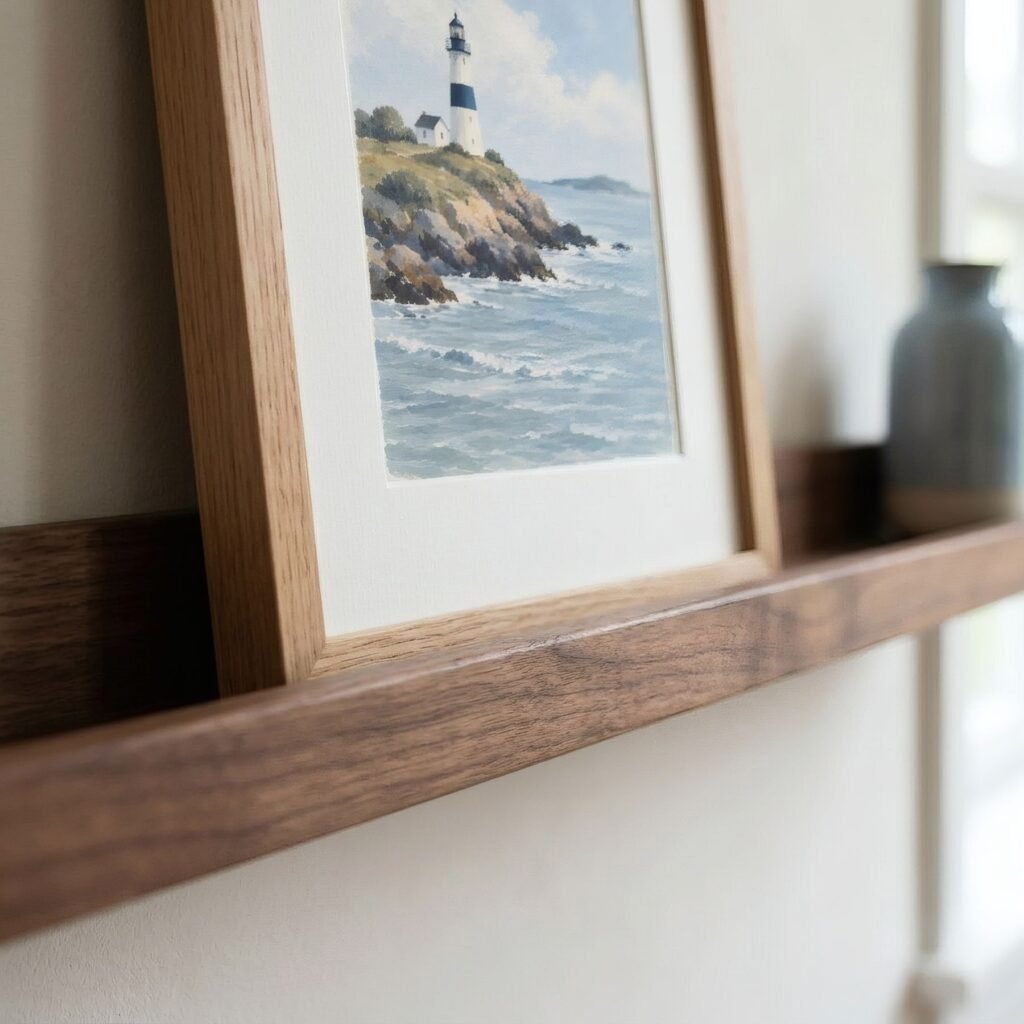
Picture ledges are narrow shelves, only a few centimetres deep, with a small lip or groove along the front edge that stops frames sliding off. You fix them to the wall once and from then on can place and rearrange prints without making new holes.

They can go above a sofa, bed or desk, or run along a hallway. A long ledge works as a baseline for a gallery: every work shares the same bottom edge, which brings order even when sizes vary. We touch on this in how to create a gallery wall at home.
When positioning it, consider the height of the tallest works you will lean: the ledge should be low enough for prints to sit near eye level and high enough that heads and cushions will not knock them if it is above a sofa.
Layering: the pleasure of depth
One of the loveliest things about leaning prints is the chance to overlap them, which is impossible when they are hung. A large print at the back, a smaller one in front, slightly offset, perhaps a third, smaller still, at the front. That layering creates depth and makes the arrangement feel spontaneous.
To keep it from becoming chaotic, follow a simple logic: larger works behind, smaller in front, overlapping partially so the essence of each remains visible. It helps if the back piece is the calmest, so it does not compete with those in front.
Mixing art and objects
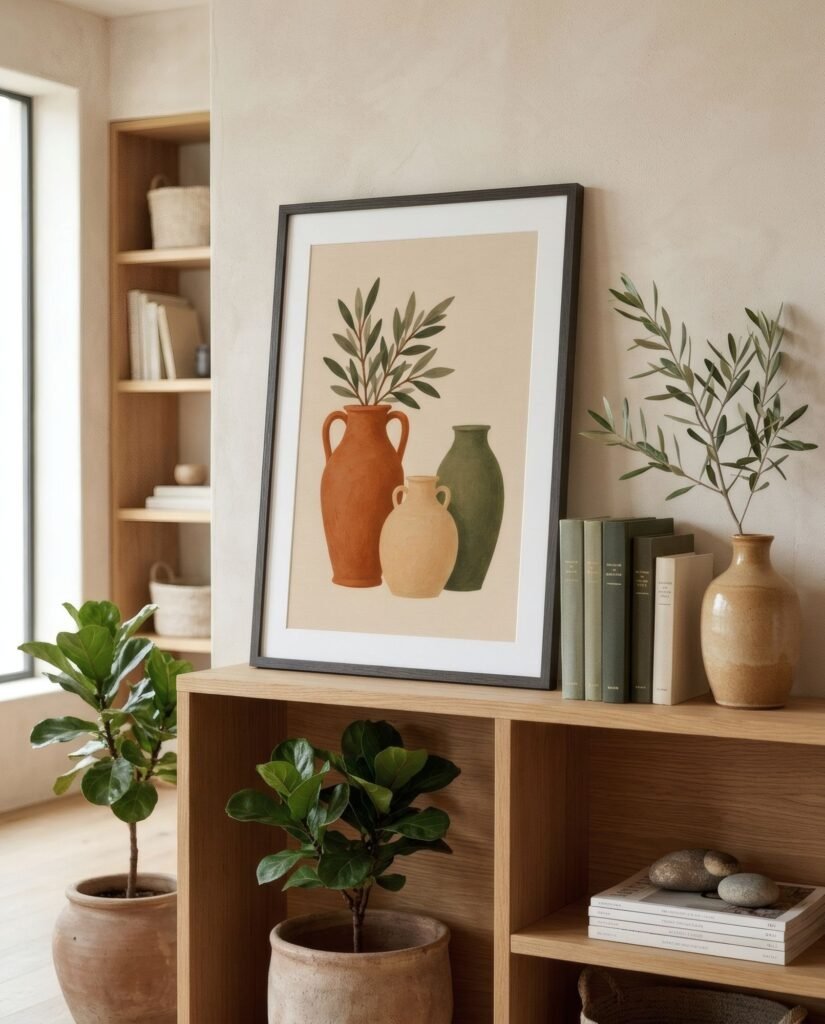
On a shelf, prints share space with books, ceramics, plants and objects. That mix can be lovely if composed with intention. A few principles help: vary heights and volumes, so a tall print sits beside a low, wide object; repeat colours between artworks and objects to create a visual thread; and leave gaps, because a shelf with no empty space feels crammed.
Leaning a print in front of a row of books works beautifully too, like a cover for the library.
On furniture
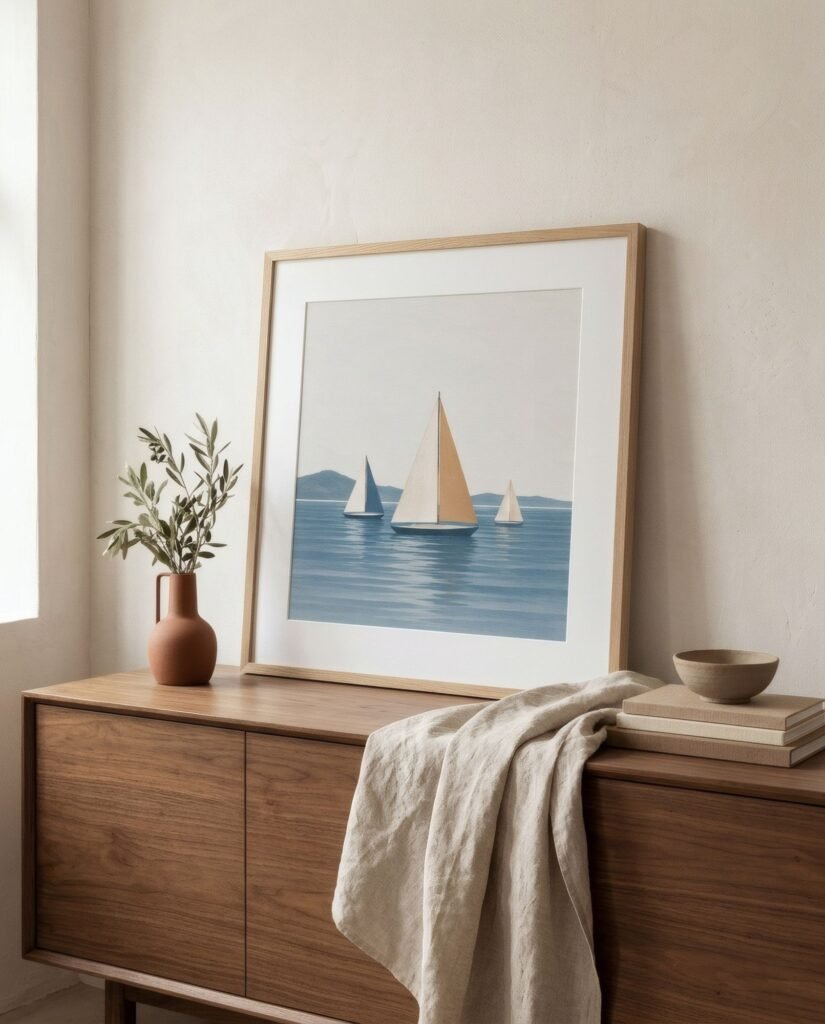
A print, especially a medium or large one, leaning on a chest of drawers, a sideboard or a mantelpiece has a very natural presence. Lean it directly against the wall, centred or set to one side, and add one or two objects. It is also a good way to try a work in a spot before deciding to hang it.
On the floor, leaning against the wall, a large framed print gives a studio or gallery-installation feel. It suits generous spaces and substantial formats, though it is more exposed to knocks and dust.
Safety first
Leaning does not mean careless. A framed print falling from a shelf can break its glass, damage the work and, at worst, hurt someone.
So, first, use ledges with a lip or groove that stops frames sliding forward. Second, tilt the work slightly towards the wall, with its base firmly at the back of the ledge or surface. Third, fix the ledge securely, with anchors suited to the wall and the total weight it will carry. Fourth, prefer acrylic to glass for leaning works, especially on high shelves or in homes with children or pets. And fifth, avoid leaning heavy works on high shelves or in busy walkways where they could be knocked.
On deeper shelves, small non-slip pads under the frame help keep it in place.
The freedom to change
The great advantage of leaning art is freedom. You can change it with the seasons, rotate your collection and try new combinations without commitment. Many people find that doing so makes them look at their prints more closely, because every change brings them back into view.
If you would like to start a leaning arrangement, Bendíra’s A4, A3 and 30 × 40 cm sizes sit beautifully on ledges and shelves, alone or layered.
Keep reading: Triptych Wall Art: When and How to Use It, Common Wall Art Mistakes and How to Avoid Them and Small Space Wall Art Ideas.