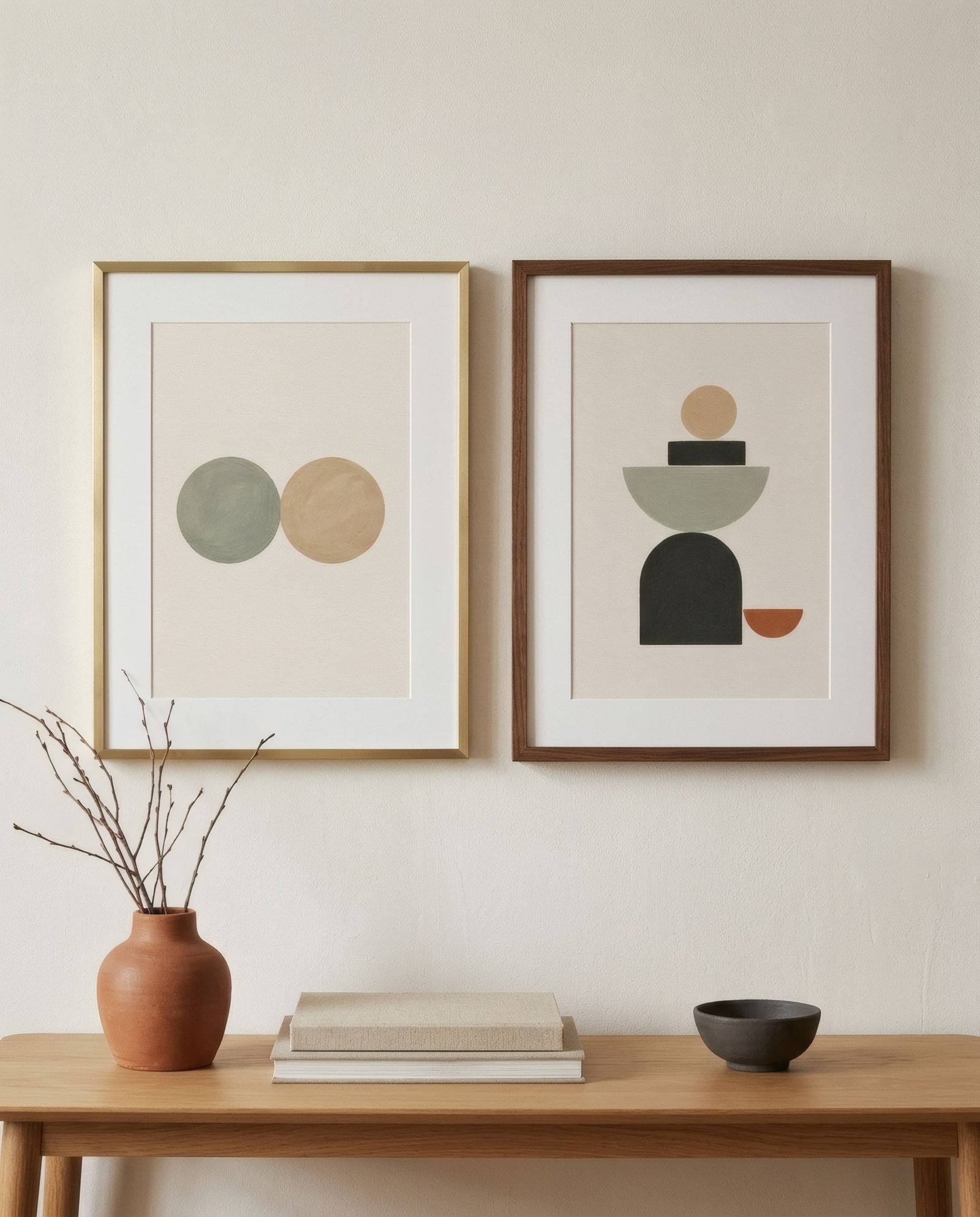
In some homes every frame is the same: the same slim black, the same pale oak, repeated on every wall. It’s elegant and safe. But plenty of homes look more like life: frames that arrived at different times, a wooden one inherited, an aluminium one that came with a print, a gilt one found at a car boot sale. The question isn’t whether you can mix them, because you can, and it often looks better. The question is how to make the mix look like a decision rather than an accident.
Why mix at all
A wall where every frame matches has order, but it can tip into stiffness, almost catalogue-like. A wall of varied frames has depth and history, the sense that the pieces have gathered over time. Mixing metal and wood in particular brings together two complementary qualities: the precision and lightness of metal with the warmth and texture of wood.
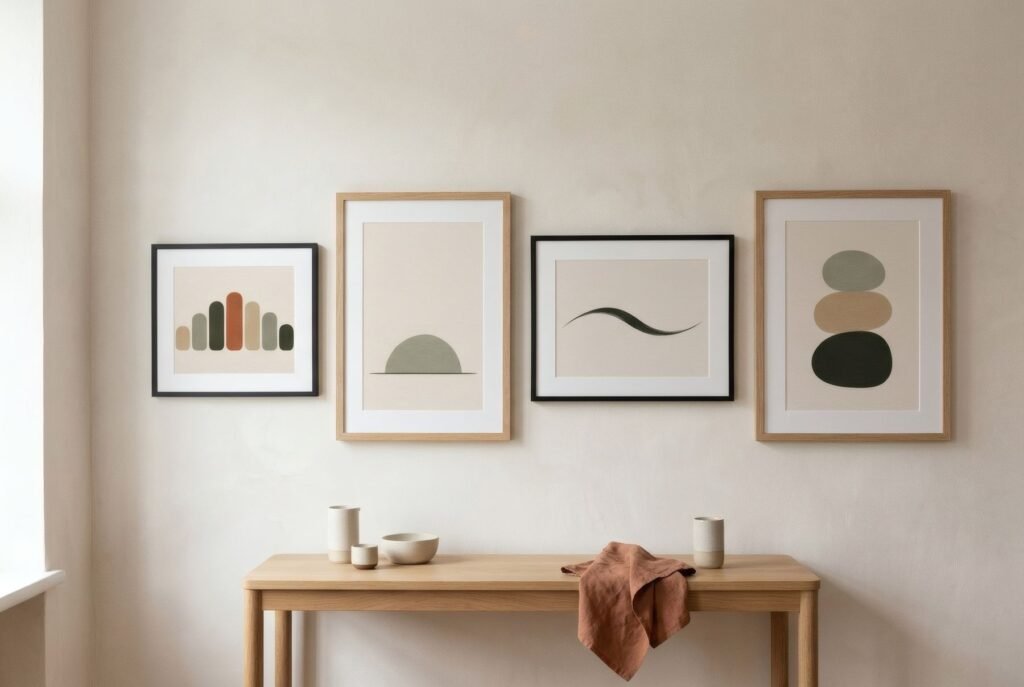
It’s also liberating in practice: you can use frames you already own, give each piece whatever suits it best, and extend a grouping without hunting down the exact same model years later.
The principle: something must repeat
The rule that makes any mix work is repetition. If every frame differs from every other in every way, the wall looks random. If at least one element repeats, the eye finds a thread and the whole thing falls into place.
That element can be several things.
Tone. All the frames in one colour family, even if the materials change: matt black metal alongside black-stained wood; pale woods with brushed brass, which share warmth; silver metals with whitewashed wood, which share coolness.
Profile. Slim frames throughout, whether metal or wood. A wall of narrow profiles reads as one even when the materials vary. It’s probably the simplest thread of all.
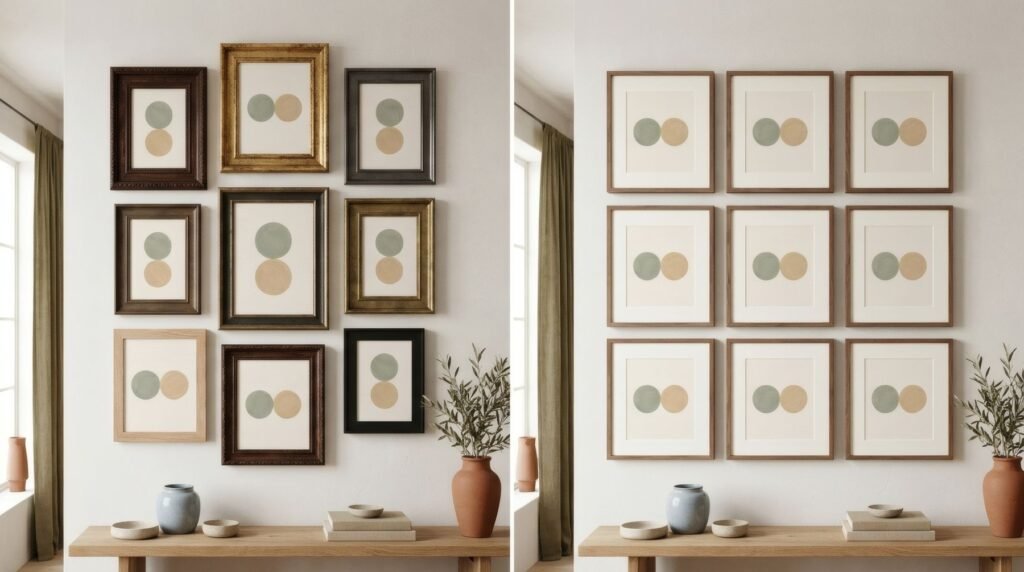
The mount. If every piece has the same white mount, the frames can vary far more without the wall losing coherence. The mount acts as a uniform.
Proportion. Repeat each material more than once. A wall of six with one gilt frame among five black ones makes the gilt look like a mistake. With two or three spread across the wall, it looks like intent.
Pairings that tend to work
A few combinations that get along easily.
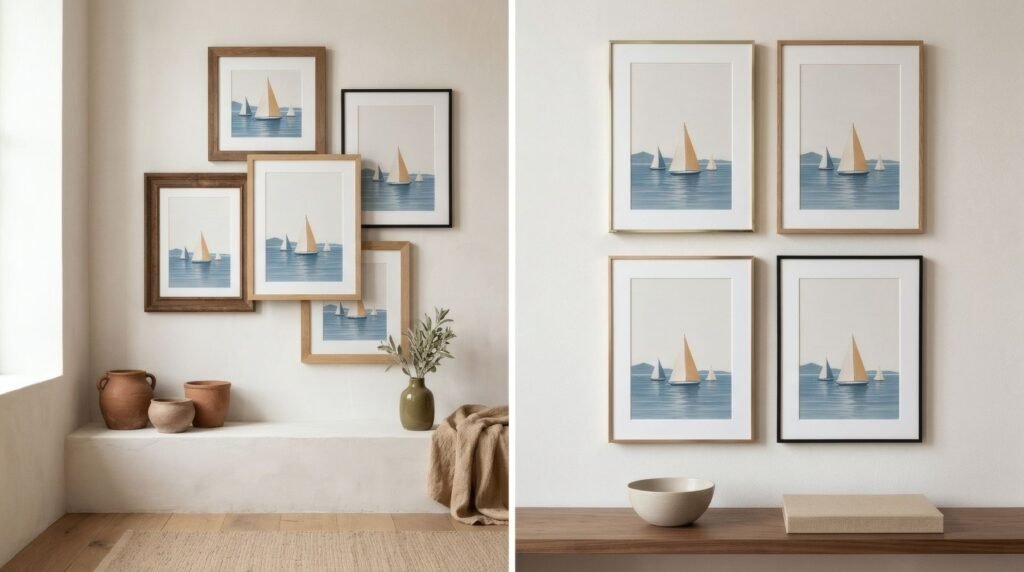
Matt black and natural oak. Perhaps the most versatile pairing: black brings graphic definition, oak brings warmth. It works in almost any style, from Scandinavian to industrial.
Brushed brass or gold and walnut. Warm and slightly classic, lovely in living and dining rooms with warm light. Brushed or aged gold works better than shiny.
Silver aluminium and whitewashed wood. Fresh and bright, at home in coastal or very pale interiors.
Black and gold. Two metals with plenty of contrast. Elegant on dark walls.
How to distribute them
On a gallery wall, spread the materials evenly, avoiding all the wood on one side and all the metal on the other, unless that’s the effect you’re after. A simple trick: lay everything out on the floor, look down at it with half-closed eyes, and check there are no clumps of a single material.
Across different rooms, mixing is even easier: metal on one wall, wood on another, and the whole home converses without any single wall having to resolve the mix alone. There’s more on composition in how to create a gallery wall.
The frame that suits the piece
Ultimately, mixing frames allows something valuable: choosing the frame that suits each piece best. An earthy print often wants wood; a black-and-white graphic, slim metal; a classical botanical, a subtle gilt. If every piece wears its ideal frame and there’s a common thread, the wall wins on both counts. There’s more in how to choose the right frame for a print.
Variety with order
Mixing metal and wooden frames is a balancing act: enough variety to bring life, enough repetition to bring order. With a shared tone, profile or mount, the mix stops being an accident and becomes a style.
Because Bendíra prints arrive unframed, you can choose the material that suits each one and keep a common mount as your thread.
Keep reading: Wall Art for Industrial Interiors: Adding Warmth and How to Choose Art for Maximalist Interiors.