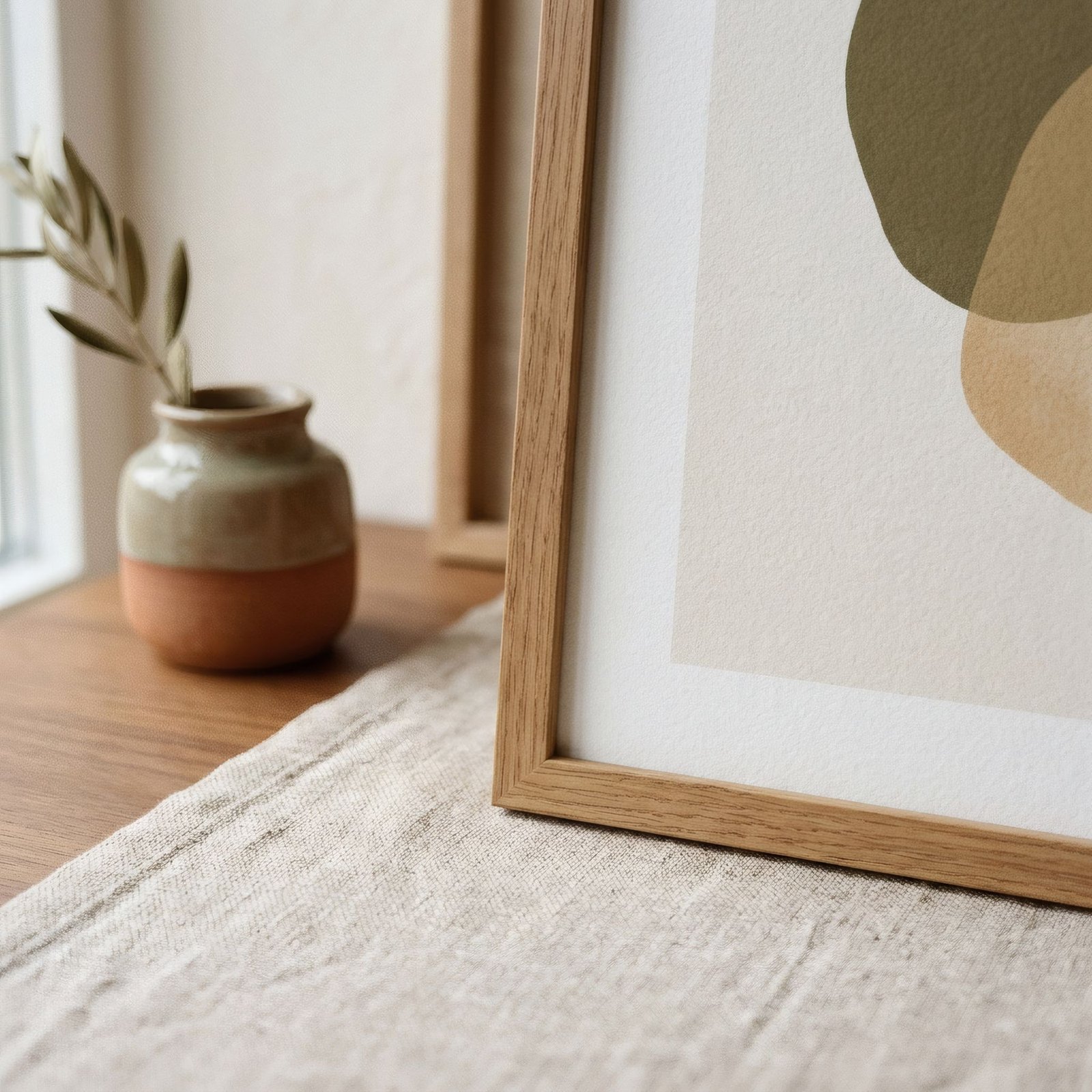
There is a moment we love in particular: when a freshly printed sheet leaves the printer and is held, for the first time, in two hands. It has weight. Not much, but enough to notice that it is something, that it exists and takes up space. Running a fingertip lightly along the border, you find the surface is not quite smooth. Light from the window does not bounce off it as off a screen; it settles. And the image, which a moment ago was only light on a monitor, has become matter. That passage from intangible to tangible is, for us, a small everyday kind of magic.
What a screen cannot give
We spend much of the day looking at images on screens. They are bright, sharp and immediate. But they cannot be touched. They have no weight, texture or edges. They switch on and off. They slide away with a gesture and are gone.
An image on paper is something else. You can hold it, turn it, take it to the window to see it in other light. You can frame it and hang it, and then it stops being something you look at and becomes something you live with. That physical presence transforms our relationship with it.
Paper
Paper is the first quiet protagonist of any print. Its colour, weight and surface, and the way it receives light, decide much of what we see.
We love matte paper, where the image does not hide behind a sheen but shows itself with an almost velvety softness. On paper like this, light produces no reflections that make you shift position to see the work; it simply illuminates it. And the paper itself can be felt. It does not disappear beneath the image but becomes part of it, as canvas is part of a painting.
Seen up close in raking light, the paper has a subtle texture, a surface that reminds you it is a material and not merely an image. A small detail, but it is what makes a print feel like an object.
Ink
Ink is the other protagonist. In art printing, millions of tiny droplets settle onto the paper and combine to form each colour, gradient and line. To the naked eye they are invisible; only the continuous image is seen. But they are there, settled on the surface, turned into colour.
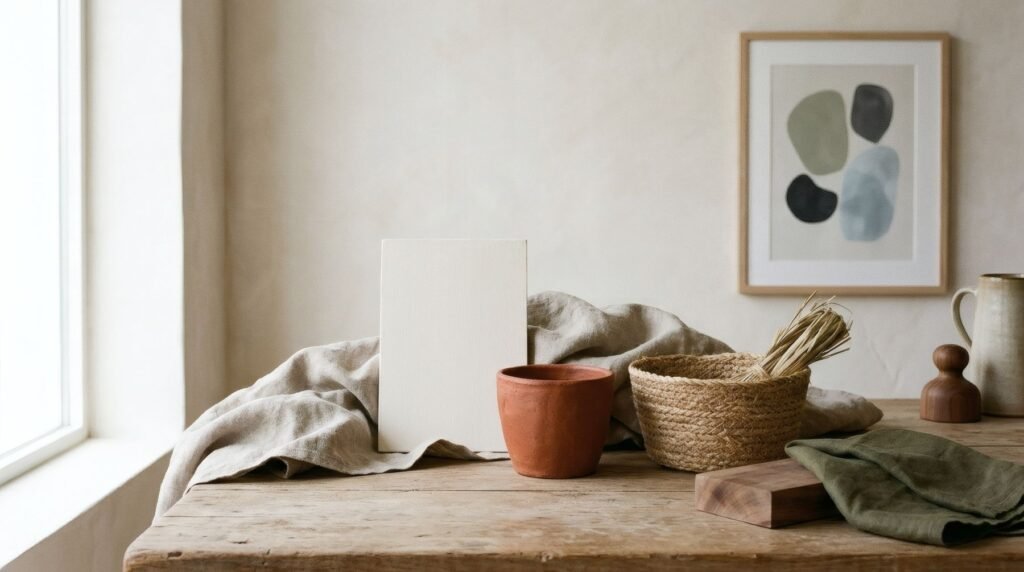
There is something beautiful in that transformation: a liquid becoming image, fixing itself to paper and staying. And in the way that colour, unlike a screen’s, does not emit light but reflects it. That is why a print changes through the day: warmer at dusk, cooler in north light, more intimate under a lamp.
Borders and edges
We love what surrounds the image too. A print’s white border, where there is one, is like a small silence before music: it separates the work from the world and prepares it to be seen. A cleanly cut, straight edge speaks of the care taken. These are details almost no one notices consciously, but they are felt.
Tangible things age with us
Tangible objects have another quality digital images lack: they age. Not in the sense of deteriorating, if cared for, but in the sense of keeping us company over time. A print hung years ago is the same and yet different. We see it with other eyes, in another home, at another point in life. It has been there, physically, while everything else changed.
That is why caring for it is part of the relationship: keeping it out of direct sun, protecting it from damp, framing it with suitable materials. More in how to care for your art prints.
A modest celebration
We do not claim paper and ink are better than screens for everything. Each medium has its place. But for the images we want to live with, the ones we hang at home and see each day, we believe the tangible has a beauty of its own, quiet and lasting, worth celebrating.
Our prints are made on matte fine-art paper, precisely for the way it receives light and makes the material present. If you would like to see for yourself, we invite you to explore our collections.
Keep reading: Accessible Art Without Compromising on Quality, Creating Personal Spaces Through Art and Matte vs Satin Paper for Art Prints.