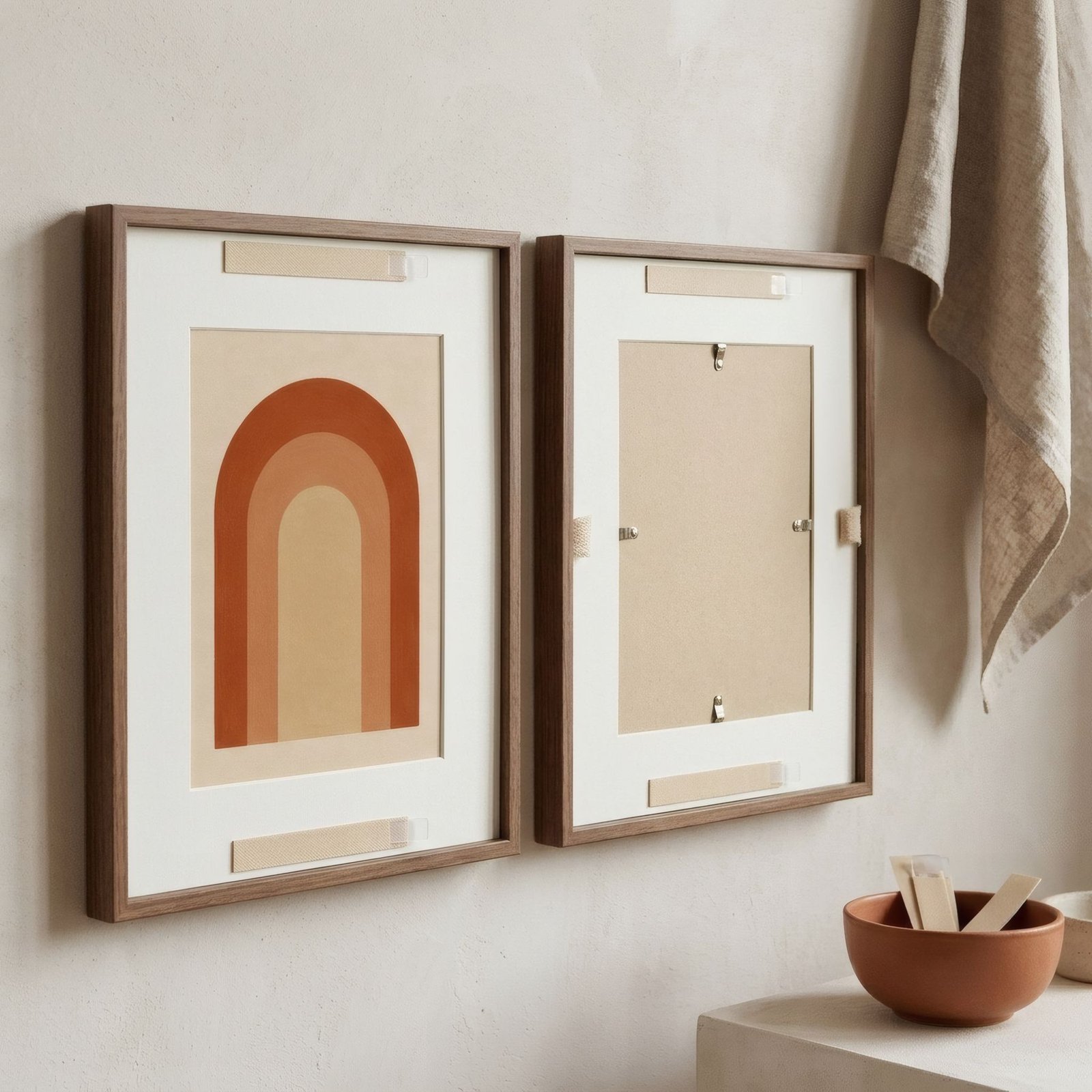
Renting has a temporary feel to it, and it’s easy for that to spread to the walls. You move in, unpack, and the prints you brought with you end up leaning against the skirting for months, sometimes years, because you don’t quite dare make holes in a wall that isn’t yours. Fair enough: the deposit matters, and not every landlord is relaxed about a drill. But a home with nothing on the walls feels like somewhere you’re passing through. The good news is that there are ways to hang or display art that leave little or no trace, and that let a rented flat feel like yours from the first week.
First: the tenancy agreement and the wall
It’s worth reading your agreement and, if in doubt, asking the landlord. Some are happy with a few small nail holes, filled before you leave; others would rather nothing were touched. Knowing which changes your options.
It also helps to know your wall. Smooth emulsion in good condition is the best surface for adhesive solutions. Textured plaster, freshly painted walls, very flat matt paint and wallpaper are more delicate: adhesives grip less well and can pull paint away when removed.
Adhesive strips: useful, within limits
Removable picture-hanging strips are the best-known option. They work well with light frames, and each manufacturer states how much weight a set of strips will hold. The key is to stay well within those limits, because the real weight of a glazed frame tends to surprise people: a 50 × 70 cm (20 × 28 in) print in a wooden frame with glass can easily weigh several kilos.
A few habits make them work: clean the wall with isopropyl alcohol first, press firmly for a few seconds, wait as long as the manufacturer recommends before hanging, and when removing, pull the tab slowly downwards, parallel to the wall. For large or glazed frames, look for another solution; a frame that falls doesn’t just break, it can hurt someone.
Ledges and shelves: the most flexible answer
A picture ledge or a slim shelf lets you lean several prints and swap them whenever you like. Yes, the ledge itself needs fixing, but that’s two or three holes rather than ten, and once it’s up it takes care of the whole wall. Leaning rather than hanging also frees you from millimetre precision: frames overlap, move, change. There’s more in how to lean art on ledges and furniture.
Leaning on furniture and the floor
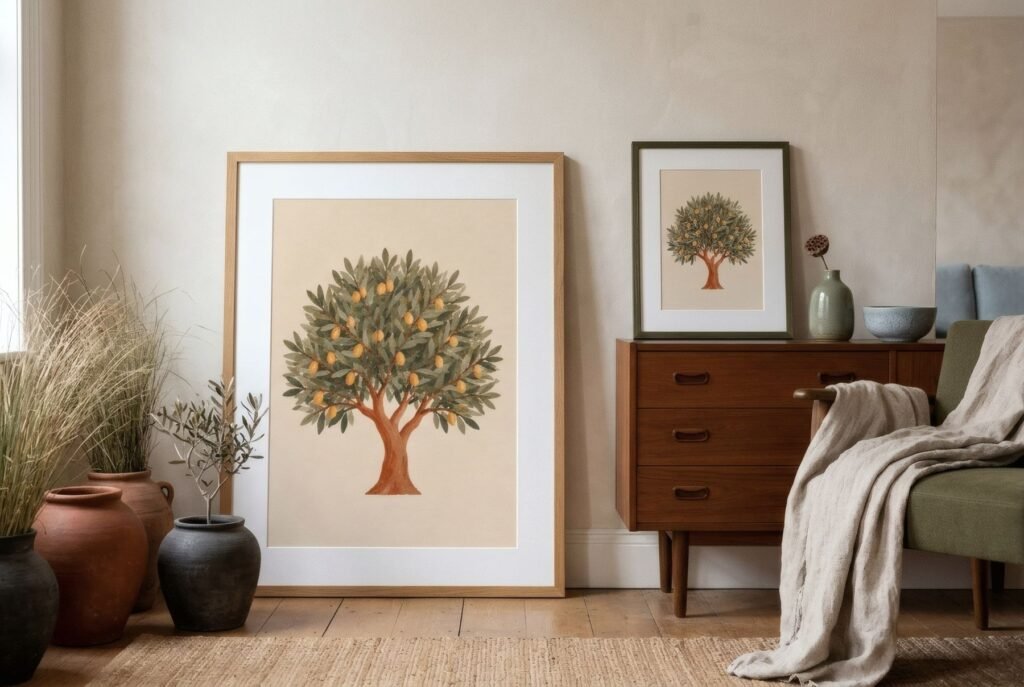
The simplest option of all, and one that doesn’t touch the wall: lean it. A framed print on a chest of drawers, a console, a sideboard or a deep windowsill makes a relaxed, very current arrangement. A large piece propped on the floor against the wall, in a corner of the living room or beside an armchair, has an artist’s-studio feel that works particularly well in flats with high ceilings.
Two precautions. Make sure it’s stable, with a small stop or a non-slip pad at the base if there are children or pets. And keep it out of walkways where it could be knocked over.
Picture rails
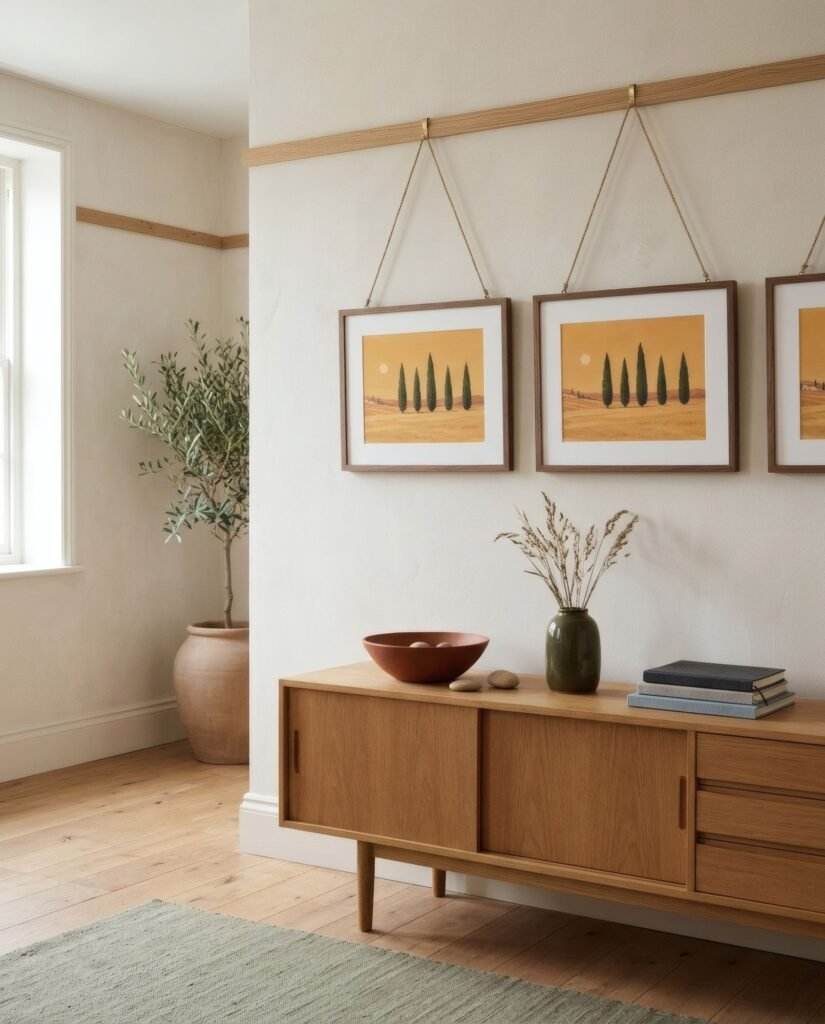
Some period properties still have a picture rail near the ceiling, made precisely for hanging frames on cords or rods without touching the wall. If your flat has one, it’s a gift. If not, there are hanging rail systems that install once near the ceiling and let you hang and move pieces indefinitely. They do need a few holes, but discreet and few in number.
What works best when you rent
Light frames are your friend: slim wood or aluminium, with acrylic instead of glass, weigh considerably less and widen your adhesive options. Unframed prints held with clips or magnetic wooden hangers are another simple way to get art on the wall with minimal weight, though the paper is more exposed.
Making it home without asking permission
A rented flat doesn’t have to look like a waiting room. With leaning, ledges, carefully used adhesives and light frames, you can surround yourself with art without worrying about the deposit, and take it all with you to the next place.
Bendíra prints arrive unframed, so you can choose a lightweight frame suited to no-drill hanging, or simply lean them on a piece of furniture from day one.
Keep reading: How to Choose a Frame for an Art Print, How to Choose Wall Art for a Dining Room and Art for Temporary Homes: Making Space Your Own.